

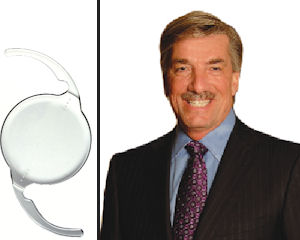
Santa Ana-based Abbott Medical Optics Inc. is readying a product push.
The maker of eye surgery devices, part of Chicago-area drug and medical device maker Abbott Laboratories, has plans for 20 new products by 2014, according to President Jim Mazzo.
They include implantable lenses for cataract patients, devices for laser vision-correction surgery and contact lens solutions.
“We’re now becoming an R&D machine,” Mazzo said. “Abbott has allowed us to increase our investment in R&D without having to take it from some other place.”
Abbott Laboratories doesn’t break out research and development spending for units. The entire company spent $3.7 billion, or about 10% of sales, on R&D in 2010. That was up 36% from 2009.
Abbott Medical, which Abbott Laboratories bought for $2.8 billion in 2009, accounted for $1.1 billion of its parent company’s $35 billion in sales last year.
Products
The new products span Abbott Medical’s various markets.
For cataract surgery, the Unfolder Platinum 1—a device that makes a tiny eye incision for inserting a replacement lens—is due in the second quarter in Europe.
Also due in Europe in the second quarter: Tecnis Toric, an intraocular lens for patients with corneal astigmatism, or curvature of the eye.
A new device that’s used during cataract surgery to help the eye maintain its shape also is set to be released overseas in the next quarter.
Abbott Medical plans to submit the device to the Food and Drug Administration for U.S. approval this year, according to Mazzo.
Most of Abbott Medical’s products are set to appear in Europe first because of quicker approval times there, he said.
In laser vision-correction surgery, Abbott Medical plans to come out with a device in October that measures eyes as part of the procedure. The product will be offered in Europe and Japan.
In contact lens solutions, Abbott Medical plans wider marketing of its RevitaLens line, which saw a limited debut in 2010.
Also in the works is Synchrony, an intraocular lens Abbott Medical got through its $400 million buy of Irvine startup Visiogen Inc. in 2009.
Synchrony’s in limited release outside the U.S. with an application for approval under review at the FDA, Mazzo said.
“All requests for additional information have been answered and we’re meeting with the lead reviewer on an ongoing basis,” he said.
The company doesn’t have a time frame for when Synchrony might be available in the U.S., Mazzo said.
Abbott Medical is looking at getting into a new market—eye drugs.
The company once was part of Irvine eye drug maker Allergan Inc. but has focused on devices and contact lens solutions since then.
A move into eye drugs would bring Abbott Medical more in competition with Alcon Inc., a unit of Switzerland’s Novartis AG with about 800 workers in Irvine, and former parent Allergan.
Mazzo said he has “an appetite for pharmaceuticals, ones that would kind of surround our surgical procedures.”
The company wants to build on its over-the-counter dry eye drops with possible deals and internal product development, he said.
Abbott Medical has formed a “subteam” looking at shrinking some of its parent company’s existing devices and drugs for eye diseases, according to Mazzo.
The company could take drug-eluting stents used to treat blood vessel diseases and adapt them to a size where they could be used to treat age-related macular degeneration, glaucoma, retinitis pigmentosa and other back-of-the-eye problems, according to Mazzo.
“We don’t have to start from ground zero because we already have those technologies entrenched here at Abbott,” he said.
Spinoff?
Mazzo passed on addressing Wall Street chatter on the prospect of Abbott Laboratories potentially spinning off businesses.
Companies such as Abbott, which had a market value of about $70 billion last week, could get a stock boost of as much as 30% if they sold or spun off businesses, according to Jami Rubin, a Goldman Sachs & Co. analyst.
Mazzo’s boss, Abbott Laboratories Chief Executive Miles White, dismissed the idea, saying on a conference call that he didn’t make “strategic decisions for the company based on transactions the Street may like to see.”
Mazzo has been one of the county’s most visible executives and continues to be active locally and in his industry.
He’s started his second and final year as chairman of the Advanced Medical Technology Association, a Washington, D.C.-based trade group.
Mazzo succeeded Michael Mussallem, chief executive of Irvine heart valve maker Edwards Lifesciences Corp., as head of the trade group.
Priorities for AdvaMed this year include working on regulatory, reimbursement and trade issues as well as prodding for FDA alignment with companies on timelines for product approvals, he said.
