

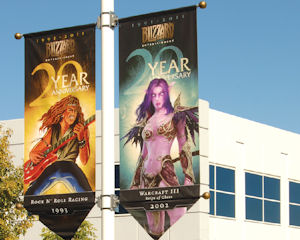
Irvine-based Blizzard Entertainment Inc. has kicked off a trip down memory lane to mark its 20th anniversary.
Around Blizzard’s Irvine Spectrum headquarters campus are anniversary banners with characters from the company’s games, which are played by millions online.
Employees recently were treated to a barbecue and given an anniversary jacket with Blizzard’s blue and black logo on the back.
In typical Blizzard style, the company recognized its earliest employees with a service award that tops all others—a crown made by New Zealand visual effects company Weta Digital Ltd., known for its work on “Avatar” and “Lord of the Rings.”
Past service awards include a sword, a shield, a ring and a medieval-looking stein—all inspired by lore from “World of Warcraft,” a fantasy role-playing game played by 12 million people online.
Players of the game take on the role of avatars and form social alliances, engage in battles, or embark on quests in a fantasy world of orcs, trolls, elves and other creepies.
Most pay $15 a month to play “World of Warcraft.”
Bigger Role
There’s more pressure on Blizzard these days.
The company is part of Santa Monica-based Activision Blizzard Inc.—itself part of France’s Vivendi SA.
Activision is working through issues with some of its titles for video game consoles.
Earlier this month, Activision pulled the plug on its “Guitar Hero” games as well as the associated “DJ Hero” and a “Tony Hawk” line of skateboarding games.
Blizzard accounts for about $1.6 billion of Activision’s $4.8 billion in yearly sales. Blizzard, a big money-maker for Activision, saw 2010 profits of $850 million.
Blizzard “has built a competitive moat over many years of investment and development that has allowed ‘World of Warcraft’ to achieve a place in history as one of the most profitable interactive entertainment franchises of all time,” Activision Chief Executive Bobby Kotick said in a recent conference call with analysts.
Blizzard’s been hiring at a rapid clip on the heels of two game releases last year. It has some 1,500 workers in Irvine and nearly 5,000 in all.
The company also is working on two games due in the next two years—one of which is a massive multiplayer online game.
The company is working on expansion packs, or add-ons, for “World of Warcraft” and “StarCraft 2,” as well as a sequel to “Diablo.”
None have firm release dates.
“We have a very strong pipeline, perhaps our strongest ever,” Chief Executive Mike Morhaime said. “We are very busy working on new stuff all the time.”
Blizzard and Activision are riding atop a shifting video game industry in which more revenue is coming from digital downloads and casual online games with a social networking aspect.
“Gaming is continuing to grow as broadband access grows around the world,” Morhaime said. “You are seeing a big move into more social gaming and being able to play online with your friends.”
Casual games, such as “Angry Birds” for Apple Inc.’s iPhone and “Farmville” on Facebook, are leading the new era.
“Twelve million people playing ‘World of Warcraft’ sounds like a lot until you start talking about the number of people on Facebook,” said Blizzard cofounder Frank Pearce, the company’s executive vice president of product development. “It makes ‘Warcraft’ look like a boutique product.”
Blizzard’s games share some similarities with casual games in that both are played online and have loyal followings.
But unlike casual games that are easy to get into and don’t have much depth, Blizzard’s “game universes” are complex with rich settings, characters and twisting story lines.
History
Blizzard, now the county’s largest software company, started out small.
In the early 1990s, the company’s three cofounders shared the equivalent of a studio apartment—a 650-square-foot office at the corner of Jamboree Road and MacArthur Boulevard in Irvine.
The company got its start in 1991 after Morhaime borrowed $15,000 from his grandma.
The founders, all University of California, Los Angeles alums, left software jobs they landed after graduating to start Blizzard.
Pearce left Rockwell International Corp., where he worked during the former aerospace company’s days in Seal Beach.
Morhaime had a gig at Irvine disk drive maker Western Digital Corp.
Cofounder Allen Adham was a mutual friend from college.
They had a drive to make “great games” that they themselves would want to play, Pearce said.
“We are reaching tens of millions of players today, and I don’t know if that’s what we imagined when we started,” he said. “I don’t even think we thought about this stuff. It was more about making the games we wanted to play and making them ourselves.”
In 1994, Blizzard’s predecessor was acquired by Torrance-based Davidson & Associates Inc., a maker of educational software for kids, for nearly $7 million.
Davidson was acquired by Comp-U-Card International Inc. in 1996.
Comp-U-Card was then bought by HFS Inc. the following year, and the combined company changed its name to Cendant Corp.
Two years later, New Jersey-based Cendant was ensnared in an accounting scandal and sold its games business to Havas SA, which at one point was France’s largest game maker.
Vivendi bought Havas in 1998.
The strength of Blizzard help Vivendi buy Activision Inc. in 2008 in a deal valued at $19 billion.
