

The business of advising wealthy families and business owners on what to do with their money isn’t quite the same.
For one, the field is smaller after the recession and Wall Street’s downturn of late 2008 and early 2009. And big deals, such as Bank of America Corp.’s late 2008 buy of Merrill Lynch & Co., have dramatically changed the local market.
But even as things change around local wealth managers, those with long track records and solid clients have held their own.
Those on the Business Journal’s list of top wealth managers report that they’ve made it through two tumultuous years of investing without severe slippage in clients or returns.
“I’ve been through several bear markets, including the crash of 1987 and the terrible markets in the early 1990s and 2000,” said No. 11 Mike Thompson, a UBS Financial Services Inc. adviser based in Irvine. “But I’ve never seen as much fear and confusion in the 28 years I’ve been in the business. There was an element of panic that took a lot of time and patience to deal with and to help people work through.”
The 11 wealth managers on our list manage $10.7 billion in assets for the wealthy, retirees, business owners, rank-and-file employees and others.
Our list is made up of the Orange County wealth managers that appeared on Barron’s magazine’s 2010 top advisers for California earlier this year.
The wealth managers are ranked by a proprietary formula that looks at assets under management, years of experience, investment strategies, customer service, sophistication of service offerings and other factors.
Nationally, wealth managers saw a 97% retention rate after Wall Street’s meltdown, according to Barron’s, part of Dow Jones & Co.
Barron’s doesn’t break out retention rates for wealth managers. But advisers here said they’ve been able to steer investors through volatile markets without much turnover.
Communication
A common theme among top wealth managers here: communication with clients.
During the height of Wall Street’s downturn, it was common for wealth managers to log 16-hour work days. They said they beefed up conference calls, newsletters, e-mail alerts and private consultations.
Topping this year’s rankings is Bank of America Merrill Lynch’s Troy Armstrong. The Newport Beach-based wealth manager has $1.7 billion in assets under management, according to Barron’s.
Armstrong’s practice has a typical account size of $25 million. His typical client has a net worth of $50 million.
He moved his team in 2002 to what then was Merrill Lynch & Co. from JPMorgan Chase & Co. At the time, he reportedly had $700 million in assets and was part of an exodus from Chase’s Hambrecht & Quist following the combination of Chase Manhattan Bank and J.P. Morgan & Co.
Bank of America Merrill Lynch, which dominated Barron’s national rankings, tied with UBS Financial Services locally for the most managers on the list at four each.
Besides Armstrong, the other Bank of America Merrill Lynch entries were: No. 3 Mark Binder, No. 5 Tom Blanchfield and No. 9 David Runstrom, all of Newport Beach.
UBS Financial Services had No. 6 Ed Levin and No. 10 Marc Foster in Newport Beach, No. 8 Sid Miramontes in Brea, along with Thompson.
The second-highest ranked wealth manager was Bob Klein of J.P. Morgan Securities Inc.
The Newport Beach-based adviser had $350 million in assets with a typical account size of $1.5 million and $5 million in net worth for a typical client.
Klein has been a student of financial markets since he was a child, he said. His first investment was buying a stock at age 11, he said.
Klein invests in stocks, bonds and will short stocks—betting the shares will fall in value.
“My clients tend to be business owners and people with a strong entrepreneurial spirit who think outside of the box,” Klein said.
Two local independent money managers again made our list.
Laila Marshall-Pence, who runs Pence Wealth Management in Newport Beach with her husband, Dryden Pence, ranked No. 4.
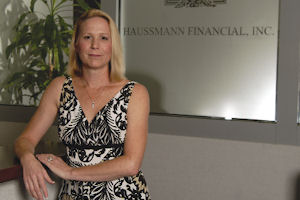
Trudy Haussmann, who runs Haussmann Financial Inc. in Newport Beach, ranked No. 7.
Haussmann has the largest number of clients on the list with some 2,240 different investors. She also has the smallest typical account
size, at $500,000. Her firm includes four other advisers.
Like most others on the list, her clients mainly are retirees or workers saving toward retirement.
During Wall Street’s downturn, Haussmann said she was able to draw steady gains from international bonds, which have done relatively well the past two years.
“That allowed us to hold our equity positions pretty much intact,” she said. “And since we didn’t make many changes in our allocations in 2008, our
clients benefitted when the market turned around last year. Most of our clients have recovered about 80% to 85% of their losses at this point.”
Haussmann said she’s been able to keep most of her clients focused on their individual strategies, even during the darkest days of the downturn.
Lately, Haussmann has been increasing client allocations to mutual funds with “go anywhere” types of managers. Those managers make a variety of investments, including shorting stocks, she said.
“We think it’s important for portfolios to have a lot of flexibility these days,” Haussmann said.
Many managers on the list keep significant holdings of municipal bonds for their wealthy clients. That isn’t surprising—tax-free bonds long have been popular with well-off investors.
And, despite California’s troubles, most local managers remain bullish on the state’s bonds. Some have bulked up on those in the past year.
“We did a lot of fixed income investing in 2008 and early 2009,” Merrill Lynch’s Runstrom said. “People were just throwing munis away after all of the headlines came out about the state’s budget deficit problems. We picked up some good, solid issues at bargain rates.”
2009 was a unique, once-in-a-lifetime opportunity to buy stocks and bonds at big discounts, said Foster of UBS.
In particular, buying shares early on of companies and banks bailed out by the government has proved to be a good strategy for his clients, he said.
“That was a slam dunk,” Foster said. “We backed up the truck and bought a bunch of those securities. We have clients with gains of 200%.”
He also has been buying commodity exchange-traded funds and stocks tied to big international industrial and technology sectors.
“That also helped us outperform last year,” Foster said.
