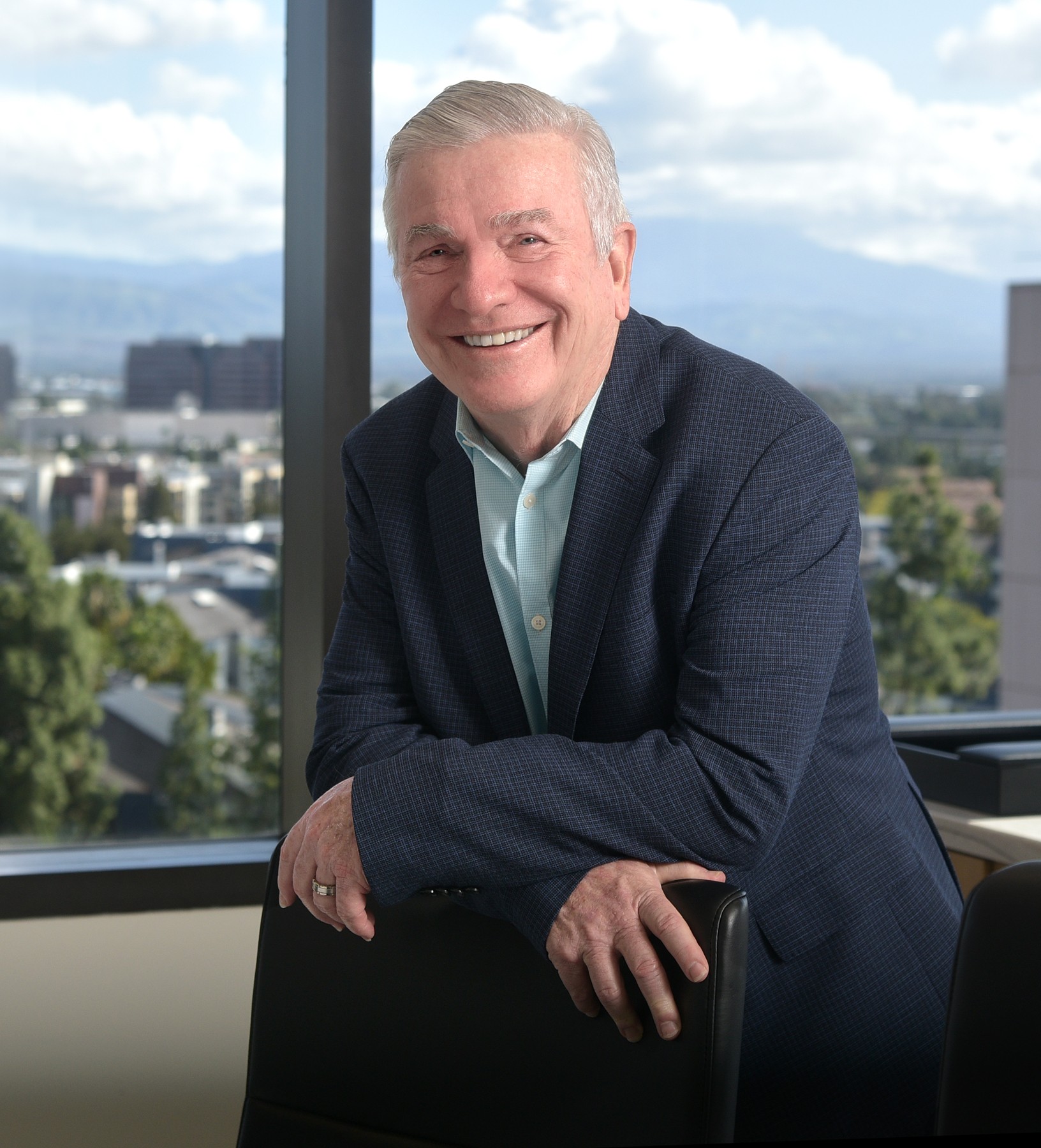
Steve Jones has done it again.
The acquisition master who built Santa Ana-based Allied Universal Security Services LLC into North America’s largest provider of security services last week struck a $5.1 billion deal to buy London-based G4S plc, an acquisition that could create the world’s seventh largest private employer.
“It’s eye opening when you look at the number of employees and number of countries if this is completed,” Allied CEO and Chairman Jones told the Business Journal in an interview a day after the proposed deal was announced.
“This is an exciting opportunity for what was a little Orange County company,” he said.
“It’s an exciting story for anyone who is an entrepreneur. You can dream big and achieve big. Our fingers are crossed that we get this done.”
The acquisition still needs approval from G4S shareholders, and Allied could still face a higher offer from a rival.
If the deal closes, which may be in the first quarter of 2021, Allied will have more than 750,000 employees, just trailing Taiwan’s Hon Hai Precision Industry’s 757,400, according to Fortune magazine’s annual ranking of large private employers. Walmart is the world’s largest employer with 2.2 million workers, according to Fortune’s data.
Allied, which currently has about 250,000 workers, will upon completion of the G4S purchase have annual sales around $18 billion, a large international platform and an extensive portfolio of blue-chip clients across the public and private sectors.
“The play here for us is being able to service our customers on an international basis,” said Jones, who will remain CEO and chairman of the combined company. “We’ve had so many customers ask us to expand into other markets.”
Financing in Place
Allied has the “committed financing” available to satisfy the full cash consideration, GS4 said. Allied’s owners include Caisse de dépôt et placement du Québec (CDPQ), Canada’s second largest pension fund, and an investment group led by Warburg Pincus and an affiliate of the J. Safra Group.
G4S said the combination will lead the industry shift towards security services integrated with technology and provide a global one-stop shop for customers.
“The G4S Board is confident in the long-term prospects of the business and believes this offer represents an excellent opportunity to create a leading global security company,” G4S Chairman John Connolly said in a statement.
G4S, which can trace its origins to Copenhagen in 1901, was officially formed in 2004 when two security firms from the UK and Denmark merged. It now operates in 90 countries across six continents, running everything from train security in the Netherlands to mine clearing in Africa. G4S in 2019 reported about $10.1 billion in revenue, a 2.6% increase from 2018.
It’s sometimes criticized in the British press, such as when it paid a $59.4 million fine for overcharging the British government on an electronic tagging contract. Its latest annual report says about 200,000 of its 533,000 employees turn over annually.
The Jones Story
Jones joined the predecessor of Allied in 1996 when it had only $12 million in annual revenue. Jones and partner Brian Cescolini, who was also in managerial roles at the company, bought out the original owners in 2000.
Through more than 75 acquisitions and organic growth, he’s built it into the nation’s largest private security firm with about $8.5 billion in annual sales.
Jones’ strategy is for an acquired company to adopt Allied’s systems, branding and culture in an effort to boost the margins of a business with traditionally low profit and high turnover. Jones said he’s an admirer of how Waste Management rolled up independent trash companies in the 1980s.
He also emphasizes guards using the latest technology to their advantage, such as employing robots and monitoring social media websites for potential protests or riots near their customers. G4S is also passionate about technology, Jones said.
“They’re very similar to us,” he said. “I think the combining the two really creates that leader in technology.”
Jones earned a Business Person of the Year award from the Business Journal in 2019, as a recognition of his company’s rapid growth. This September, a panel of independent judges also awarded him a Business Journal Excellence in Entrepreneurship award.
“If you would have told me I’d be here 24 years ago, I’d said probably not [believe it],” Jones told the Business Journal after receiving the entrepreneurship award. “I was just an ex-football player and took the philosophies that I had in sports and translated them into work.”
Bidding War
Bidding for G4S began in September when Garda World Security Corp., a Quebec-based private security firm with 102,000 employees, offered $3.8 billion or 190 pence a share for G4S, whose stock is traded on the London Stock Exchange (LON: GFS).
“G4S is a huge worldwide business that is very badly run,” Garda World said in an Oct. 6 letter to G4S shareholders, citing as examples unfunded pension liabilities and a suspended dividend.
Allied then jumped in on Oct. 28 with an offer for 210 pence a share, or $4.3 billion, which G4S called inadequate. Allied on Nov. 13 said it received U.S. antitrust preapproval for the deal.
Jones said he’s known G4S CEO Ashley Almanza for almost five years, saying they have been friendly competitors. When Garda World began a hostile takeover offer, it presented an opportunity for Allied, he said.
“We’ve always had a tremendous amount of respect for the global company that they have built,” Jones said. “Their ability to service customers on an international level is second to none.”
On Dec. 2, Garda World raised its offer to 235 pence or $4.9 billion, which G4S rejected.
After Allied offered $5.1 billion or 245 pence a share, G4S’s board on Dec. 8 board unanimously accepted the offer. As recently as April, the company’s shares traded below 70 pence each.
Garda World can still counter with a higher bid and at press time, the shares traded around 256 pence.
“Overall, we think this is a fair price” offered by Allied, RBC analyst Andrew Brooke said in a report to investors. “Whilst one could argue that the stock could be worth more over the medium-term if it can deliver on organic growth and margin improvement and convert that into cash without exceptionals, there is uncertainty given current management’s poor track record of delivery.”
After the deal closes, Allied Universal will remain a private company and will keep its headquarters in Santa Ana, Jones said.
The biggest obstacle will be to integrate the two companies in the coming two years, he said.
“We’ve always been able to successfully integrate,” Jones said. “We have an opportunity to continue to do something special in the industry.”