

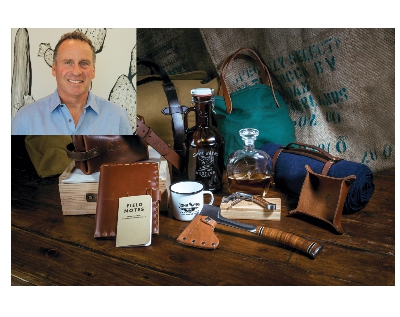
The T-shirts are folded next to the single-action revolver and shotgun, which sit near the leather journals, the bourbon and beef jerky as if the Duke himself was gearing up for a boat trip on the Wild Goose.
It’s a table laid out in the Newport Beach office of John Wayne Enterprises, just off Pacific Coast Highway, assembled to present the depth of John Wayne (née Marion Michael Morrison)—in product form.
Licensed product of the Duke—arguably one of the most famous locals in Orange County’s history—is nothing new, existing in the market splashed across all the usual suspects a celebrity’s name might appear: mugs, refrigerator magnets, calendars and the like.
But Ethan Wayne, son of the actor and now keeper of the man’s legacy as president of John Wayne Enterprises and chair of the John Wayne Cancer Foundation, has hit the restart button on that legacy, hoping to build a lifestyle brand that encompasses apparel, food, drinkware and leather goods. But, to do so he’ll have to segue beyond startup territory and also shake a lingering perception held among some in the marketplace of another side to the actor that’s more recently reared its head.
“I always thought, gosh, we should create some product that maybe my dad would have enjoyed in his personal life and I’ll tell you what,” Wayne said as he sat at the head of a table inside the company’s offices, shooing away a dog named Hank.
“I think about that because, when I was a little boy, my dad would take me with him to work and when he went to work he’d be gone for three months and it wasn’t working in New York City or L.A.
“He was working in Durango and Santa Fe, New Mexico and places that are pretty rural and remote. So we would do this ritual of loading the station wagon with all the stuff he wanted. I carried his boots, his leather bag, his jackets, his gloves, his hats, his bourbon, his Abba-Zaba bars and his beef jerky, you know? All the comforts of home.”
Boutique, RVCA Ties
About a year ago, the company brought much of the product development in-house, adding staff for a fresh perspective and expertise building a brand with a full catalog of product. The assortment, ranging from $30-$300, is currently sold under the John Wayne Stock & Supply online boutique.
There’s also Duke Spirits Bourbon, handled by a licensee and counting roughly 10,000 points of distribution, such as Total Wine & More, MGM Resorts, Mastro’s Ocean Club, and The Ranch Restaurant. Beef jerky and coffee are slated for a December launch. Tequila is scheduled for a Father’s Day 2020 rollout.
Two years ago, the company hired Casey Holland as brand manager at John Wayne Enterprises to handle product development, bringing with him expertise in the youth culture space, most recently having worked at RVCA as vice president of art and creative.
Holland’s skillset will be needed as the company looks to capture the 25- to 35-year-old demographic.
Growth Potential
If the company plays its cards right, there’s market share to grab.
The action sports apparel industry, with a large hub in OC, has been hampered for some time now as surf-inspired brands fell out of favor and skateboarding and streetwear gained ground.
Some streetwear labels then did the unthinkable—managing to parlay themselves into luxury labels, driving the broader trends in the men’s and women’s market for the past few years and even inspiring collaborations with European luxury houses, such as Supreme and Louis Vuitton in 2017.
But with streetwear now giving way to more tailored looks, and Americana and workwear never really having died off, being a company peddling an all-American, outdoors, cowboy story could prove fortuitous timing.
“There’s a huge customer base out there that really wasn’t being addressed,” Holland said as he talked about what brought him to the brand. “Everything was revolved around action sports across the West. There wasn’t anybody per se that was speaking to a Western, outdoors lifestyle.”
“I think a lot of people make the assumption that John Wayne has gone away or nobody knows who he is, but if you get 10, 15 miles off the coast across the entire U.S., people love John Wayne.
“I think there’s a lot of value still in John Wayne and what his image is.”
Three years ago, the company sent out a press release noting that John Wayne, the “most popular film actor of the 20th century,” still sat in the top five on The Harris Poll’s annual list of “America’s Favorite Movie Stars.”
Unwanted Attention
The public’s perception of the actor, who died 40 years ago at the age of 72, has gotten its share of attention of late.
Comments he made in a 1971 interview with Playboy Contributing Editor Richard Warren Lewis reared its head earlier this year, went viral and, more recently, set off calls by some to rename John Wayne Airport. A spokeswoman for the airport said last Thursday, “Although there has been discussion and media attention, the County and the elected board of supervisors has not proposed changing the name.”
Ethan Wayne waved the controversy off. However, it becomes a valid consideration in the context of building a business and whether the more negative sentiments around John Wayne could infringe on the brand’s ability to scale.
The infamous interview, a winding, raw conversation Wayne did with the magazine revealed his thoughts on subjects such as homosexuality in the movies, support of Richard Nixon, socialism, affirmative action and Native Americans. Some of those sentiments were pulled and then tweeted and retweeted in February—causing for calls first from the Los Angeles Times and then later the Orange County Register in September, to have OC’s airport renamed on account of Wayne’s comments.
“I don’t know where this stuff comes from. They’ve got two soundbites out of a 50-year-old interview for a man that’s been dead for 40 years,” Ethan Wayne said in response to the Register’s more recent piece.
“Is there not something else we should be talking about today? I think if you look at the full measure of my father’s life, you’d know who he was.”
Still, as a fledgling business Wayne himself characterized as small, operating out of a 10-person office (some of that staff being dedicated to the Cancer Foundation), blowups such as these could be costly in a world where “cancel culture” is a very real thing.
True Grit’s Appeal
The team thinks the John Wayne brand and all the positives it represents—perseverance, grit, honesty and loyalty—are the aggregate of the artist’s work and will be enough to overshadow any criticisms.
If the numbers are any indication, the company’s apparel has traction—specifically in Dallas-Fort Worth, Houston, Chicago, Los Angeles, and Phoenix—and has garnered some interest from retailers without any real marketing efforts at trade shows or to consumers beyond social media and collaborations with young contemporary artists such as Jon Flaming and Chloé Marie Gaillard Burk.
The company said online sales have grown more than 330% year-over-year, although officials declined to provide revenue.
It’s also looking for real estate to build out a concept that could be one part curated exhibition, store and distillery. If successful, it could be opened in multiple markets.
The company is also testing and has tested pop-ups, with the next one scheduled in December during the National Finals Rodeo in Las Vegas in December.
The 1,000-square-foot experiential buildout will have new and limited edition product, alongside a 2,000-square-foot exhibit of Duke memorabilia.
“A way to reach out to people and tell that story is experiential events like an exhibition,” Holland said. “People can really get in and learn about John Wayne, the guy—personal and professional.”
Although Wayne continued to hammer the point of how modest the business is in size, he is ambitious in his aspirations for what he thinks the brand could grow up to be, saying he sees it fitting within the space occupied by brands such as C.C. Filson, Ralph Lauren’s Double RL and Sundance Catalog started by Robert Redford.
Quality, Craftsmanship
Wayne pointed out the business is not venture backed with plans to get the product into hundreds of doors to grow quickly.
Instead, he and Holland are focused on quality and craftsmanship and measuring off a different gauge.
“There’s evidence that somebody made that [notebook] and I think that’s important in today’s Frappuccino world,” Wayne said, motioning to a leather journal. “Just focus on the reality of, to me, what’s right and what’s good. How much can we improve this? By making it out of carbon fiber or some other silly stuff? Or, it can just be a beautiful piece of leather with a nice design on it. It feels good. It looks good.
“Right now, this is just something we’re doing because we like it. We think it’s going to do well, but we don’t know.
“I just look at it and think, would my dad like this?”
