

Hotels, compared to other commercial real estate buildings, have seen some of the biggest declines in values during the downturn.
But that hasn’t translated into a surge of lender-driven hotel sales. Even sales of stable assets in the area are few and far between, according to local hotel brokers.
“People have been asking, Where’s the flood? Why aren’t we seeing more?’” said Rod Apodaca, managing partner for Los Angeles-based PKF Capital Inc., a hotel brokerage and consulting firm.
Apodaca said he’s working on one sale of a higher-end property in Anaheim, but thus far hasn’t seen many banks willing to let go of their best assets, especially in Southern California.
A few more deals are happening in PKF’s Seattle and Northern California offices right now, he said.
“The pickings are extremely lean. Banks are not letting (distressed hotel properties) go at a reduced price,” said Jordan Richman, senior vice president at the Los Angeles office of Grubb & Ellis Co.
There are plenty of distressed hotels for banks to choose from.
There were a total of 478 California hotels that have defaulted on their loans at the end of the second quarter, according to Irvine’s Atlas Hospitality Group. That’s up more than 130% from a year ago.
Of those distressed hotels, 100 have been foreclosed on during the downturn, according to Atlas’ data. Four of those properties were in Orange County, with the largest being the St. Regis Monarch Beach Resort in Dana Point.
Seattle-based Washington Real Estate Holdings LLC took over the St. Regis earlier this year for undisclosed terms. It held part of the $230 million in primary debt on the hotel along with Newark, N.J.-based Prudential Financial Inc.
More deals could be coming if banks decide to act.
“There’s a tremendous amount of property that has gone back to the lenders. Right now the lenders (have) put receivers or special services in charge, but they’re not releasing them to sell,” Richman said. “They’re waiting for the market to turn around, and then reap the harvest. That’s going to be awhile.”
With such a tight market, some owners who aren’t in distress are trying to sell their hotels for a profit, according to Richman.
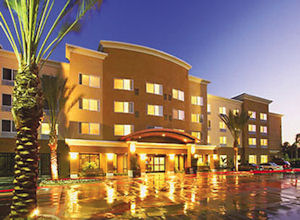
Richman’s team worked on a deal like that for the $25 million sale of the Courtyard by Marriott Anaheim Hotel at Disneyland.
Chesapeake Lodging Trust, an Annapolis, Md.-based real estate investment trust, this month finalized the purchase of the four-story hotel from Newport Beach’s Tarsadia Hotels, which will continue to manage it.
The Marriott Anaheim, at 2045 S. Harbor Blvd, opened in 2006, next to the Anaheim Convention Center. It has 153 rooms, putting the sales price at about $164,000 per room, with a capitalization rate of about 7.5%.
Last year’s largest sale of an OC hotel—Costa Mesa’s 238-room Wyndham Orange County—went for almost half that per-room price. It sold for $21 million or about $88,000 per room. Apodaca’s team represented the buyer of that property, an affiliate of Hong Kong-based Wincome Group.
The difference: the Wyndham hotel was sold at a foreclosure auction, while Tarsadia’s property wasn’t in any financial distress.
Tarsadia “didn’t budge on price,” said Richman, who also helped Chesapeake Lodging Trust in the recent $46 million buy of the Hilton Checkers Hotel in Los Angeles.
Chesapeake Lodging used a $115 million credit line, arranged by Wells Fargo Securities LLC and J.P. Morgan Securities Inc., to fund the two deals, according to regulatory filings. That’s a rarity for many hotel buyers these days.
“There’s been talk of (more) availability of financing, but it’s still pretty difficult” to find loans on hotel deals, said Apodaca.
The bulk of deals today are getting done without financing in place. Buyers will pay cash for hotels, and select debt to put on the property later, Apodaca said.
In addition to REITs like Chesapeake Lodging, increased interest in deal-making is expected to come from large real estate investors, including private equity firms, and hedge funds.
REITs “have the cash—they don’t have to go to the lender,” Richman said. “The ones that have the cash are in the driver’s seat.”
Those groups largely were looking at buying high-end hotel properties a few years ago. Now, with pickings that are slim, they might have to take a step down in quality when looking for potential acquisitions, Apodaca said.
Banks, courts and other lenders have been slow to market their best properties for sale. Most of the under-water properties being marketed today are “junk” with a bevy of financial issues, Apodaca said.
