

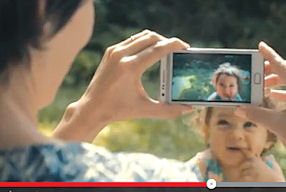
Western Digital Corp. has undertaken its first-ever advertising campaign to establish a brand image with consumers.
The Irvine-based disk drive maker’s effort includes TV spots and print ads placed in a wide range of media. It aims to create emotional connections between the company and consumers in a bid to keep its data storage products above commodity status.
“It’s a very competitive marketplace—you can’t charge a gazillion dollars for something, but we’re going be able to at least maintain our price competiveness,” said Catherine Scott, vice president of corporate communications for Western Digital.
The campaign—with a budget “in the millions”—kicked off last month and will run through the year. It will have a “heavy presence” in the New York, L.A. and San Francisco markets.
The company wants to be perceived as the trusted brand for storing digital content, whether its music, vacation photos or kids’ artwork.
Los Angeles-based ad agency R&R Partners is handling the campaign, dubbed “Absolutely.”
The new TV ad features slick external hard drives traveling from a factory conveyor belt into the lives of everyday people, while a narrator relays the company’s brand message.
“We don’t see magic in anything we make, we see magic in what you make—masterpieces painted with pixels, symphonies composed with keyboards, cinéma vérité directed with smartphones,” the narrator says.
The goal is to “reach beyond the technical people” already familiar with the company’s hard drives and make the brand familiar to the growing numbers of consumers who are using off-the-shelf storage products.
“More and more people are creating content,” Scott said. “I’ve got a smartphone and 100 different ways to take photos and share them. That’s the digital creativity which is extremely important to everyone.”
The media selected for the campaign reflects its broad goal, with placements on programs ranging from college basketball games to The Simpsons and late-night talk show Jimmy Kimmel Live. The print ads have yet to debut, but will have a similar range.
“We are in technology magazines, but we are also in Real Simple,” Scott said. “We span across a multitude of media and communications to reach both males and females. It used to be the guys [who would] go out to buy technology stuff, but not anymore. Anyone who has a smartphone is a technology user now, and women are in the market as much as men.”
Western Digital has long been a leader in the consumer segment of the disk drive market, with annual sales of $12.4 billion and a market value of about $12 billion. It competes with chief rival Seagate Technology LLC in Cupertino and others in the consumer and corporate segments.
“Building brand and awareness is really going to help us,” Scott said. “We understand the importance of your data, and we’ll do everything in our power to protect it, but we have not been able to reach out and communicate that from a [broad-based] communication plan. Now we are.”
Western Digital doesn’t have a separate branding campaign for its corporate customers, a segment it has bolstered recently with recent acquisitions, including a $4.3 billion deal for Hitachi Global Storage Technologies Ltd. a year ago.
Scott said the company expects the “Absolutely” ads will “bleed over” to that segment.
Western Digital’s tack on advertising follows a trend, said Carolynn Coal, an assistant professor of marketing at California State University, Fullerton. More advertising campaigns have companies portraying themselves as being of service to consumers rather than touting their products explicitly.
“They are after a delayed response,” Coal said. “It’s not about trying to get you to go out right now to buy something as they impress you with a call for action. It’s about relationship-building.”
It’s difficult to measure the effectiveness of a branding campaign.
YouTube
Western Digital’s Scott said that an early measurement showed that the TV ad had more than 31,000 views on YouTube; a recent TV ad by McDonald’s was on pace for similar numbers on the video-sharing website.
The brand campaign has some work to do in terms of winning over hearts, according to at least one analyst.
Phil Mause, a senior adviser with Pacific Economics Group, a consultancy with an office in Palo Alto and Pasadena, recently labeled Western Digital and Seagate as a “duopoly” that has become tech’s “ugly sisters,” among the “most unloved of the despised tech sector.”
“I heard that,” Scott said, laughing. “We’re going to be beautiful.”
