

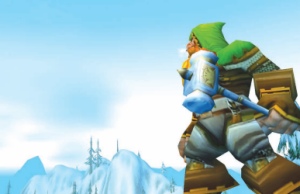
Last week marked a big milestone in an Internet subculture steeped in mythology and science fiction that’s been seeping its way into computers around the world.
Irvine’s Blizzard Entertainment Inc., the largest creator and operator of online video games, saw its “World of Warcraft” blockbuster game turn five last week, and its original predecessor, “Warcraft,” turn 15.
The games, built around a fantasy world of orcs, elves and trolls, has become a billion-dollar business for Blizzard, part of Vivendi SA’s Activision Blizzard Inc., based in Santa Monica.
“One pretty amazing part of this is how much the industry has grown in the past 15 years and how much the company has grown as a result of the success of ‘Warcraft,’” said Blizzard cofounder and Chief Executive Michael Morhaime. “And we started out here as three guys in Orange County.”
Borrowed $15,000
In 1991, Morhaime borrowed $15,000 from his grandmother to start the company with college buddies and fellow developers Allen Adham and Frank Pearce.
Morhaime has the handwritten loan contract with his grandma framed on his office wall.
“We started in an 800-square-foot office on Jamboree and MacArthur,” he said. “And now we have more than 4,000 employees in six countries. It’s pretty insane.”
These days, Blizzard operates out of a 235,000-square-foot office campus in the Irvine Spectrum. It has yearly sales of $1.3 billion, making it OC’s largest software company.
If Blizzard’s growth is hard for Morhaime to believe, it might be even harder to grasp for the uninitiated.
That an online fantasy game in the tradition of “Dungeons and Dragons,” “Lord of the Rings” and other staples of geek culture could grow to more than 11 million players worldwide may be baffling to some.
But clearly, Blizzard’s games are big business that go beyond a niche following.
A movie based on “World of Warcraft”—with a budget of more than $100 million—is due in 2011. A novel about one of the game’s characters, “Arthas: Rise of the Lich King,” is a New York Times best seller.
Fans of the games are devoted, giving “Star Wars” followers and Trekkies a run for their money.
For the past few years, fans have descended on Anaheim for the company’s annual BlizzCon fan fest, many dressed as their favorite characters from Blizzard’s games.
Formula
Blizzard’s games have become the most successful of their type by stressing ease of use, attention to detail and graphic art that’s distinct, according to observers.
In the case of “World of Warcraft,” the game’s epic storyline of two races fighting for control of a fantasy world helps draw—and keep—players, who pay $15 a month to play.
The first “Warcraft” game debuted in 1994 as a real-time strategy game where players manipulated an army, staging attacks and retreats from an enemy.
The game mined geek love of mythology by pitting armies of orcs, trolls and ogres against humans, dwarves and elves.
“World of Warcraft” followed in 2004, advancing the story line.
When signing up, “World of Warcraft” players must align themselves with one of the two opposing camps in the game, either the Horde or the Alliance.
Each user also picks a race and attributes of his or her character, such as its sex, class and physical traits.
Players join up with others to go on quests and raids, which involve a lot of virtual bloodshed.
Blizzard’s games are “pretty simple to get into,” Morhaime said, “but very difficult to master.”
Masterminds
A handful of Blizzard’s original founders and employees created the seeds of the “Warcraft” series.
Sam “Samwise” Didier was Blizzard’s earliest art director. Ron Miller was its original designer. They largely are responsible for the look of game’s fantasy world, dubbed Azeroth, and the characters in it.
Chris Metson, vice president of creative development, is keeper of “Warcraft” lore.
Some of the questions he and his team face are purely out of another realm, such as, “What is the motivation of an orc?”
“‘World of Warcraft’ is a place with history and characters that have history together,” Morhaime said. “We want all of those things to be consistent.”
During the creation of the original “Warcraft,” the team tried to keep a neutral perspective when telling the story of the game’s conflict, according to Morhaime.
“If you are a human, you see this conflict one way, and if you are an orc, you see this conflict with humans in another way,” Morhaime said. “When you dig down into the conflict, you get to see that it’s textured and layered and not just a simple good versus evil.”
Blizzard’s attention to detail is one reason why its fans love the “Warcraft” games.
The other biggie—“World of Warcraft” makes online game playing social.
“Playing against other people is a very social experience,” Morhaime said. “People come to play the game, and they stay because they’ve made real life friends.”
Morhaime grew up reading J.R.R. Tolkien’s “Lord of the Rings” and playing “Dungeons and Dragons” and “Magic: The Gathering.”
Those influences weigh heavily on “World of Warcraft.” A more modern inspiration, he said, is Walt Disney Co.’s Pixar Animation Studios Inc., which also uses technology to tell rich stories.
Morhaime said his favorite “Warcraft” character is an orc named “Thrall” who’s part of the Horde faction.
Thrall was orphaned and raised by humans and went on to become leader of the orcs. He’s described as “clever, quick and enormous, even by orc standards” on WoWWiki, an editable encyclopedia site for the game.
Thrall is “a noble shaman, natural-born leader type of character,” Morhaime said.
