NEWPORT BEACH — When it comes to investing, John Saunders says he likes real estate that rarely goes empty.
Since August, Saunders Property Company, has bought about $170 million in manufactured housing communities across the U.S. That includes two communities in Bozeman, Montana, for $71.5 million, the Newport Beach investor told the Business Journal.
The family business is also under contract for another $83 million in deals. One is a $28 million mobile home community in Southern California, and the other is a property in Naples, Florida, for more than $55 million.
Altogether, Saunders has invested nearly a quarter of a billion dollars in this niche asset class in less than a year. That’s on top of the more than $1 billion worth of manufactured home communities he already owns.
Saunders said manufactured housing offers something that office buildings, retail centers and other commercial properties can’t always guarantee: steady occupancy.
“I buy real estate that never goes vacant,” Saunders told the Business Journal during a recent visit to his Newport Beach office.
Manufactured Housing
This investment comes at a time when more private equity firms and investors are entering this niche housing asset class, as the country faces an affordability and housing crisis.
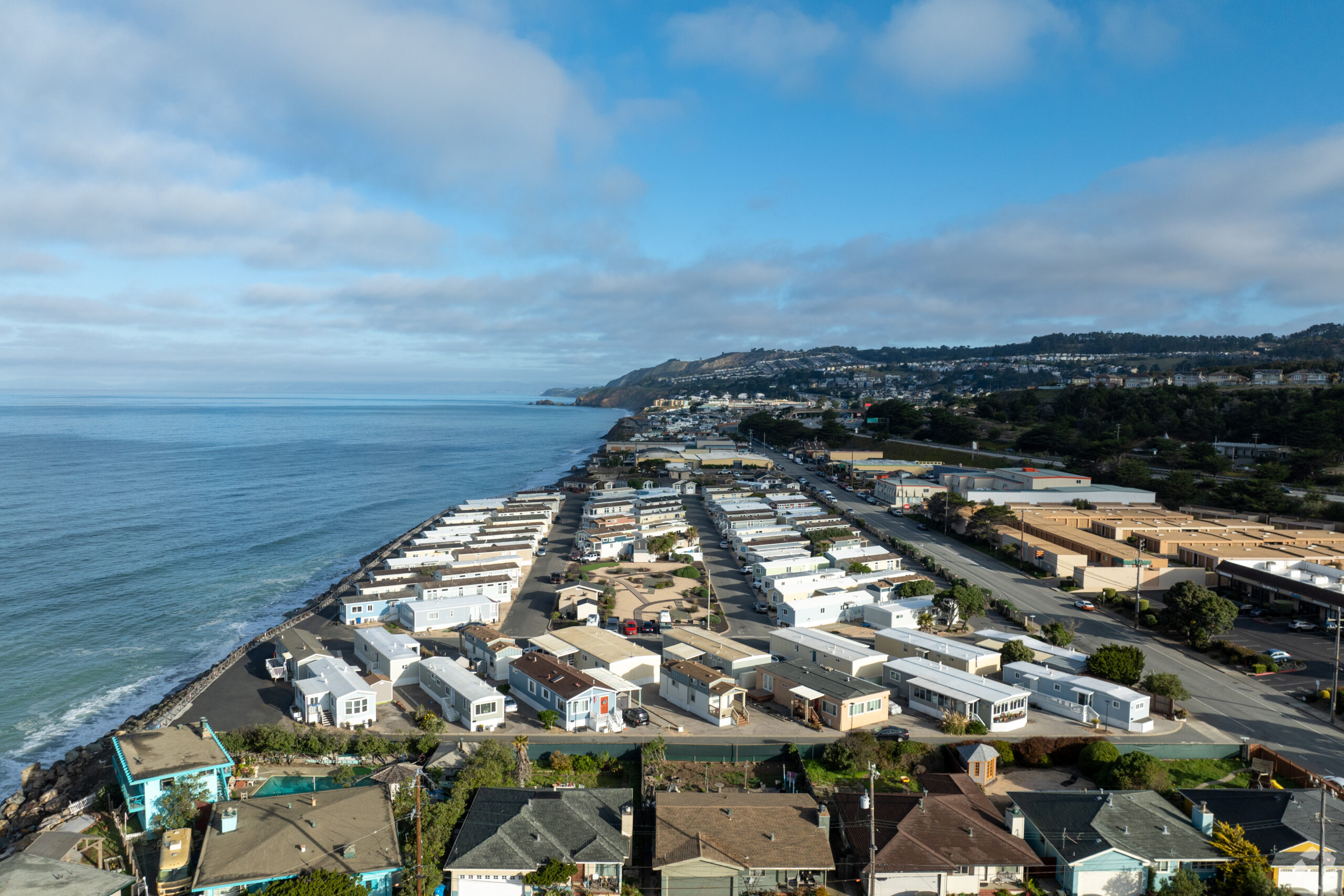
Manufactured housing communities, more commonly known as mobile home parks, are land-lease communities in which residents own their homes but rent the land from the owner.
The term “mobile home parks” comes from the fact that many homes built before 1978 had wheels.
Today, the official term is manufactured home community, since these homes have no wheels and are rarely moved. Proponents hope the new name will help reduce the stigma associated with living in these types of communities.
More than 22 million Americans live in manufactured home communities, according to the Manufactured Housing Institute, a national trade organization.
Most people view these communities as an affordable housing option for those who can’t access the traditional housing market.
According to a 2023 study by the U.S. Government Accountability Office (GAO), Fannie Mae reported that institutional investors and other real estate firms acquired up to $9.4 billion in mobile home communities in 2021 alone. That amount was the highest transaction volume recorded in the five years prior to 2023, the report said.
Like Saunders, other investors are drawn to this sector because of its high demand, strong occupancy rates and steady cash flow. According to the GAO, most communities are 95% occupied.
From Coin Collecting to Real Estate
In a private study next to his main office, Saunders sits on a gold-yellow wingback chair. He’s dressed in a light blue button-down shirt and navy slacks.
He said the chair is one of three he brought out of storage to decorate the room during a recent office renovation.
The three chairs have sentimental value. His mother bought each one, at different times, for his father to relax in after long days at work.
“I grew up seeing him sitting down in these chairs reading a newspaper or listening to the radio,” he said.
Behind him, family photos line a brown bookcase, and paperwork from deals is scattered around the room. A red silo cup and a can of Diet Coke sit on a small table, which also holds various medications. Books about rare coins lie on the floor.
“I’m old school,” he said as he handed out printed marketing material of his recently acquired mobile home deals.
Saunders is a former international banker for American Express Bank, where he worked in London and the Philippines in the 1970s, before giving it up to pursue his hobby — coin collecting.
He’s the founder of London Coin Galleries Inc., a Newport Beach-based company that deals in rare 100-year-old coins from around the world and has expanded to other antiquities such as ethnographic art, shipwreck items, diamonds, fine jewelry and luxury watches.
“I remember telling my father, who grew up during the Great Depression, that I was quitting the bank; he thought I was crazy,” Saunders recalled, chuckling. “He told me, ‘You went to college, you graduated and you have a good job. And you threw it all away.”
“And luckily, he lived long enough to see the success.”
In 2017, Saunders received a Business Journal Excellence in Entrepreneurship Award.
Saunders loved collecting coins, which he started in junior high school.
It’s the history of it.
Growing up, he used to consume history books. He specializes in collecting coins from the Low Countries, which are now known as the Netherlands, Belgium and parts of Northern France.
Over time, the profits he received from trading coins, he put into Orange County real estate.
“I learned how to make deals, learn how to do deals, through coins. I took the same skills to real estate,” he said.
Why Mobile Homes
Saunders first invested in offices, buying office buildings around John Wayne Airport, Mission Viejo and Irvine.
He explained that he started looking into mobile home parks after his office properties were hit hard during the Great Recession. A friend suggested the idea to him.
“In a mobile home park, you never go vacant,” said Saunders. “If they do, the home usually sells and you get paid out of the proceeds.”
Saunders said his company has interests in 57 mobile home parks with about 7,746 spaces. The portfolio is usually 98% to 99% occupied and valued at more than $1.5 billion.
Saunders looks nationwide for parks in markets where new housing is difficult to build and demand remains strong. That strategy recently took him to Bozeman, Montana, where he paid $71.5 million for two communities.
The parks in Montana initially seemed like an unlikely target, he said.
But the properties were sandwiched in between Yellowstone National Park and a ski resort. He added that the city has a limited housing supply, strong demand and few places to build new housing.
“It’s very, very supply-constrained,” Saunders said. “I like to buy parks in supply-constrained markets where there is a big gap between the rent of a two-bedroom apartment and the rent in a mobile home park.”
The company’s portfolio also includes parks in coastal California such as Oceanside and Pacifica, as well as inland areas in Garden Grove and Riverside.
But California carries an added risk due to rent control, Saunders said.
He said rent control can limit returns and discourage new supply, even when the intent is to protect residents.
In one Oceanside park, Saunders said average rents are about $580 per space, while market rents for manufactured homes are closer to $1,800.
“I am in the red with some of my properties,” he admitted.
Still, Saunders said the company doesn’t come in and push rents to market when it buys a park.
Instead, it takes a long-term approach, raising rents gradually and often waiting for homes to naturally sell before resetting rents.
“We play the long game,” he said.
Keeping it Affordable
Saunders also said the company has a rent subsidy policy to help residents who can’t afford big increases.
If a resident’s rent exceeds certain income limits, annual increases are capped. In hardship cases, such as serious illness, some residents receive no increase or even a rent reduction.
“I like money. I like to make money, obviously,” Saunders said. “But I don’t need money so bad that I’m going to ruin somebody’s life over getting a little extra money.”
Saunders said the company spends $40,000 to $50,000 a month on subsidies. He works with a third-party company, and residents must submit their finances to qualify.
He puts it in perspective. Many of the current deals he’s purchasing really aren’t for him.
He’s structured it so that his children, two of whom now work at the family-owned real estate investment company, can inherit it.
“They’ll eventually take it over,” he said.