

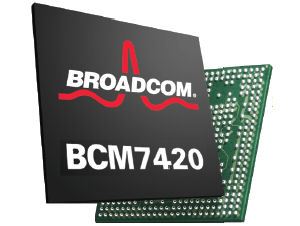
In 1993, a young Broadcom Corp. got its big break when TV set-top box maker Scientific-Atlanta Inc. tapped it to supply chips for boxes used in an experimental interactive cable system in Orlando, Fla.
Nearly 20 years later, the Irvine-based company is seeing a new demand for chips used in cable, satellite and other TV set-top boxes.
“Way back, the main part of the set-top box chip was how you connected to the cable signal,” said Stephen Palm, technical director for Broadcom’s broadband communications group. “That communication path, which started very simply, now is a very rich broadband pipe for TV, data, voice and entertainment.”
Broadcom’s set-top box chips, which date back to the earliest days of company founders Henry Samueli and Henry Nicholas, have had to keep up with changes in networking and entertainment.
These days, set-top boxes attached to digital TVs are envisioned as hubs linking to other household devices and to the Internet.
It’s a long-promised vision that has been slow to realize. In many cases, broadband routers have stolen the thunder of set-top boxes and emerged as the common link for household devices that connect to the Internet. But market watchers say the set-top box’s evolution still is unfolding.
“The industry is in a transition from a box that just sends you TV services to a box that controls everything in the home that connects to the Internet,” said Jonathan Gaw, research manager at Minneapolis-based market research group IDC Corp. “It’s now a gateway for many devices.”
Broadcom designs chips for the largest makers of set-top boxes: Motorola Inc. of Illinois, France’s Technicolor SA and Britain’s Pace PLC.
The boxes are sold to pay TV companies, Internet service providers and others, which typically “lease” them to customers along with service.
Broadcom’s chips “really concentrate the heart of a set-top box,” said Stephen Froehlich, an analyst in the consumer electronics research group of Britain’s IMS Research, part of Intex Management Services Ltd.
Encryption
The selling point for pay TV providers is Broadcom’s ability to encrypt what its chips handle, which protects licensed content (think big Hollywood films) from being ripped off during transmission.
“The feature that really keeps Broadcom in business is security,” Froehlich said. “Lots of chip guys can decode video. But it’s the conditional access that secures their lock on the market.”
Broadcom’s set-top box chips are among its fastest growing.
They are part of the company’s broadband communications division, which is divided up into cable, satellite and Internet TV groups.
In the second quarter, the unit saw the highest growth rate of any part of Broadcom’s business.
The unit “delivered the highest sequential growth rate in the second quarter, at approximately 15%, with record sales from core set-top boxes and broadband modems,” Chief Executive Scott McGregor told analysts.
The company doesn’t break out sales figures for broadband communications or any other specific chips.
Analysts on average expect Broadcom to see total 2010 sales of $6.6 billion, nearly double what it saw in 2009.
Demand for set-top box chips is expected to come from a number of sources.
Deals
Broadcom announced a slew of set-top box design wins earlier this month at, a consumer electronics trade show in San Jose.
It struck deals and partnerships with Colorado’s EchoStar Corp., Georgia’s Arris Group Inc. and Turkey’s Vestel Electronics, among others.
Broadcom is looking to increase chip sales with set-top boxes in emerging markets, such as Brazil, China, India and Indonesia.
Those countries are set to account for about 40% of set-top boxes shipped worldwide in 2010, according to IMS Research.
Broadcom and its rivals are in a heated battle to dominate in newer, fast-growing markets.
The company competes against Switz-erland’s STMicroelectronics NV and a former unit of Newport Beach’s Conexant Systems Inc.
Conexant sold off the unit in 2008 to NXP Semiconductors, the former chip arm of Royal Philips Electronics NV, for up to $145 million.
In October, NXP was bought by Santa Clara’s Trident Microsystems Inc. for about $30 million.
Broadcom also competes with Sunnyvale’s Zoran Corp. and other smaller players.
Demand is coming from new technology standards that allow multiple devices to communicate and be hooked up to a network within a home.
Home Network
Broadcom’s engineers envision a day in which a home’s TV, telephone, computer, home monitoring and security and energy monitoring systems all can be managed via a set-top box.
“What the cable guys would like to have is a set-top box in which everything connecting to the Internet goes through it,” Gaw said. “That’s what set-top boxes have the potential for, and Broadcom sells the chips that can make that happen.”
