

A lot of companies are working through turnarounds these days.
With the help of Newport Beach’s Jazz Semiconductor Inc., Tower Semiconductor Ltd. says it has pulled one off.
In late 2008, Israel’s Tower paid $40 million plus an additional $129 million in debt for Jazz, which makes chips under contract for others.
Tower has hit product and financial milestones in the year or so since it’s had Jazz under its belt, according to Chief Executive Russell Ellwanger. They include a profitable third quarter after more than a year of losses.
“It’s truly a much bigger, much stronger company than either one was on its own before,” Ellwanger said. “One plus one equals more than two in this case.”
A few weeks ago the chipmaker changed its brand name to TowerJazz to better represent the combined company.
Both companies—roughly the same size at the time of the buyout—have benefited from the combination, Ellwanger said.
Tower has added business from Jazz, roughly doubling its customers.
“We were both of relatively the same size, but we didn’t have one customer in the top 20 of each company that overlapped,” Ellwanger said.
By combining operations and expanding sales, Tower was able to cut costs by about $80 million a year.
“Being of the same relative size, we had the ability to show we could cut out substantial costs to eliminate duplicate jobs,” Ellwanger said.
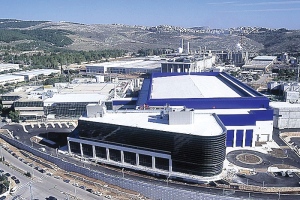
Tower, which now has three chip plants, has managed to grow during one of the worst downturns in recent memory for the industry.
In the third quarter, the company reported sales of $80 million, up 36% from a year earlier, thanks to Jazz and newly won business.
Excluding charges for stock compensation, interest and other costs, Tower posted profits of $11 million, after more than a year of losses.
Tower forecasts fourth-quarter sales of $90 million to $94 million, which would be up 16% to 21% from a year earlier. It didn’t give a profit outlook.
The Jazz buy gave Tower “the ability to gain new customers and new projects through cross-sells during a time when very few companies would entertain a new supplier,” Ellwanger said. “During a downturn people are reluctant to qualify any new suppliers.”
Tower landed a deal valued in the “multiple hundreds of millions” with Milpitas-based Intersil Corp., its largest to date. The company is set to make power management chips for Intersil.
It also landed contracts with six new customers in South Korea in the past few months.
Tower focuses on making what are known as power management chips.
They help modulate voltage levels in electronics.
From Jazz came a long history of chip making for aerospace and military uses, including chips that go into infrared detectors, night vision devices and communications gear.
Growth Projection
Ellwanger sees big growth ahead.
He said the company could reach $900 million in sales in 2012, or nearly three times yearly sales now.
Shares are up 350% since the start of the year on a recent market value of around $160 million. The stock hovers at around $1 a share and is lightly traded. No U.S. analysts currently follow Tower.
The company has roughly 1,000 workers in Israel and nearly 600 in Newport Beach.
The Tower buyout ended Jazz’s brief run as an independent company.
Jazz got its start as the chip making arm of Rockwell International Corp., which no longer exists but left behind Milwaukee-based Rockwell Automation Inc. and Cedar Rapids, Iowa-based Rockwell Collins Inc. What became Jazz made chips for aerospace and modems.
Rockwell spun off the business as Newport Beach-based Conexant Systems Inc. in 1999.
In 2002, Conexant split off its Newport Beach chip factory as Jazz.
In 2007, Apple Inc. alums Gil Amelio, Steve Wozniak and Ellen Hancock bought Jazz after raising money from investors.
Amelio ran Jazz as chief executive until the sale to Tower.
He stayed on for a time as an adviser to the board.
Ellwanger
A handful of local executives report to Ellwanger, who was recruited to be Tower’s chief executive in 2005. He works mostly from Israel and comes to Newport Beach every five weeks or so.
Earlier, he spent nearly a decade in a variety of posts at Applied Materials Corp. He was stationed in Israel for two years as general manager of Applied Materials’ metrology and inspection unit.
He also did long stints at Novellus Systems Inc. and at the chip arm of Royal Philips Electronics NV.
Ellwanger describes himself as a devout Mormon and the “only Mormon CEO in Israel.”
He lives in Caesarea, midway between Tel Aviv and Haifa. Ellwanger has four children and is a former wrestler who represented the U.S. in several international competitions.
