

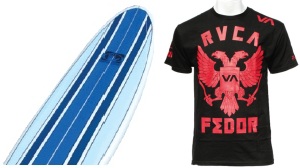
Holiday cash registers closed last week with a mix of fear and hope for sellers and makers of clothes inspired by surfing, skateboarding and snowboarding.
“Every retailer is concerned about holiday shopping,” said Sean Smith, executive director of the Aliso Viejo-based Surf Industry Manufactur-ers Association, an industry group that represents makers of clothes and other products. “The good thing is that expectations are not what they were last year.”
Makers of clothes inspired by surfing, skateboarding and snowboarding—dubbed actions sports by those in the industry—are hoping to see a slow rise into the New Year.
But expectations are realistic, according to Smith.
“No one is expecting the economy and consumer spending to go back to what it was,” he said.
November was “another down month” for action sports boutiques, according to a survey by Milwaukee-based investment bank Robert W. Baird & Co.
Even so, November was “essentially in line with (October), but not nearly down as much as a year ago,” analyst Mitch Kummetz wrote in a report.
There are some bright spots.
At Torrance-based Becker Surfboards, which runs three Orange County stores and is opening a fourth, online sales are hitting last year’s numbers and then some, according to President Dave Hollander.
In January, the retailer is opening Becker Paddle Surf in Mission Viejo. The 7,000-square-foot shop is set to sell everything for standup paddle surfing, a sport Hollander said is all the craze these days.
But the industry’s dominant retailer, Anaheim-based Pacific Sunwear of California Inc., isn’t faring so well.
The company, which runs some 900 clothing stores, said in November it expects a loss of as much as $22.4 million for the three months through January, much more than Wall Street was expecting.
The company said it saw “a precipitous decline” in sales of clothes for guys and females in the last two weeks of October and first two weeks of November, prompting the lower forecast.
Part of Pacific Sunwear’s troubles are its own.
In December, Chief Executive Gary Schoen-feld said Pacific Sunwear “didn’t do a great job of staying the leader” at an executive roundtable put on by Irvine-based industry Web site Shop-Eat-Surf.com.
“Brands and retailers need to know who their customer is. PacSun lost that,” he told the crowd.
Beyond Pacific Sunwear’s own problems, there’s no escaping that the industry’s downturn of the past year is a big factor for the retailer and others.
“This fall and holiday seasons are challenging,” said Dylan Slater, marketing director at Costa Mesa-based Rip Curl USA, a maker of surf-inspired clothes. “There’s a lot of discounting out there, which makes it tough.”
Rip Curl, which has been around for 40 years, focuses on surfers. It makes technical, function-based boardshorts and gear and is less fashion-driven than other local clothing companies. It runs 13 of its own U.S. stores.
“We’re trying to maintain the strength of our brand and avoid discounting,” Slater said.
Becker has had to contend with warehouse sales hosted by clothing makers looking to blow out unsold clothes, Hollander said.
“It used to be you were concerned about the word promotional,” he said. “But now I’m concerned about liquidation—that some will just clear everything out at the end of December.”
“Things are still tough for these shops, but better than a year ago,” said Jeff Van Sinderen, an analyst at Los Angeles-based B. Riley Co. “There are some smaller retailers that are financially distressed and having a tough time.”
Those that can’t ride it out are going to sink, he said.
There could be a real shakeout on the boutique level, Hollander said.
“There are lots of guys who won’t get through the first quarter,” he said. “They’re barely making it through the fourth quarter.”
Blowout sales have affected everyone, including buzz brand Rvca Clothing of Costa Mesa.
“It’s a double whammy because retailers want lower retail prices and expect more margin,” President Brad Blankinship said. “This is a huge challenge. We have to rely on our quality, brand image and strong sell-through.”
Rvca and Costa Mesa-based Volcom Inc. are brands that retailers cited as being hot, according to Robert W. Baird’s quarterly report.
Playing with the big boys is tough for a smaller company such as Rvca, Blankinship said.
“The biggest issue we deal with is that (bigger companies) can afford to offer discounts, extended dating and back-end concessions in these difficult economic times and retailers expect the same from Rvca,” he said. “It’s the sales volume these companies have that allows them this luxury. This forces us to be more creative in our retail and marketing objectives.”
As for Volcom, it offered a fourth-quarter forecast below what analysts had been expecting. It expects to earn $246,000 to $980,000, versus the $2.7 million analysts had been looking for. Sales are seen coming at $59 million to $62 million, in line with the estimates.
The company cited “myriad complexities in accurately assessing the current state of the global retail environment.”
Gomez is a freelance writer in Long Beach.
