
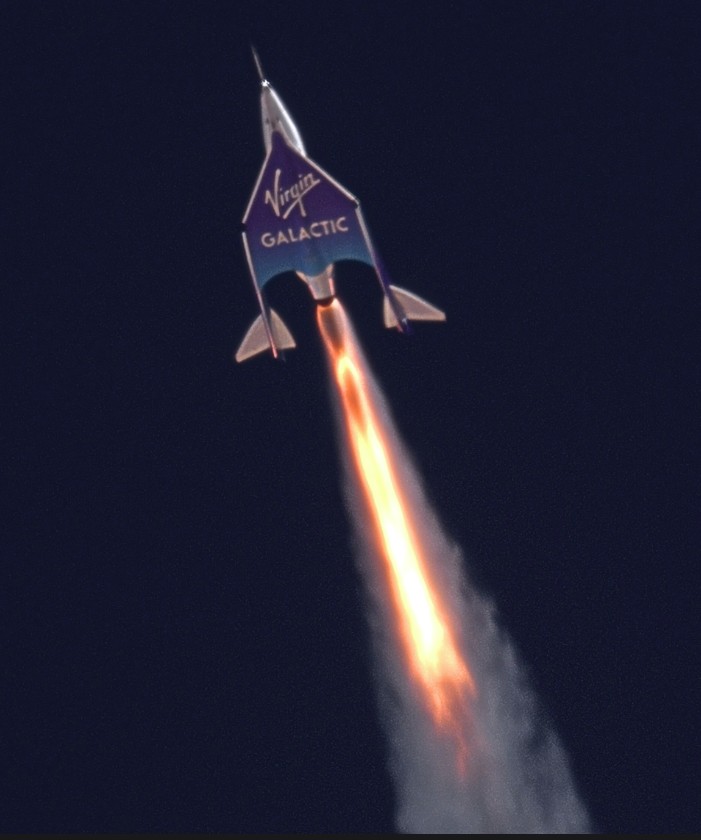
Space tourism company Virgin Galactic, which aims to restart commercial flights later this year, saw its stock price swing wildly during a two-week stretch
After the shares closed at $2.47 on May 20, the craziness began over the next nine trading sessions, culminating in a more than threefold increase to $8.90 on June 1. Trading volume that day reached 286 million shares, about 15 times the daily average.
By June 3, shares of the Tustin-based company had plunged 50% to $4.29 for a market cap of $448 million. (NYSE: SPCE).
The trigger for the rise may have been news that Rich Huang’s RichRich Capital had taken a 5.3% stake in the company. Huang is an American investor whose company is based in Miami, according to filings.
Another trigger for the climb may have been the infamous short squeeze, in which traders who had bet the stock would fall scrambled to cover their positions when it rose. Short interest was between 22% and 28% of publicly available shares, well above the normal range of 5% to 10%.
A reason for the sudden drop may be the Virgin Galactic filing on June 2 that it would issue new common stock to noteholders, diluting existing shareholders. The company is required to redeem $30.4 million of its 9.80% notes by Sept. 30. The transaction may be completed by June 10.
“Management believes current market conditions provide an opportunity to execute this transaction,” according to a regulatory filing. “This redemption also strategically aligns with the company’s expected increase in spaceflight cadence and price.”
The drop could also be linked to the industry becoming overheated, as evidenced by the Procure Space EFT Index doubling over the past year.
In the past week, shares of Intuitive Machines, Long Beach-based Rocket Lab and AST SpaceMobile have all sunk.
SpaceX is moving closer to a public listing at a $1.8 trillion valuation, down from an earlier estimate of $2 trillion. And Blue Origin suffered a launch-pad explosion involving one of its rockets on May 28.
CEO Focused on Flights
Despite the recent selloff, investors found a reason for optimism late last month when Virgin Galactic said it expects to start test flights of its new spaceship, in the third quarter of this year with “commercial spaceflight operations expected to begin Q4 2026.”
The company in 2024 suspended space flights to build new spacecraft.
“With commercial space flight operations continuing to draw closer on the horizon, we’ve accelerated efforts across the company to prepare for the ramp of activity,” Chief Executive Michael Colglazier told analysts on a May 14 conference call.
“We’re hiring our next group of world-class spaceship pilots as we prepare for flight test and ongoing space flight operations.”
The company reported a first-quarter loss of $65 million, an improvement from an $84 million loss in the prior year’s first quarter.
It also reported $251 million in cash and marketable securities on hand, down from $338 million on Dec. 31.
By redeeming the bonds, the company on June 2 said its cash position will improve by not having to make any principal payments until 2028 after flights have resumed.
The company also on May 28 announced that the U.S. District Court for the Eastern District of New York issued an order granting preliminary approval of its proposed settlement with plaintiffs that would resolve all claims pending in two shareholder derivative actions.
The proposed settlement will result in, among other settlement considerations, the monetary payment of $2.75 million by the company’s insurers to the company, half of which the Company will retain.
Virgin Galactic said its current and former officers and directors, who are defendants in these actions, have denied and continue to deny each and all of the claims and allegations of wrongdoing asserted in these actions.
Banking on the Future
Virgin Galactic is banking on the future with its “suborbital flights” – a brief pop into space that comes nowhere near the challenge posed by circling the Earth in a modern spaceship.
Virgin Galactic faces potential competition from various companies, including Jeff Bezos’s Blue Origin. The current price for a Virgin Galactic seat has climbed to $750,000, according to Colglazier.
“We’ve provided our roughly 650 founding astronauts, who make up roughly a year’s worth of advanced bookings, with expected flight windows in 2027 and early 2028,” Colglazier said.
Virgin Galactic, founded by flamboyant British investor Richard Branson 22 years ago. Branson said in December 2023 that he had no plans to invest more money in Virgin Galactic, adding that the company already had “sufficient funds.”
That new Spaceship is still being developed. Its predecessor, VSS Unity, has been pressed back into service for testing in the skies above New Mexico.