
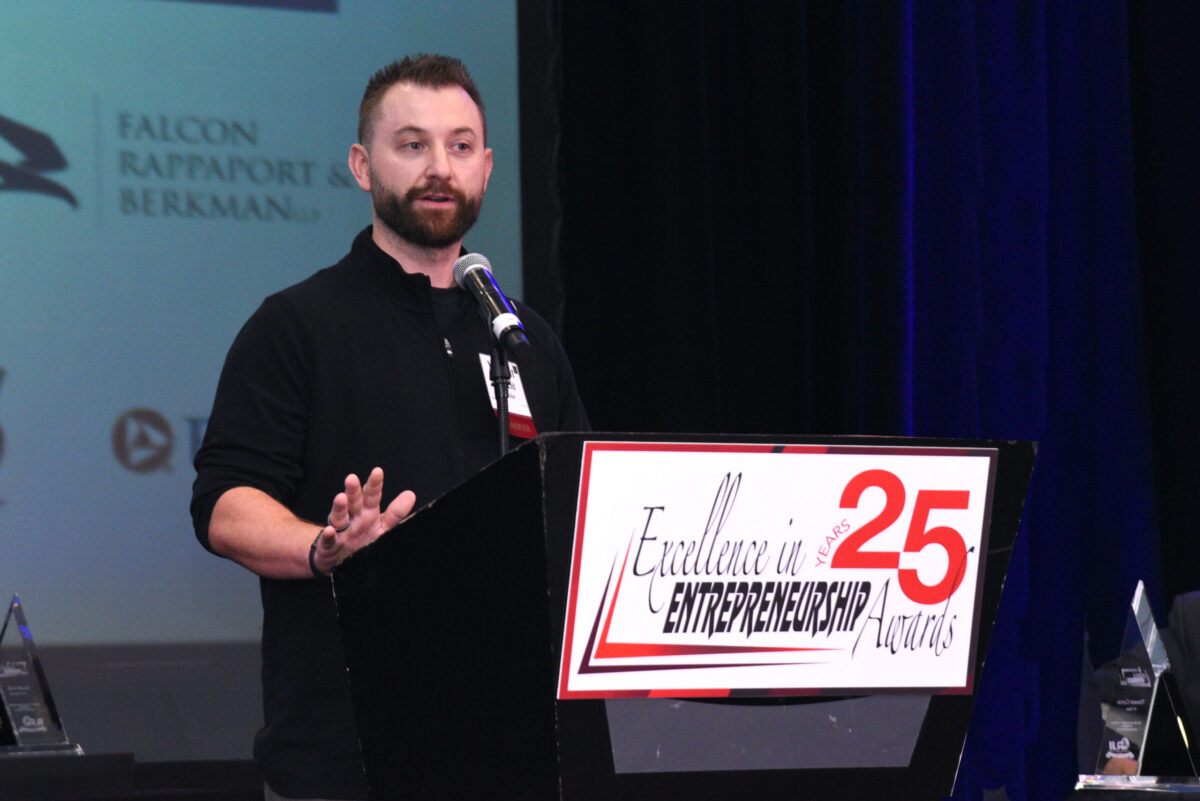
Vinnie Curcie decided to build his company, OC Solar, by making customer service his top priority.
“There are a lot of contractors who have bad reputations for overpromising and underdelivering,” Curcie said. “Everyone has a bad construction story. We’re trying to be different.”
He certainly is making a difference. On March 26, he won a Business Journal Excellence in Entrepreneurship Award. Since starting in 2016, he’s built his company to $62 million in sales last year with 115 employees.
“We get to change people’s lives,” Curcie told the audience of 300 at the Irvine Marriott.
“We make a difference. The average person using solar saves $100,000 over 25 years.”
Golf to Solar
Curcie, who grew up in Villa Park, wanted to be a professional golfer and pursued a career on the links after graduating high school. After his golf career didn’t pan out, he worked with a family member in the construction business; his grandfather was a general contractor.
In 2011, he joined a solar company, where he learned the intricacies of the industry. In 2016, he struck out on his own.
“I wanted to start a company with good service and deliver on promises,” Curcie said in a prior Business Journal article.
He said the industry is affected by numerous outside forces, including slim margins, interest rates, tax incentives, regulations imposed by homeowner associations and government entities and tariffs on Chinese imports, which supply the majority of solar panels.
To make it worse, the salespeople who sign up the clients are often outside contractors who don’t work at the same company as the installers, creating problems for what is promised and what is delivered, he said.
“Solar installation and construction have a bad reputation, which is well deserved,” Curcie said.
“Transparency is huge at OC Solar. We try really hard to be a contractor that is ethical and gets things done.
“Our reputation ends up being the linchpin in the whole thing. Come and kick our front door if you have problems.”
The Tesla Edge
OC Solar uses Tesla’s Powerwall batteries, which he said are the industry’s best “by a lot.”
Curcie is one of 12 installers on the Tesla Pro Council, which meets quarterly with Tesla executives. The company has no debt or venture capital, he said.
OC Solar is gaining recognition in Orange County, including serving as an official sponsor of the Honda Center in Anaheim. The Irvine Company, OC’s largest real estate company, is so pleased with its tenant that the landlord features OC Solar as an example of its Flex+ program, which enables quick expansion of floor space.
It’s also become a family business, with brother Ashton Curcie as chief operating officer; his mother, Sherri Curcie, manages marketing; his father, Vincent Curcie, handles permits; sister Savannah Curcie runs customer service; brother-in-law Jesse Raymond is head of project management; and uncle Paul Gemmell is in charge of human resources.
“We are such a close, tight-knit group,” Vinnie Curcie said. “My family is as trustworthy as it gets. That’s a core aspect.”
OC Solar already has a presence in the greater Los Angeles and San Diego areas, and it’s looking to add territories in California’s Central Valley.
“In Southern California, we have the most expensive utility prices combined with the most amount of solar. That is what makes Southern California the mecca for solar.”
The Dec. 31 Rush
Last November, he predicted the first half of 2026 would be slow because the Big Beautiful Bill, enacted in July, eliminated a 30% rebate for solar panels for homeowners as of Dec. 31.
“January was the worst month in three or four years that we have had,” Curcie said.
“February wasn’t a great month. In March, we recovered earlier than I thought. April is looking pretty good. We’re on an uptrend.”
While the direct incentive has ended, Curcie is seeing a new method emerge: a corporate tax credit that expires at the end of 2027.
Companies are forming new financial vehicles to own tax credits, which they will pass through to consumers. For example, a system that costs $30,000 could get a $9,000 corporate tax credit. The entity would keep $1,000 and pass the remaining $8,000 to the consumer.
“Solar is definitely going to survive. In June, when the weather gets hot and people start seeing their electric bills jump, people will start to get solar. The best companies will be fine.”