

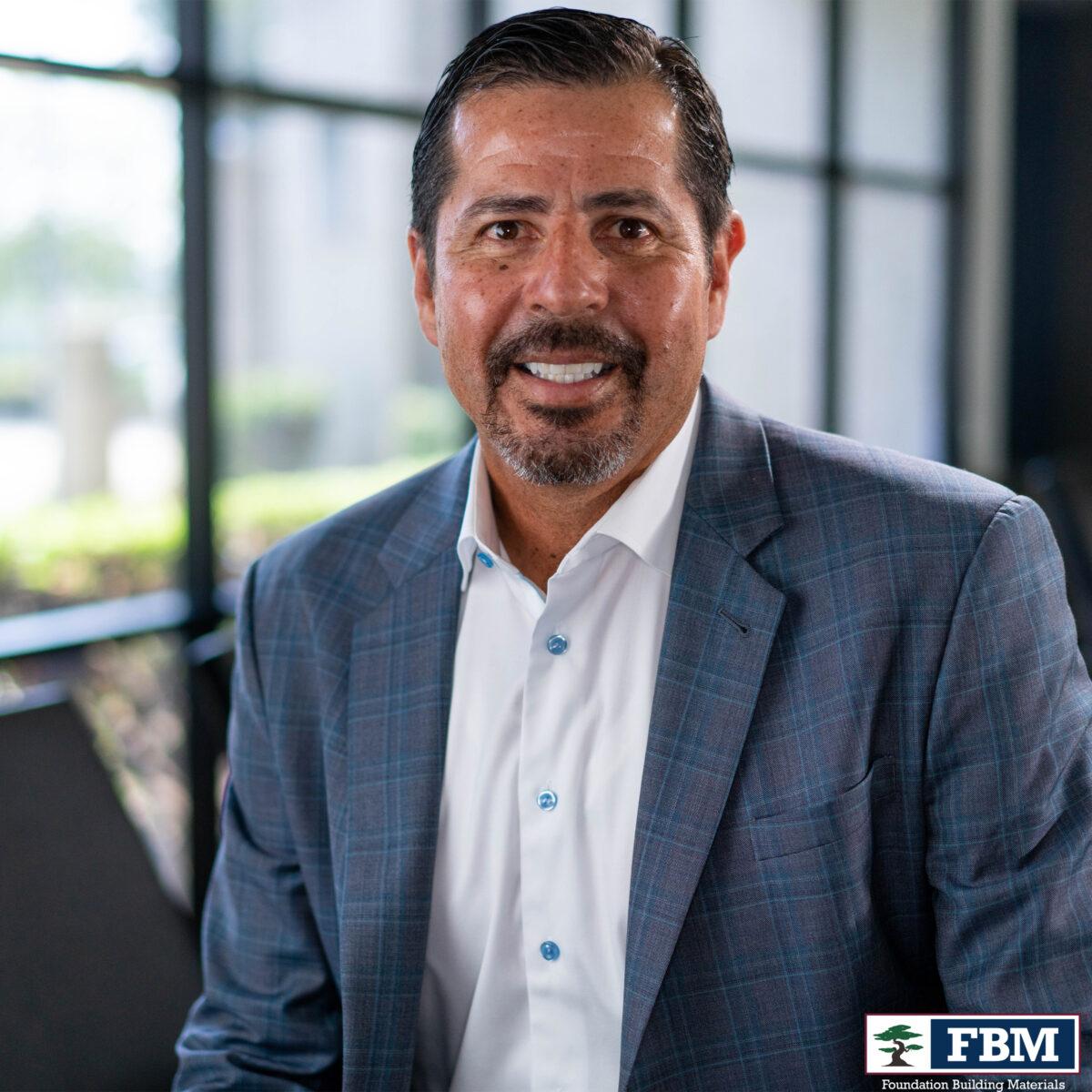
Nearly 15 years ago, Ruben Mendoza was on his knees praying for the survival of his fledgling distribution company—Foundation Building Materials.
The first 18 months were particularly challenging as the Santa Ana company faced constant rejection for its services. Trucks sat around, and many of his own employees didn’t think the company would survive.
“We started this business from scratch. It’s the hardest thing I’ve ever done,” Mendoza told the Business Journal in September. “I was on my knees every day, just praying to make it.”
Mendoza eventually turned the construction distribution business into a national player through a bullish acquisition strategy combined with Mendoza’s unfailing faith. Foundation Building Materials (FBM) now has over 370 locations in the U.S. and Canada.
Lowe’s Companies Inc. took notice last year, acquiring the firm for $8.8 billion. For building his company to a successful exit, the Business Journal has named Mendoza Businessperson of the Year in the retail sector.
$1.3B in Quarterly Sales
Lowe’s completed the acquisition of FBM in October.
“This acquisition gives us a more comprehensive product portfolio, expands our revenue streams, and further enhances our offering to our Pro customers,” Lowe’s CEO and President Marvin Ellison told investors in November during the company’s third-quarter earnings call.
The chief executive specifically noted that FBM’s 370 locations will strengthen the home improvement retailer’s fulfillment capabilities, especially in high-density urban markets.
“That’s going to be a huge deal for us because it is very challenging for us today to fulfill a large order of something, let’s say, drywall to a customer job site and do it efficiently,” Ellison said.
“We now are working to just transition that entire fulfillment process to a company that’s best-in-class at it, and that’s FBM. And so we think this is going to be great for FBM. It’s going to be great for Lowe’s, but more importantly, it’s going to be great for the customer.”
The acquisition of FBM will boost Lowe’s large Pro business—a $250 billion space. In the fourth quarter, Lowe’s said FBM sales of approximately $1.3 billion are expected to boost the company’s sales to roughly $86 billion for 2025. That outlook is adjusted from a previous range of $84.5 billion to $85.5 billion.
Mendoza, who remains president of FBM as well as holding the new title of Lowe’s executive vice president, declined to be interviewed for this story. He previously told the Business Journal that Lowe’s was attracted to FBM’s Pro relationships.
“The Pro is where they’re going to grow,” he said.
FBM has 3,000 trucks on the road every day, delivering products to homes, high-rises and multifamily properties. Mendoza said Lowe’s, in comparison, might have one flatbed truck for every two stores.
“They don’t do that many deliveries. They do a lot of inbound and a lot of distribution center deliveries to their stores, but not a lot of delivery to the customer,” Mendoza said of Lowe’s. “We do a lot of it, every day.
“If a do-it-yourselfer or a small pro went into Lowe’s and said, ‘I need a truckload of drywall,’ it’s hard for that store manager to get that for him,” Mendoza continued. “Well now, they can get that to him 50 times a day. That’ll be easy for them.”
FBM’s business mix is currently balanced evenly between commercial and residential.
Ellison told investors that commercial space accounts for 55% of FBM’s revenue.
The CEO says they see FBM positioning Lowe’s to accommodate large-scale commercial projects, such as “data center development and construction, medical facilities, residential facilities.”
“And while the housing market is currently under some pressure, we’re pleased with the momentum we’re seeing with FBM’s commercial sales,” Ellison said.
“Some recent highlights include several data center projects, a luxury 150-unit residential high-rise and medical facilities, as FBM leverages a strong reputation for reliability and technical expertise to win these contracts.”
From Cleaning Carpets to CEO
Mendoza’s path to building FBM began modestly in Southern California. Raised in the Diamond Bar–Walnut area, Mendoza met his wife, Heidi, in eighth grade, and the two have now been married for 35 years.
“My first jobs were cleaning carpets and offices,” Mendoza said in a previous interview.
He initially worked for others before launching his own office cleaning business, with his wife helping along the way. The company helped support him through college.
After attending but not graduating from college, Mendoza moved into advertising and later joined a printing company. He transitioned into the building materials distribution industry, working as a drywall and metal framing salesperson for his father-in-law’s company. When Mendoza joined in 1991, the business had $40 million in sales.
By the time it was sold in 2003, revenue had climbed to $275 million.
After running another company for several years, Mendoza decided to start his own distribution firm alongside two partners. He invested 70% of the capital—some of it raised by selling a vacation home. Other partners contributed 25% and 5%, respectively.
FBM launched March 1, 2011, with $4 million in seed funding.
The early days were difficult.
Mendoza and his partners bought trucks from a guy who was going out of business.
“We leased a place,” Mendoza said, noting that he and his CFO personally guaranteed both the lease and the loan. “Our whole butts were on the line for everything.”
Transitioning from a large enterprise to a startup proved challenging.
Mendoza pushed forward, accelerating growth through acquisitions in Northern California and San Diego. The strategy worked, and within four years, FBM was approaching $1 billion in sales.
Coming up with new ideas has defined most of Mendoza’s career.
“All I ever do, all day, is think of stuff. Some of it works, but obviously some of it doesn’t,” he said.
“But you have to make decisions and go for it.”
