

Lumitron Technologies Inc.’s ultra-high-energy X-ray technology has caught the attention of one of Australia’s largest private mining companies.
Hancock Prospecting last month invested $50 million in Lumitron with the option to increase its investment to $100 million by the end of the year.
The funding will help Lumitron commercialize its HyperView system, which is said to deliver imaging resolutions up to 1,000 times greater than traditional X-rays while using 100 times less radiation.
While the company’s initial focus is healthcare, its technology also has potential applications in industrial imaging and mining, where it could help inspect materials and analyze ore.
“In mining and resources applications, HyperView is designed to go beyond conventional industrial X-ray systems, which are typically limited to analyzing the shape and density of materials,” Gina Rinehart, executive chair of Hancock Prospecting, said in a statement.
“HyperView has the potential to identify the composition and concentration of minerals and contaminants in ore, allowing mining operators to selectively process higher-value ore, thereby improving recovery rates while potentially reducing energy consumption and overall processing costs.”
Rinehart is one of Australia’s wealthiest persons with a net worth of around $33 billion, according to the Bloomberg Billionaires Index. She owns Hancock Prospecting, which generated $11.6 billion in the fiscal year that ended June 30, 2025.
Early Cancer Detection
The company has been promoting its technology to improve early cancer detection and minimize harm to healthy tissue.
“If we do this right, you’re never going to have to remove a breast or a prostate again because you’ll be able to treat it early enough,” Chris Barty, co-founder and chief technology officer of Lumitron, told the Business Journal.
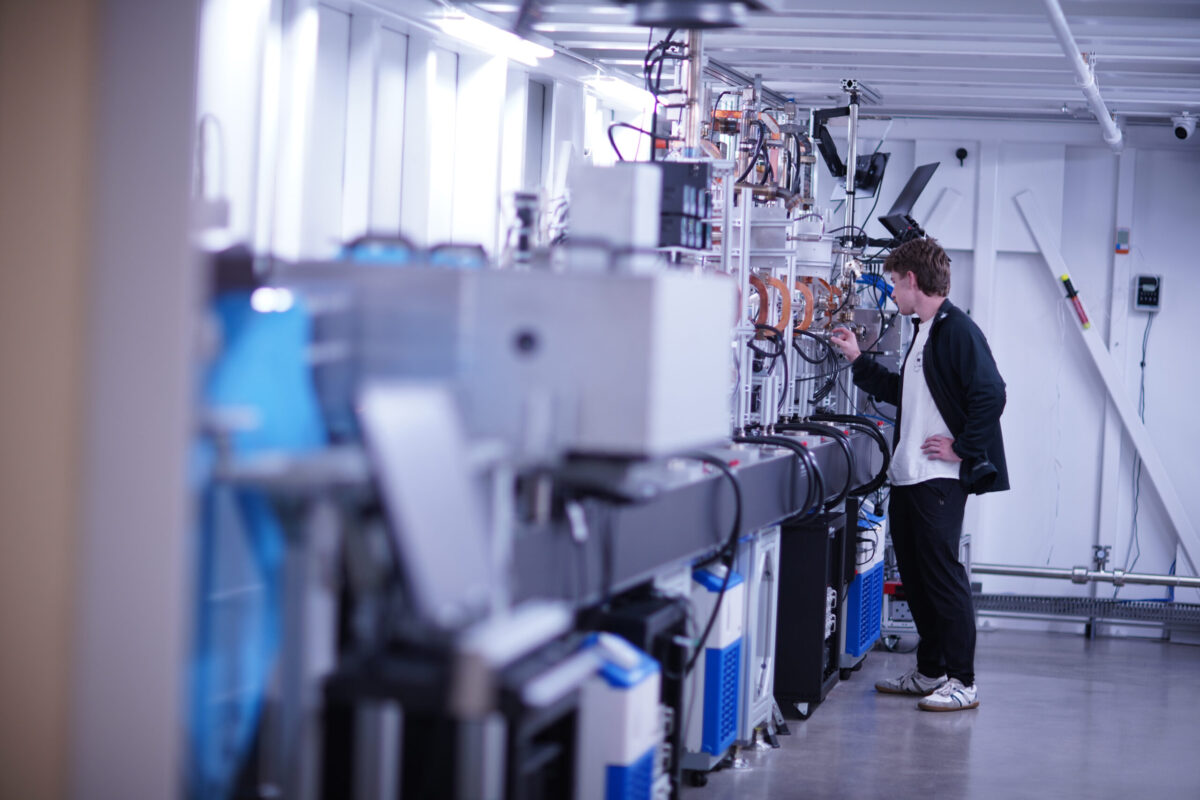
Lumitron currently manufactures nearly every component at its 21,000-square-foot headquarters and R&D facility at UCI Research Park.
As it prepares to scale production, the company has been evaluating sites in Orange County for a facility capable of producing up to 100 machines a year with a move-in targeted for next April or May, Barty said.
The added capacity will support a global launch across the U.S., Europe and Asia, while three systems are reserved for Australia as part of the agreement with Hancock.
Lumitron is also in a big hiring push and expects to grow from 60 employees to 100 employees by year-end.
Technology Originally Developed in Nuclear Lab
Barty is a professor of physics and astronomy at UCI, as well as a member of the Beckman Laser Institute & Medical Clinic and the Chao Family Comprehensive Cancer Center.
The basis for Lumitron’s X-ray is a result of nearly 20 years of federally funded research totaling $220 million.
Barty developed the technology while he served as CTO for the laser directorate of the Lawrence Livermore National Laboratory, one of three nuclear labs owned by the federal government and housed under the U.S. Department of Energy.
He initially set out to develop an X-ray system to prevent terrorists from smuggling uranium-235 into the country.
Upon retiring from Livermore in 2017, Barty wanted to base Lumitron in Pleasanton, a town next to Livermore, so he could recruit people from the lab.
Colleagues at UCI heard about Barty’s new venture and established a professorship to recruit him to Orange County.
After spending a day at the medical school, Barty said “it became very clear it was better for the company to be across the street from the end user.”
Of the current 60 employees, only three have been hired from a job posting, according to Barty.
“I found in coming down here is that Orange County has such a huge concentration of medtech that we easily are able to hire people into the company who have experience in bringing machines into the commercial arena,” he said.
Treating Cancer in a Heartbeat
Lumitron’s two main businesses are precision radiotherapy and precision imaging.
The company’s HyperView system uses high-energy electron beams to deliver radiation therapy in less than a millisecond—shorter than a heartbeat or breath—compared with today’s treatment sessions that typically last 30 to 45 minutes, according to Barty.
Barty said that traditional radiation therapy uses photon beams or proton beams.
“If you’ve got cancer in the lung, that proton beam has to go through flesh, bone and empty cavity before it gets to the nodule that you’re trying to treat, and picking that energy is not easy,” he said. “If you get the energy wrong, you deposit all of that dose in healthy tissue.”
Electrons, by comparison, go all the way through the body at a constant dose, said Barty.
One of the challenges was making a machine with high enough frequency that could fit in a clinic, similar in size to an MRI or CT machine.
“That’s what we’ve spent the eight years up to now in the company doing,” Barty said.
On the imaging side, Lumitron uses the same electron beam developed for radiation therapy and combines it with a laser beam to generate high-energy X-rays designed to detect cancer at the cellular level.
This opens the possibility to spot vascular networks indicative of early cancer. The growth of solid tumors relies on a supply of oxygen and nutrients delivered via vascular networks.
“You can’t do that without a biopsy right now because the image resolution you would need is 100 times beyond what’s done in a CT image and one thousand times beyond what’s done in an MRI image,” Barty said. “Nobody can see that right now, so they never look for it—we have to show them they need to look for it.”
Last January, the FDA granted HyperView breakthrough device designation for breast cancer diagnosis.
Lumitron’s ambitions extend beyond healthcare.
The same imaging capabilities developed to improve cancer detection and treatment could also be applied to industries ranging from mining to advanced manufacturing.
According to Barty, Hancock recognized the technology’s broader industrial potential, “particularly its ability to deliver ultra-high-resolution, material-specific imaging that could improve efficiency, reduce waste and lower processing costs across the resources sector.”
Raised $100M+ to Date
Hancock’s investment brings Lumitron’s total funding to more than $100 million.
The company raised $34.6 million in its first financing round in 2020, followed by an undisclosed second round, and has also secured about $20 million in non-dilutive government contracts, primarily from of the Defense Advanced Research Projects Agency (DARPA), Barty said.08
When asked about a potential exit, Barty said that they have no desire to sell the company but have considered the idea of going public either on the Nasdaq or Australian Securities Exchange.
“I wouldn’t mind if it’s never public, but that would depend on sales growth and things like that,” Barty said.
