
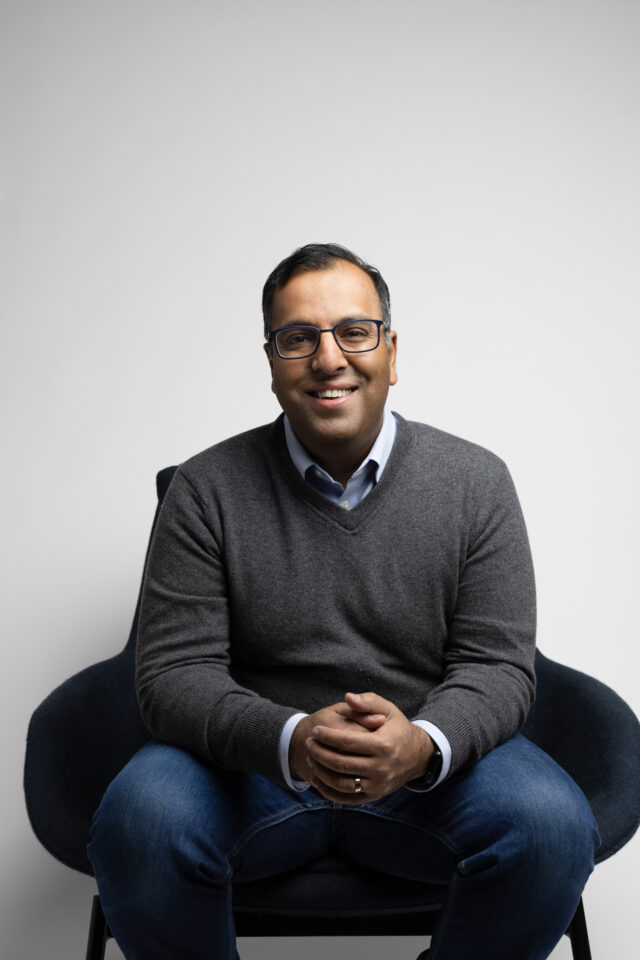
Naeem Ishaq grew up in San Juan Capistrano and Diamond Bar, where he collected the trading cards of his favorite Los Angeles teams like the Rams, Lakers and Angels.
Almost 30 years ago, he left for Northern California, where he worked for a string of well-known Silicon Valley companies, including Square, Salesforce.com and Intel. Besides San Francisco, he lived in Denver, Boston and New York City.
When a recruiter for Santa Ana-based Collectors Holdings Inc., which provides authentication and grading services for collectibles such as trading cards, autographs and memorabilia, contacted him, he jumped at the chance to return to Orange County.
“It was a dream come true,” Ishaq told the Business Journal, noting that his wife Cerena also grew up in OC. “It’s a great role, a great company. It’s my personal passion as well, so it just felt like serendipity and fate to happen.
“It’s like joining the Willy Wonka Chocolate Factory.”
In October, Collectors hired Ishaq to replace CFO Jason Harinstein, who was known as the long-time right-hand man to Chairman and Chief Executive Nat Turner. Harinstein “Moved on to pursue other opportunities.” according to the company.
Ishaq’s background in Silicon Valley indicates that Collectors is prepping for growth.
“Naeem’s experience building financial infrastructure at some of the world’s most innovative companies makes him a perfect fit for Collectors’ next stage of growth,” Turner said in a statement. “As demand for collectibles like sports and Pokémon cards is accelerating, his expertise will be critical in expanding our reach globally and strengthening our position as the trusted leader in a growing asset class.”
The Davis Connection
Collectors dates to 1986, when Professional Coin Grading Services (PCGS) was founded, and then to Professional Sports Authenticator (PSA) in 1991. Collectors went public in 1999 and for a decade hovered around a $30 million market cap. About a decade ago, it steadily climbed in value from around $100 million until its eventual purchase in 2021 for $853 million.
Turner, who had sold Flatiron Health for $1.9 billion in 2018, led a group of investors that included hedge fund magnate Stephen Cohen, owner of the New York Mets, and Dan Sundheim, whose D1 Capital opened a $5 billion fund in 2018 and is part owner of the Charlotte Hornets. Other investors include The Chernin Group and athletes such as Kevin Durant, Larry Fitzgerald and Andy Roddick.
A year after the purchase, the company said its valuation was $4.3 billion. Collectors at the time said the collectibles industry is expected to be worth $522 billion globally by 2028, up from $372 billion in 2020.
Its three main units are PSA, which authenticates trading cards and memorabilia; PCGS, which grades coins and currency; and WATA, which values video games and pop culture.
The Silicon Valley Edge
After Ishaq graduated in 2001 with a degree in managerial management from the University of California, Davis, he landed at Intel, where he worked for six years. He spent the next five years at Salesforce.com, rising to the senior director of finance & strategy, managing the company’s long-range plan and supporting M&A activities.
He worked under Sarah Friar—the current CFO at OpenAI—who he followed to Square, an online payments company, in 2012.
During his four years at Square, he headed finance, strategy and risk, helping the company go public. The company, which changed its name to Block Inc., currently has a $42 billion market cap (NYSE: XYZ).
Ishaq’s first CFO gig was in 2016 at online retailer Boxed Wholesale, which he described as “Costco online.” He left in 2018, five years before the company would file for bankruptcy.
Most recently, he spent the past six years as CFO at Checkr Inc., which uses AI to provide background screening and workforce monitoring services.
“My primary calling card is helping companies to scale on the global level and on a national level,” he said.
He said he’s worked at “some of the best and most impactful businesses in the last decade.”
Globally Relevant
At Collectors, Ishaq said he aims to scale the grading company into a “globally relevant enterprise.”
What has helped is that the items that Collectors and its business divisions grade have become investment-grade assets as the trading industry has “professionalized,” according to Ishaq.
“When something is graded, it’s protected, it’s verified, it’s authenticated, it’s sealed,” Ishaq said. “And that allows you to say, ‘I can now with confidence, go ahead and put my money here, even if it’s from a seller who I will never meet in person.’”
Ishaq added that the process of grading trading cards and other items based on condition has created a layer of trust for customers and thus, Collectors has boosted the industry.
“That allows for more liquidity in the market than existed before,” he said. “And so that has pulled the whole ecosystem from what was a little bit more of a cottage industry, to now becoming a full on, true investment grade asset.”
Its Santa Ana offices span nearly 287,000 square feet at the Pacific Center office complex. Collectors also spent the last few years expanding its footprint internationally with facilities in China, France, Japan, Canada and soon Frankfurt and London to increase access points for customers.
Tech-Forward Lens
Ishaq said that the grading industry takes a unique physical item, like a sports card, and makes it fiscally exchangeable by applying specific standards based on its condition, such as a PSA 10.
“Because it’s hard to have an investment grade asset when each item is unique and one-on-one—but when you’ve now standardized those, it can become much more valuable and accessible,” Ishaq said.
With his background working at technology firms, Ishaq was drawn to the digital lines of business that Collectors has been building.
One of the recent innovations has been the PSA Vault, also the official vault of eBay, where the company accepts customers’ graded cards and collectibles and keeps the collections in a physical location.
PSA can digitize the objects and upload photos to a mobile app where the owners can still access and see their collections and even auction or trade with others, which is an example of Collectors building a bridge between the physical and digital worlds, Ishaq said.
“Collectors historically was a smallish public company, was more artisanal, and when Nat (Turner) led the purchase of the company a few years ago—as a tech entrepreneur—he took that tech-forward lens and applied that,” Ishaq said.
He added that Turner’s strategy has helped the company “scale dramatically” in the last couple of years and bring the hobby of collecting into the modern world by bridging the realm of physical cards with digital experiences such as the PSA vault or the mobile app.
Collectors is currently testing a new online feature, via a partnership with GameStop, called Power Packs that introduces digital repacks of a random group of physical, graded cards that customers can purchase and open to trade or keep.
What’s driving the industry even further is the connection to pop culture, Ishaq added.
“There’s a cultural overlay too,” he said. “When I was collecting as a kid, I certainly didn’t see my favorite pop stars wearing a PSA graded card around their neck. It’s this intersection of technology, of pop culture, of investing, all combining to create these challenges, that has really helped to make it huge.”
“And when I look forward, I think that’s only going to continue to accelerate.”
The CFO Gameplan
Chief Financial Officer Naeem Ishaq has a three-point plan for Collectors.
“Number one: it means making sure that we understand what it is our customers need, and we’re increasingly able to meet that,” Ishaq said. “And as a CFO, you’re the primary steward of capital for the firm, and so you want to make sure that those investments are going to the right place.
“Number two: that you have the right infrastructure that will support a growing company’s needs, whether it’s technical infrastructure, whether it’s human infrastructure and human capital, whether it’s logistics—all those things come into play.
“Then number three: that we’re able to demonstrate that as a compelling story for our shareholders, current and future, about what this industry is, what our future expansion plans look like, so they are excited about that as well.”