
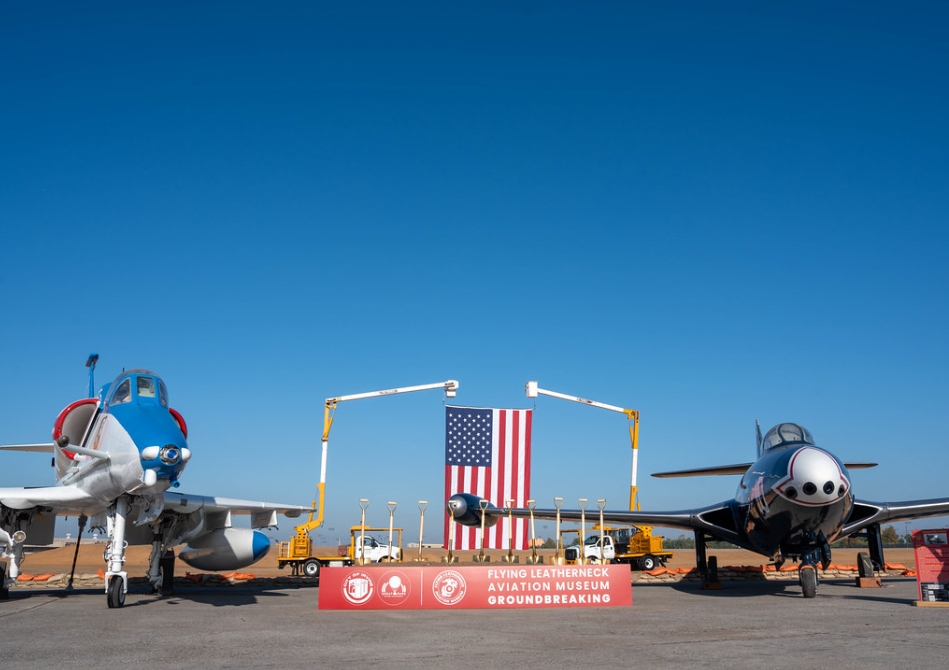
A new museum is about to take off in Irvine’s Great Park.
More than 100 dignitaries attended an Oct. 28 groundbreaking for the Flying Leatherneck Aviation Museum, which is located next to Hangar No. 297 on the former El Toro Marine Corps Air Station.
“This moment honors Marine Corps aviation history and the incredible community that has made this possible,” said Mike Aguilar, a retired Marine brigadier general and chief executive of the museum.
The $63 million museum is slated to be one of four to five special sites that will be opened in the coming years in an area that will be known as “Cultural Terrace.” Other facilities that may open in this terrace include Pretend City, the Pacific Symphony, and a museum dedicated to Asian American art.
The city is spending $1.2 billion to develop the 1,347-acre park, which officials say is the biggest municipal park under development in the U.S.
“Twenty years ago, the path forward for this former base was in dispute,” Mike Carroll, an Irvine City Council member and chairman of the Great Park, told the audience. “Some saw only asphalt and concrete. They demanded a massive international airport—another LAX—to occupy this space.
“But the people of Orange County rose up. They said no. They voted, they demanded, and they won. They chose a park, a Great Park, for all to enjoy.
“This is a day that brings forth the best of Irvine: our commitment to public safety, our visionary master planning, and our deep, abiding respect for the history and legacy that forged this remarkable place.”
In honor of Veterans Day, the Business Journal is featuring a special report, beginning on page 23, to honor the 250th anniversary of the U.S. Army, Navy and Marines.
WWII Beginnings
Both El Toro and the nearby Marine Corps Air Station Tustin were built during World War II.
The museum traces its origins to 1989, when Marine generals decided to open the only such facility dedicated exclusively to Marine Corps aviation.
“It was born from a simple but powerful idea: that the history, courage, and innovation of Marine aviation and aviators should never be forgotten,” Aguilar said.
When El Toro closed, the museum, along with the entire 3rd Marine Aircraft Wing, relocated to the Miramar Marine base in San Diego.
From 2000 to 2020, it operated as a USMC Command Museum, with operational and financial support provided by the Flying Leatherneck Historical Foundation. In 2020, the Marines decided to close it due to financial constraints.
“At that moment, many organizations might have folded,” Aguilar told the audience. “But not this one—because Marines don’t give up.”
In early 2021, when hope was fading, he said the museum received a call from Irvine city officials.
“They asked a simple but powerful question: ‘What if we brought the museum home?’”
Museum officials reached an understanding with Irvine.
“But there was one condition: We had to raise $5 million—and do it fast, meaning less than a year,” Aguilar said.
Fred Smith, founder of FedEx and a former Marine, pitched in.
As the deadline drew near, the pressure mounted.
“I’ll be honest with you—there was a moment when I wasn’t sure we were going to make it,” Aguilar said.
Then, on a Friday afternoon, he received a call from Charlie “CQ” Quilter, a retired Marine colonel, and his wife Ann. They, along with brother Patrick Quilter, donated more than $3 million. The Quilter brothers started QSC LLC, a Costa Mesa-based maker of audiovisual and control systems, which was sold for $1.2 billion earlier this year.
The Irvine City Council then approved a $20 million grant for aircraft transport and museum construction. The museum still needs to raise another $20 million, Aguilarsaid.
“From El Toro, to Miramar, and now back home again—the Fighting Leatherneck Aviation Museum stands as a living tribute to the courage, skill, and sacrifice of Marines in the air,” Aguilar said. “This museum isn’t just about preserving the past—it’s about the future.
Inspired by a B-26 Gunner
Since he was in the 7th grade, Mike Aguilar knew he wanted to be a military pilot, having been inspired by his father, who was a gunner on B-26s in World War II.
Aguilar’s parents, who were Mexican immigrants who picked fruits on farms in Northern California, taught him to be proud of this country.
“They were very appreciative of America. They brought us up to serve the country.”
During his 31-year Marine Corps career, Aguilar held a variety of flying and command billets, accumulating over 4,000 hours, primarily as an attack helicopter pilot. He was a highly decorated veteran of the Gulf War. He is the first person of Mexican descent to reach the rank of General Officer in the United States Marine Corps.
After Aguilar retired, he worked for the federal government and then as a consultant. He volunteered on the museum’s board at Miramar.
When it was threatened with closure, he became CEO and president and has successfully engineered the transfer of planes from Miramar to Irvine.
Several planes had to be dismantled, with their wings removed to be transported on flatbeds up the Santa Ana (5) Freeway.
Hangar No. 297 now houses 43 aircraft, ranging from a vintage biplane to World War II planes, including the B-25J Mitchell and the F/A-18-A Hornet. One of its most famous crafts is the helicopter that took the American ambassador from Saigon to safety during the fall of Vietnam in 1975.
Once up and running in the first half of 2027, the museum’s annual operating budget will be about $4 million, he estimated.
“It’s going to be a big operation,” Aguilar said. “We’re not a mom-and-pop operation. We are starting a museum business—it’s a business.”
The museum isn’t ready yet to accept volunteers; it would like to partner with businesses as sponsors or to hold social events at the museum.
“We would love to have the local business entities in Orange County see us as part of the community.”