

Launched in 1999, Irvine’s Eon Reality Inc. was thinking about the metaverse five years before Facebook (Nasdaq: FB), last year renamed Meta Platforms Inc., was even founded.
The augmented and virtual reality software company, with offices around the world and a network of more than 1.1 million licensed users, is now following the $475 billion-valued social network in one important regard: it’s planning to go public.
Eon Reality, the creator of what it calls the “Knowledge Metaverse,” and whose AR and VR software is used in a variety of educational and business applications, last week said it would go public via a reverse merger with a Florida-based Special Purpose Acquisition Company, or SPAC.
The deal, with Arogo Capital Acquisition Corp. (Nasdaq: AOGO), a blank-check company whose executives count numerous business ties to Thailand and Southeast Asia, implies a proforma company enterprise value of about $655 million for Eon Reality, according to the company.
The transaction will provide Eon Reality with about $101 million in cash proceeds to its balance sheet, which are expected to be used to expand the company’s base of operations.
The deal is expected to be competed in the second half of the year, with Eon’s stock trading on the Nasdaq under the “EOXR” ticker symbol.
Securities and Exchange Commission documents detailing Eon’s revenue and earnings hadn’t been filed as of late last week.
Extended Reality
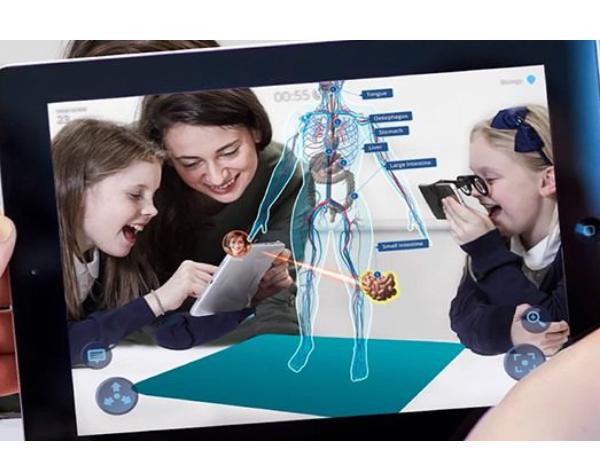
Eon Reality specializes in what is known as “extended reality,” or XR, which lets people use electronic devices to visualize objects ranging from the parts of the human heart to component pieces of jet engines with full three-dimensional effect.
XR is essentially the combination of virtual reality and augmented reality.
The company says it has created “the world’s leading XR library for education and industry,” with over 2.1 million 3D assets as of March. Its software supports a variety of devices, from mobile phones to head-mounted displays to large-scale screens and facilities.
“We have more than 400 academic institutions around the world” as partners, Eon Reality founder, CEO and Chairman Dan Lejerskar told the Business Journal last year.
Education partners and users span the globe, and include Los Angeles City College, Mississippi Gulf Coast Community College, Mohawk College in Canada, New Mexico State University, Central University of Technology in South Africa and Nanyang Technological University in Singapore.
“We usually charge per user/per month—$36 per user per month for students and $55 per user per month for teachers and administrators,” Lejerskar said last year, when discussing fees for educational institutions.
The company has pivoted in the past two or three years more toward education, while retaining a full roster of business clients, Lejerskar said at the time.
Lejerskar last year said the company has been consistently profitable.
The CEO, who will remain in charge of the public company after the reverse merger is completed, said his goal with the company is to “democratize extended reality, not to make it special.”
SPAC Returns
The Arogo SPAC, when it went public late last year at $10 a share, said it was looking to combine with a “business focusing on operations or prospective operations in electric vehicles (EV) technology, smart mobility or sustainable transportation and related business ecosystem in Asia Pacific, primarily South East Asia.”
Eon Reality counts numerous locations in Asia, and says Singapore and Irvine are its biggest offices.
The Irvine headquarters and North American regional headquarters office, where some 35 people work, “specializes in product development and marketing, as well as providing sales and technical support for our global offices,” the company says.
Arogo’s stock was up slightly after news of the business combination was announced, trading around $10.20 as of late last week.
Many larger OC-based companies that have gone public via the SPAC route the past two years—a group that includes Indie Semiconductor Inc. (Nasdaq: INDI), retail marketing firm Advantage Solutions Inc. (Nasdaq: ADV) and the parent company of cannabis-focused software company Weedmaps Inc. (Nasdaq: MAPS)—now trade well below the typical $10 a share price that their SPAC sponsor went public at.
Mixed financial results haven’t kept other private companies from using the SPAC vehicle to get a public listing.
Last month saw the Shanghai-based parent of Irvine luxury knit house St. John Knits International Inc. and other brands announce a planned SPAC deal.
The deal would value St. John’s parent company, Lanvin Group, around $1.5 billion.
