

More than 100 Orange County-based companies demonstrated their newest products last week at the world’s most prominent technology trade event.
OC presenters at Las Vegas’ CES Show, which featured more than 4,500 companies from around the globe, ranged from well-established industry pioneers, including Universal Electronics Inc. (Nasdaq: UEIC) and D-Link Systems Inc., to startups such as Quube and Flint Rehabilitation Devices LLC.
A diverse contingent of local companies like Kingston Technology Inc. and CalAmp Corp. (Nasdaq: CAMP) highlighted their ongoing diversification efforts into new market segments.
Many OC companies opted to hold base camp at the crowded convention center halls, home to a mind-boggling 3 million square feet of exhibition space, while others chose the more private and plush confines of hotel suites and showrooms.
Cutting through the clutter is the name of the game in Sin City, which was expected to draw more than 180,000 visitors from 155 countries to the Jan. 8 to 11 trade show.
5G is Coming
Perhaps no other technology drew more buzz in Las Vegas than the next wave of wireless connectivity, known as 5G, or fifth generation.
Here’s a roundup of some of the more innovative 5G-related product launches from OC companies, as well as other big trends that defined the consumer electronics show and which the Business Journal will be covering over the course of 2019:
• Chipmaker Skyworks Solutions Inc. (Nasdaq: SWKS), whose senior management works out of Irvine, said its SkyOne Ultra line of chips will be used by San Diego-based Inseego Corp. (Nasdaq: INSG) in their next-generation mobile hotspot products.
The integration, paired with Qualcomm Inc.’s LTE X20 modem, is promised to deliver “unprecedented” mobile communication speeds and “highly-reliable connections in dense traffic areas,” according to Ashish Sharma, Inseego’s chief marketing officer and executive vice president of Internet of Things and mobile solutions.
• Fountain Valley-based networking equipment maker D-Link introduced one of the first gateways available for 5G broadband networks. The high-speed 5G NR Enhanced Gateway is billed to enable download speeds more than 40 times faster than the current standard in the U.S.
“5G is going to be big in 2019,” spokesman Shane Remer said during a demonstration at a ballroom in the Venetian Resort Las Vegas. “People will be able to use this to get that service.”
The product, yet to be priced, will be available in the second half of the year.
Internet of Things
• D-Link was also one of several OC companies that showcased smart home products and services at CES. Notable devices introduced by the company included new indoor and outdoor “smart plugs,” along with a battery Wi-Fi Water Sensor. A smart plug enables users to remotely monitor and control devices like lights and thermostats. A water sensor, about the size of a finger, is placed near a water source such as a water heater or kitchen sink to alert homeowners via a siren or an application if a leak is occurring.
The North American unit’s Taiwan-based parent, D-Link Corp., generates about $1 billion in annual sales.
• Santa Ana-based Universal Electronics, the world’s largest universal control maker with 2017 sales of $695 million, continued its push to bridge the entertainment system into the connected home.
The company launched two kits featuring various safety and security sensors, including smart thermostats, developed by its Ecolink and RCS brands.
They are powered by Universal Electronics’ proprietary, voice-activated Nevo Butler smart hub, which includes a built-in digital assistant, akin to Amazon’s Alexa.
“Everything is merging together,” Universal Electronics spokesperson Benny Canady said during a demonstration at the company’s 2,500-square-foot space on the showroom floor of the Sands Expo and Convention Center. “The only way to make this all work together is to make it all talk to each other.”
• Irvine-based startups Quube and Flint Rehab got a jump on the competition, opting to showcase their technology at Pepcom’s Digital Experience at the Mirage Hotel, an annual event for media that precedes the official kickoff of CES.
Quube, launched a few months ago by former Westinghouse Digital Chief Executive Richard Houng and longtime tech veteran Ray Roque, showcased hardware that allows devices to speak to each other directly, bypassing the server.
“Imagine all your IoT devices at home can be meshed into one network,” Houng said. “We’re trying to create a product where there is actually a need.”
Flint Rehab, which aims to make stroke and spinal cord injury recovery as easy and motivating as possible, made the same case.
Established in 2011 by University of California-Irvine doctoral grads Nizan Friedman and Dan Zondervan, the company introduced the first commercially available, wearable activity tracker specifically designed for stroke survivors.
MiGo, which tracks upper extremity activity and walking, includes a smartphone app that provides motivational support with digital coaching, progressive goal setting, and social networking with other stroke survivors.
Stroke is the leading cause of adult disability, affecting over 7 million in the U.S. alone.
Transportation, Gaming
• Vehicle technology has taken on more prominence at CES the last few years amid the development and adoption of autonomous driving features, such as lane assist and crash avoidance, in the ramp up of fully driverless transportation.
Verizon Connect, which bought Aliso Viejo-based Telogis Inc. in 2016 for about $900 million, introduced wireless, connected-car product that uses Telogis technology with built-in Google Assistant.
Hum by Verizon provides users with vehicle location, diagnostics, emergency roadside assistance, and trip history, among other features.
The Verizon partnership aims “to bring the assistant and the power of voice to make it safer for users to engage and get more information,” said Sampada Telang, Google’s head of assistant distribution for IoT/SmartHome.
• Irvine-based CalAmp, which makes cellular tracking devices for the transportation industry, partnered with Oxnard-based OjO Electric to offer an on-demand scooter sharing service, as well as real-time diagnostics, including location, geo-fencing, mileage, and battery usage.
It also announced a deal with audio vanguard Pioneer Electronics to create rDrive, a service that can monitor teen and senior driving, as well as provide vehicle health diagnostic alerts, business or personal drive logs, and vehicle theft recovery built on similar technology developed by its LoJack brand.
“We’re basically the telematics behind the scenes,” CalAmp Chief Executive Michael Burdiek told the Business Journal in a private meeting at a 29th floor suite at the Venetian.
• One floor above, Kingston and its HyperX gaming unit touted new product releases in a pair of facing suites.
Kingston, OC’s largest consumer electronics maker with estimated revenue of $6.7 billion last year, introduced its new lines of consumer and enterprise solid state drives, which use chips to store and transfer data. The demonstrations included an 8K video editing station to highlight the company’s emerging presence in Hollywood.
“This is the kind of thing we’re trying to introduce,” to the industry, Kingston spokesperson David Leong told the Business Journal.
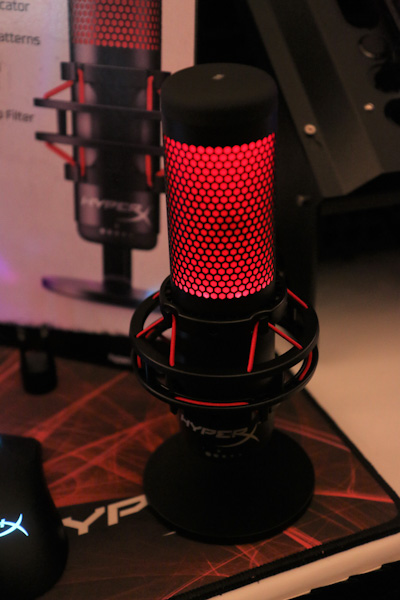
In the other suite, HyperX—whose gaming peripherals, like headsets and microphones, are heavily used in the esports industry (see separate story, front page)—debuted two firsts: the HyperX Quadcast Standalone Microphone designed for PC, PlayStation4, and Mac streamers; and the HyperX Cloud Orbit and Cloud Orbit S Gaming headsets powered by patented mini-speakers developed by Santa Ana-based high-end headset maker Audeze LLC and 3D audio technology from Tel Aviv-based Waves Audio Ltd.
“It’s basically bringing gaming to the edge of the audiophile sound,” said Mark Tekunoff, HyperX corporate public relations manager.
