

A slew of U.S. patents issued over the last 10 weeks to Disney Enterprises Inc. give expression to experiences planned for Star Wars: Galaxy’s Edge, the new 14-acre “land” at Disneyland Resort that Walt Disney Co. plans to open by next summer.
The patents also reveal ever-developing aspects of virtual reality, augmented reality, mixed reality and immersive interactivity in entertainment offerings.
Burbank-based Disney owns the resort and Disney Enterprises, which manages intellectual property for the parent company.
Specific opening dates for Galaxy’s Edge haven’t been announced, but Walt Disney Co. has said Anaheim’s iteration of the new attraction will hit in time for 2019’s high season locally, with a second installation scheduled for Walt Disney World near Orlando closer to fall.
That puts the debut date here likely less than 12 months out—and counting down—with an announcement sooner.
What Disney has planned for those who flock to a faraway galaxy brought near also touches other industries. The global entertainment giant drives development of the technologies, even as it stands on the shoulders of bigs that have come before.
Voyagers
Knott’s Berry Farm in Buena Park, for instance, made waves and upped the immersive interactive experience ante with steampunk-themed nautical attraction Voyage to the Iron Reef, which set sail in the summer of 2015. The ride—a gaming adventure involving pursuit and destruction of mythical monsters—was designed by global attractions maker Triotech Amusement Inc. in Montreal, and, at the time jumped ahead of kid-focused county-fair fare by Disney, like Toy Story Midway Mania and a renovated Soarin’ ride, both at Disney California Adventure Park.
That was three years ago—equal to at least two eternities in the virtual-augmented-immersive galaxies to come.
“Everyone’s waiting to see what’s going to happen next,” says Jeff Cole, senior creative producer at Idea Hall, a branding, advertising and PR firm in Costa Mesa. He oversees client videos, which can integrate VR, AR and other emerging technologies.
Virtual reality simulates the sense of being somewhere else, actual or imagined—courtside at an NBA game or fighting fictional battles in space; augmented reality overlays imagined material on the actual world—as in the “Pokémon Go” game; a mixed-reality experience is a hybrid of the two.
“Group settings”—amusement parks drawing tens of millions of visitors annually, let’s say—are big in consumer applications just now, Cole says—consider a group of friends or family guffawing over a shared event involving a downloaded app—and AR appears to be outstripping VR because the former needs only your smartphone to work.
An Amazon app lets shoppers use AR to “see” a product in their homes before buying; a car-buying app by Santa Monica-based Edmunds.com can “put” the vehicle in your driveway before purchase.
As for what’s next, “Most people (at the time) didn’t see the implications of what ‘Pokémon Go’ can do,” Cole says.
Patents Impending
Results of the work include reticence by companies—Disneyland Resort and a local new-media content developer involved in the work declined to comment on Galaxy’s Edge—regular rolling revisions of the technology, and added fun for park patrons.
Disney Enterprises was issued 44 patents by the U.S. Patent and Trademark Office between May 1 and July 10.
Not all necessarily relate to Galaxy’s Edge; a spokesperson, who declined to comment further, said some might never be directly used.
One patent is for “providing immersive game feedback using haptic effects.” Haptic involves perception of touch, as in a vibrating cellphone. Patent paperwork describes a process that could mimic one being shot or stabbed.
Another, issued 13 days ago, is for “systems and methods for tracking subjects within a three-dimensional physical environment”—people walking around.
Three others relate to production and playback of “immersive stereographic video” that can include “virtual reality, augmented reality or both;” the “focus control” for “virtual objects” on AR and VR displays; and “maintaining the perspective of the user” during an AR experience.
“The user experience defines the success and adoption” of the technologies, Cole says.
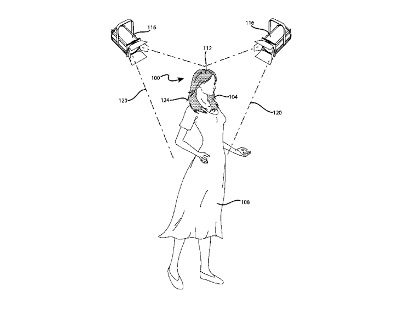
Additional recent patents are for a photochromic wig—hair that changes colors or shades when exposed to lighting of specific frequencies or intensities—and designs for a goggle-like headset, like those used in VR experiences, and a shield that looks a lot like it belongs to Captain America.
Change, Up
The company’s intellectual property activity over the last three years—493 patents since August 2015, when it announced the Star Wars-themed lands for both parks, including 106 year-to-date through last week—has been part of a steady upgrade of the entertainment technologies involved.
Media coverage of the June opening of Toy Story Land at Disney’s Hollywood Studios park in Florida included Walt Disney Imagineering Executive Scott Mallwitz’ comments that Galaxy’s Edge will be “completely immersive [on a] massive … scale,” emphasizing “exploration and self-direction” where patrons are the center of stories.
A second Imagineering executive told a trade magazine last year—when Disney opened the Avatar-themed Pandora at its Animal Kingdom theme park in Florida—that its goal was to move audiences from passivity to participation.
An exec at an OC VR company told the Business Journal at the time that “being able to move around in experiences is the natural end for all of virtual reality.”
Hinted Mint
Other news coverage and company comments, occasional dribbled details on Galaxy’s Edge, and more patents over the last three years presage a brave new world in Anaheim of multisensory experiences and personalized interactions with characters who know your name—and where you just came from and what you just did.
A hint of that came with “Star Wars: Secrets of the Empire”—a joint project of Disney’s Lucasfilm and Utah-based The Void, which installs VR experiences in retail locations; Downtown Disney’s The Void opened in January.
More recently, Disney released an app for park patrons to play trivia and other games that also connects to coming experiences at Galaxy’s Edge (see related story, this page).
Virtual reality and augmented reality are discrete activities. Mixed reality integrates the two or allows for each separately. Haptic technology brings force, vibration and motion into the mix—joining ancient environment-tweaking options, like infusing an area with scents and sounds.
A Wall Street Journal article in April noted in-development products, such as haptic gloves and jackets working to incorporate texture and temperature. For instance, feeling the rough fur of your virtual dog or the warmth of a fire or subzero air in the godforsaken virtual wilderness you’re exploring.
Now add the interactive and immersive elements—people participating in an attraction in a confined space, such as a room or vehicle—and, finally, just for fun, bringing it full circle, back to the VR/AR worlds.
Idea Hall’s Cole says, “There isn’t a cap or limit” on what can come, and “the content is there. People can do this,” that is, create user experiences, as long as there is someplace to put it.
In that sense, Galaxy’s Edge looks to be, well … light-years ahead.
