Irvine-based Aria Group’s plans to move further into the air taxi development market have received a setback from the coronavirus.
Aria, which specializes in production prototypes and low-volume manufacturing, sees huge opportunities for its new division developing airframes and fiber composite components for electrically powered air taxis and cargo transporters.
The company had begun to receive a fair amount of buzz and national media attention in the first part of the year, after it showed off some designs at the Consumer Electronics Show in Las Vegas.
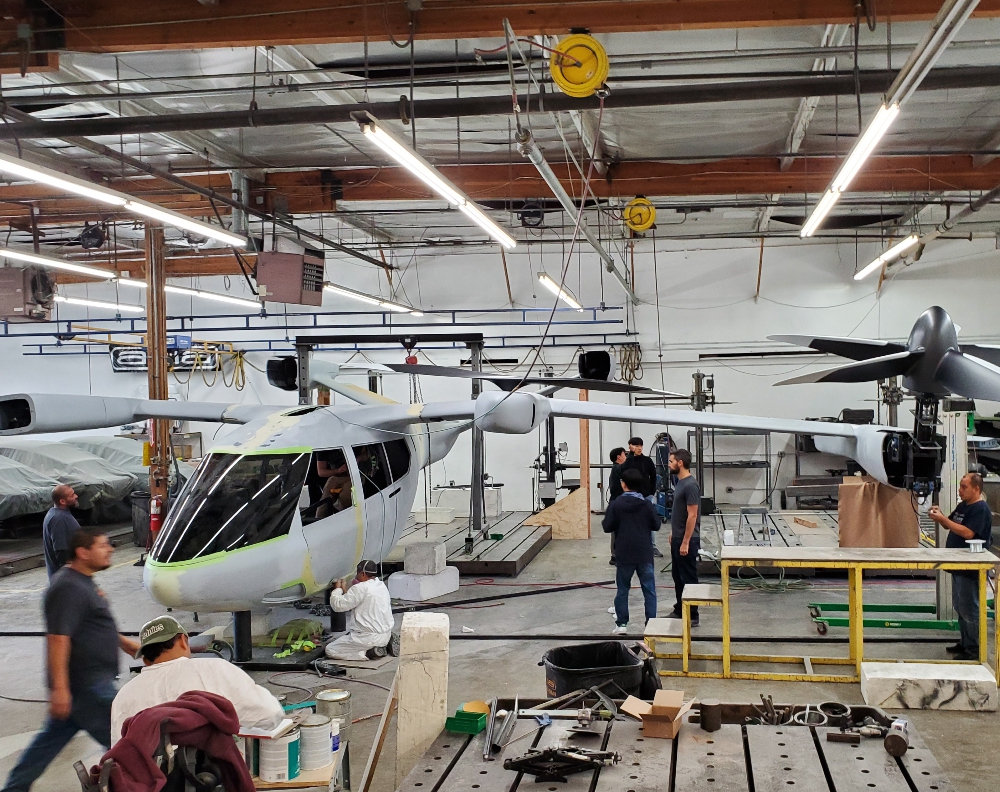
Hyundai Motor and Uber tapped Aria to create the Hyundai Personal Air Vehicle prototype, which was presented at the CES event.
Aria engineered and built the craft’s moving horizontal control surfaces, sequenced lift rotors, articulating vertical-to-horizontal thrust rotors and vehicle lighting.
The future was now—until COVID-19 threw a monkey wrench into the company’s business model.
Chief Executive and majority owner Clive Hawkins said the company is still working and staying in communication with key partner-suppliers during the COVID-19 crisis, but “for sure it’s slowed us down.”
Investment Hunt
“I don’t think it will be a long-term problem,” he told the Business Journal on April 14, but noted there are plenty of short-term difficulties with offices empty and people working less efficiently from home.
The extent of the slowdown isn’t known with “everybody in the same boat,” he said.
The pandemic has also put a crimp in the company’s hunt for new investors.
“A lot of the investor stuff happens in face-to-face meetings so obviously all that is postponed at the moment until we know differently,” according to Hawkins.
Still, the exec believes the future will be bright for the various companies competing for the lucrative future air taxi market.
“The projected volumes are tens of thousands if not hundreds of thousands per year of this type of aircraft,” Hawkins said during a March tour of the company’s roughly 24,000-square-foot headquarters on Daimler Street near John Wayne Airport in March—before the coronavirus wreaked havoc with the world economy.
Karem, Anduril
The company had set up the new unit, named Aria Composite Systems following the unveiling of the Hyundai-Uber project at the CES technology show. ACS is focused on the development and manufacture of composite structures and components mainly aimed at the market for electrically powered vertical-takeoff-and-landing aircraft (eVTOL) and autonomous vehicles.
The latter includes self-driving cars, delivery vehicles and trucks.
“We’re not really trying to develop a whole aircraft ourselves,” Hawkins said. “We’re focusing on helping our customers develop aircraft.”
In fact, Orange County has been witnessing a mini-boom in the development of VTOLs.
That includes Karem Aircraft Inc. of Lake Forest, which has also set up a separate company, Overair, to work with ride-hailing giant Uber on a flying taxi project. Dzyne Technologies of Irvine designs unmanned vehicles and drones, including VTOL-type products.
Also not far from John Wayne Airport, Anduril Industries founder Palmer Luckey said his military-oriented company is heading into VTOL work.
Uber, Aria
About 50 companies are developing civilian air taxis and cargo transporters, and Aria is working with a number of them, according to Hawkins.
Aria has worked with Uber and hopes to be part of the first air taxi slated for liftoff in Dallas in 2023.
“I would say the bulk of it at the moment seems to be focused on the air taxi side,” Hawkins said of future business. “That’s where we see the biggest growth.”
He said the vehicles predominantly are electric-powered.
He cited industry analyst estimates that the number of “air taxi type vehicles” that will be needed is in the 400,000 range.
ACS is “focused on supplying the composite components and airframes to hopefully all of these 50-plus manufacturers,” according to Hawkins.
“The material sides will be for carbon fiber primarily and other composite materials to be the main components for the structure of the aircraft— the same thing that Boeing uses for 737s and Wilson uses for tennis rackets,” according to the CEO.
Carbon fiber is a strong, lightweight synthetic fiber, and is the key material for lightweight structures in the aerospace industry.
4 Passengers
The general idea is for four passengers and a pilot in the air taxis, which hopefully would relieve congestion on crowded city streets. The ultimate goal is for pilotless vehicles.
The air taxis will be required to operate within strict noise limits, while regulators are working on rules to prevent chaos in the skies with all air taxis whizzing around.
Aria CEO Hawkins said the headquarters will stay in Irvine while the expanded composite manufacturing business most likely will be outside California.
The company plans to add employees to its current headcount of nearly 100, assuming a return to normal operations in a relatively short time.
Aria has already produced complex projects for a number of brands including Honda, Toyota, Tesla, Ford, GM, Paramount, and Northrop Grumman, according to the company’s website.