
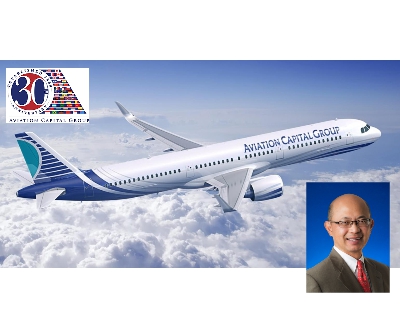
Aviation Capital Group gets little attention as the relatively quiet affiliate of the giant insurance company Pacific Life Insurance Co.
That’s about to change.
PacLife last week said it would sell its 75.5% stake in the Newport Beach-based unit, often known as ACG, to minority partner Tokyo Century Corp. for almost $3 billion.
The deal is expected to close in the fourth quarter. Tokyo Century currently owns 24.5% of ACG, which reported its total equity at $3.6 billion as of June 30.
The unit was exploring an IPO in 2016, but decided this sale was a better alternative for growth capital.
“The public market to date is still not valuing our industry and therefore our company is at the right valuation levels,” ACG Chief Executive Khanh T. Tran told the Business Journal.
ACG is one of the world’s 10 biggest aircraft leasing companies with a portfolio of about 500 aircraft that are owned, managed, and on order and leased to 100 customers in 50 countries.
The goal of Tran is to become a “teenager” with a portfolio valued at least $13 billion in assets by the end of next year.
“Growth prospects in the long run are very attractive,” Tran said. “Like Northwestern Mutual, we are the quiet company in that many in Orange County business do not know about.”
Buy Plane, Not Bond
Tran, a native of Vietnam, became familiar with the aviation industry in the 1980s when he worked for Flying Tiger Line Inc., the then-world’s largest global air freight company.
He joined PacLife in 1990, rising from treasurer to chief financial officer in 1996 and then president in 2012. He won the Business Journal’s Chief Financial Officer of the Year in 2011 (ACG’s current CFO Madhu Vijay won the Business Journal CFO of the Year award in 2016).
Aviation Capital, which began in 1989, first received a $5 million convertible debt investment from PacLife in 1996. Tran, who initiated the deal, liked the business because instead of buying bonds issued by the airlines, Aviation Capital could buy the airplanes and then lease them to the airlines.
“I said let’s own the aircraft because if the airlines fail, we own the assets and [can] lease them out,” Tran said.
“When you’re a lender to an airline that goes into bankruptcy, it takes years to get some resolution. If you’re a lessor, you can get your aircraft back in much quicker, generally in 60 days.”
PacLife, Orange County’s largest private company by revenue, continued to boost its equity stake until 2005 when ACG became a a wholly owned subsidiary.
Single Aisle Fan
Boeing Co. and Airbus SE, the two dominant plane manufacturers, sell about 55% of their planes directly to airlines. The other 45% are sold to the leasing industry, which is dominated by GE Capital Aviation Services and AerCap Holdings.
ACG negotiates with not only Boeing and Airbus, but also the manufacturers of major products like the engines and seats.
About 90% of ACG’s aircraft are single-aisle narrow body B737s and A320s because these are more liquid with a much larger lessee base and less costly to transition between leases.
“The interior for a wide body can cost 10 to 15 times more than a single aisle,” Tran said. “In down markets, the larger airplanes tend to get parked sooner than the smaller airplane. That makes it more tradeable.”
The theoretical life of a jet is 25 years.
“But most operators replace them much sooner—that creates a huge opportunity in this business,” Tran said, noting the average age of ACG aircraft is 5.3 years old.
“We sell because there’s an opportunity to monetize future gains. Our operating strategy is unique.”
“Most startups will lease because they don’t have the cash,” Tran said. “As they progress, they’ll want to own some because it gives them a balance sheet, a rating and hence the ability to borrow.”
Leasing gives airlines operational flexibility and to date ACG is the only aviation leasing company that can offer a financing program for airlines to buy the aircraft versus leasing it, according to the company.
China holds the most aircraft leased by ACG—$1.4 billion, or 15%—followed by the U.S., 10%; Indonesia, 7%; and Vietnam, 5%. ACG also leases aircraft to airlines based in Russia, Argentina and Israel, among other places.
Its top customers, representing 5% each, include American Airlines and LOT Polish Airlines.
Aviation or Life Insurance
Last year, Pacific Life’s revenue climbed 13% to $10.7 billion, and it reported operating income of $1 billion.
While ACG provided almost 10% of PacLife’s revenue, $1.1 billion, the unit generated $265 million in operating income, or about 25% of the insurance company’s profit.
ACG’s revenue is accelerating, soaring 18% to $558 million in the first half of this year from the same period a year ago.
The company’s two-year revenue growth of nearly 9% between 2016 and 2018 doesn’t qualify it for this week’s fastest-growing private company list, which ranks firms solely by the percentage gains in sales over a two-year period (see Special Report, beginning page 27).
By gross revenue growth, however, its nearly $85 million jump over the prior two years would eclipse all but seven companies on this week’s collection of lists.
The aviation unit is growing faster than the life insurance unit, which created a problem among rating agencies that questioned whether PacLife would one day morph into an aviation company with a life insurance business attached to it.
The ratings agencies would “look at our business and mistakenly associate it with the failure of airlines,” Tran said. “They don’t want ACG to get too big because then PacLife would have too much risk in aviation.”
PacLife considered an IPO for ACG in 2016, when Tran became CEO. It eventually decided to accept capital from Tokyo Century, which first invested in the business in 2017.
Bright Future
Tran said he and his management team will continue at the unit.
“Tokyo Century has been very happy with the business strategy of the company and the management,” Tran said.
ACG plans to remain in Orange County and will most likely expand its 115-person workforce by about 10% to 15% in the coming year as it hires personnel to do the work previously done by PacLife employees such as technology, human resources, and internal audits.
Tran said aviation has a bright future, noting newer airlines are forming to service smaller markets.
He pointed out that air travel is not only less expensive, but many developing countries don’t have road infrastructure and countries like Indonesia are islands. Also, the income of citizens in these countries are rising. “As economic advances happen in every country, you get more people who can afford to travel, maybe for the first time,” he said. “It’s not easy to get from Point A to Point B by trains, boats or cars. Air travel becomes more attractive.”
ACG has come a long way since 1996 when Tran orchestrated PacLife’s $5 million convertible debt investment.
“The investment has been more than a home run,” he said.
737 for Sale or Lease, Cheap!
If you think paying about $70 million for the latest Gulfstream 650—often cited as the best private jet on the market—is too much, Khanh T. Tran has a great deal for you.
“Just give me the word and I can get a used 737 or 320 for much cheaper,” he said.
“We can take an older 737 or 320 that we have in our fleet, reequip it and put it into service for under $5 million.”
The 737 Max Will Fly Again
ACG has seven Boeing 737 Max planes on lease to four airlines with another 97 on order.
Khanh T. Tran is confident Boeing will fix the widely reported problems that caused two planes to crash in the past year. He said the issue isn’t technologically significant and Boeing will just need to modify its technology and provide pilots with better training.
Plus, the world needs the plane because capacity will be greatly reduced if the 737 Max doesn’t fly again.
“We fundamentally believe the Max will fly again,” Tran said.