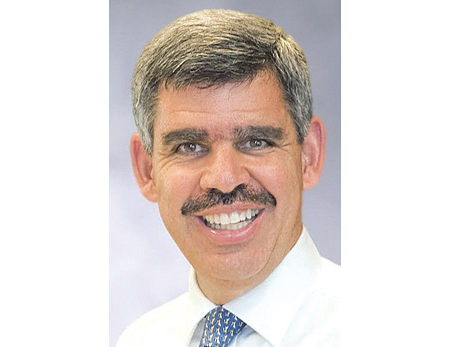
Mohamed El-Erian can remember the first day he fell in love with Orange County.
“Orange County had me at hello,” he quipped during a recent phone interview.
It was late 1998 when he walked across the street from Newport Beach-based Pacific Investment Management Co., which was interviewing him for a job, to Fashion Island.
“I had never been in an outside mall—it was very strange to me,” he recalled. “Then I realized you could have an outside mall because the weather allows it. I thought Orange County is really different.”
A lot has changed for El-Erian in those 20 years. After a 20-month stint running Harvard’s endowment, El-Erian returned to PIMCO in 2007 to become chief executive and co-chief investment officer alongside legendary bond king Bill Gross. The two guided PIMCO through the 2008 financial crisis, and the firm’s assets under management doubled to $2 trillion by 2013.
El-Erian became a world-renowned economist, penning sayings like “The New Normal” to describe a period of slow growth. He wrote books such as “When Markets Collide,” which won the Financial Times/Goldman Sachs 2008 Business Book of the Year and was named one of the best business books of all time by the U.K.’s Independent.
El-Erian, who turns 60 this year, declined to comment on a Wall Street Journal report saying he’s a candidate for vice chairman of the Federal Reserve.
Born in New York to a French mother and an Egyptian father who was a diplomat, El-Erian grew up in a variety of places, including his parents’ native countries. He’s still a die-hard New York Jets fan and can name the starting lineup of the 1969 World Series champion Mets.
He left PIMCO in 2014 but maintains an office in Newport Beach and resides in Laguna Beach. He spends his time as chief economic adviser to PIMCO parent Allianz SE, and writing articles for Bloomberg News and the Financial Times.
He also volunteers for nonprofit groups. As such, he will be the featured speaker along with FivePoint Communities Inc. Chief Executive Emile Haddad at the Orange County School of the Arts’ inaugural Creators & Innovators Speaker Series event, “OC Meets the Global Economy,” at 7 a.m. on Tuesday at the Center for the Arts in Santa Ana. Business Journal Publisher Richard Reisman is the moderator.
What follows is an edited excerpt of an interview El-Erian gave to Business Journal Editor Pete Weitzner and Financial Editor Peter J. Brennan:
What’s your take on the economy?
This is an important and favorable moment for the U.S. economy because things are coming together. The economy is responding well to deregulation, to the likelihood of a growth impetus from the tax bill, and to the possibility of an infrastructure initiative.
Second, we are getting an important tailwind from the synchronized pickup in global growth, with Europe, Germany in particular, leading the way. We’ll see a pickup in investment and consumption. It’s not just about companies. It’s about households, as well. The challenge will be to make this short-term pickup in growth a longer term one.
What’s your current investment allocation?
A year ago, I became much more bullish about the equity markets for three reasons. I realized we were in a special period where things would get aligned. There were very supportive equity conditions as companies put money back into the market through share buybacks and dividends and the European Bank and Bank of Japan continued to inject considerable liquidity every month.
Second, I thought there were good prospects for global growth.
Third, I realized that the markets would embrace the Trump administration pursuit of pro-growth policies, particularly deregulation, tax reform and infrastructure.
I boosted my allocations to equities. I became one of these people who bought on dips.
The cautionary note is we start with elevated asset prices, and we have borrowed from the future. The higher valuations go, the greater the probabilities of a correction.
I didn’t participate in bitcoins. The underlying blockchain technology is genuine and consequential. We are going to see it used by the private and public sectors. The assumption that bitcoin will become the new currency is exaggerated. But I stress that I have been wrong.
Where do you get your information?
I read a lot, everything from you guys to the Wall Street Journal to the Financial Times to a lot of research notes to academic papers.
What’s your favorite metric?
If you put me on a desert island and ask me to predict what would happen and gave me only one metric, it would be wage growth.
It’s important for economic reasons because household consumption supports a strong economy. It’s important for political reasons because, despite how well Wall Street has done, there’s still a lot of anger.
What are you studying nowadays?
How tech people are looking at established industries is fascinating. I can give you example after example—Uber, Airbnb, fintech.
I’m spending a lot of time looking at the perspectives of people who combine three things: artificial intelligence, big data and mobility. They are disrupting sector after sector in a meaningful way. They just think differently.
I would encourage established industries to look beyond their own radar screens. Hilton thought it understood really well the competitive model. Airbnb never appeared on Hilton’s competitive radar screen.
LinkedIn named your blog one of the website’s top influencers. Were you surprised, and what’s been the secret to your success?
I was surprised. I was a late adopter to social media; I was very hesitant to do so. When I left PIMCO, I was no longer surrounded by really smart people 24/7.
I wasn’t getting as much interaction as I was used to, so someone encouraged me to use social media as a way of learning and soliciting comments on my own thoughts. That person said think of social media as a community. You give and take. If you want to be successful, you not only get informed by others, you inform them. When I come across an interesting idea, article or chart, I will put it out there. Similarly, other people do that, so I’m part of a community that shares various insights. I will share articles I don’t agree with, but I think it’s important that people know that view is out there.
One thing that was hugely influential on me is when I was 13, my father encouraged me to read four newspapers a day. I said to him, ‘Dad, why four newspapers? Four is such a waste of money. We might as well read one. All the news is the same.’
He said, ‘No, the same news can be interpreted in different ways. Unless you understand how different people see the same bit of news, you won’t be able to understand how society evolves.’
That’s the principle I carried forward in my life. You do need to see different views.
What’s the future of Orange County in efforts to become like Silicon Valley?
On a stand-alone basis, Orange County has unique advantages. My main issue is we remain a secret on a whole range of things.
We’re torn. On the one hand, we like being a secret because we don’t want to be overwhelmed. On the other hand, we suffer from being a secret.
How would you promote Orange County?
It should be targeted. Decide what your edge is—we do have a few of them—and go after influencers and market players.
Why has PIMCO done so well, though it’s not based in the world’s major financial capitals?
There are a lot of advantages of having the headquarters in Newport Beach. First, you’re away from the herd. You don’t get influenced as much by herd behavior. That’s particularly important in financial markets.
Second, once you convince people to move out here, they love it. Retention becomes an advantage.
Three, you can run a global network out of Newport Beach really well. California is a really good time zone because in the morning you catch Europe, and in the evening you catch Asia.
PIMCO employees are famous for waking up early to track markets. Have you changed?
I still get up between 4 and 5 a.m. I used to get up at 2:45 a.m., so I’m sleeping in.
I continue to get up very early in the morning, even though I don’t need to, because I really value those morning hours. If you talk to other former PIMCO colleagues, many have retained the get-up-early routine because it gives you this very special moment in the morning to get a lot of things done.
What do you like about Orange County?
It’s a great lifestyle. You don’t have to wear a coat. Second, there are a lot of things to do once you understand Orange County. I like the whole range of opportunities, from the Segerstrom Center to outdoor stuff. Here in Laguna Beach, I can take my dog for a walk on the beach, in the canyons or in the city.
Third, it’s wonderful for families. It’s a great place to bring up kids. You can spend a lot of time doing outdoor stuff.
The hassle, cost of doing something is much lower than on the East Coast. Once you convince people to come out, they fall in love with the place. I saw this repeatedly at PIMCO when we initially would have enormous difficulties attracting people from New York. Once they would come out, they’d spend a few months here, and they realize it’s a great place to be.
I do wish we had more think tanks.
I could, and maybe I will, move somewhere else, but I must tell you living here is great.