

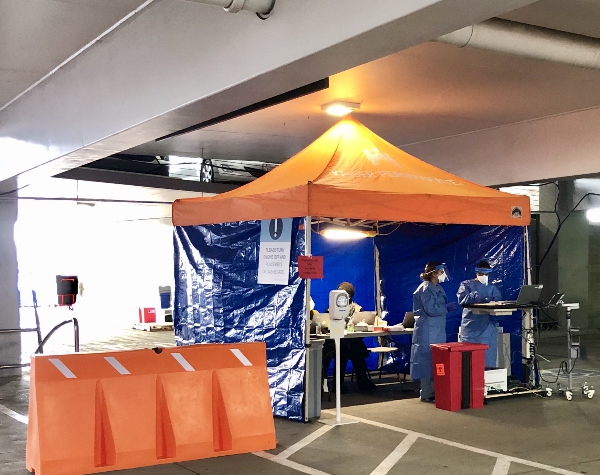
Orange County’s healthcare sector and the area’s vast medical-focused technology community are racing the clock to develop COVID-19 tests and other products to detect, monitor, and perhaps create a vaccine to fight off the coronavirus.
The participants range from a molecular diagnostic firm backed by a local tech billionaire, to large area medical centers, to upstart software companies. They include well-funded local units of large national businesses, as well as venture capital-seeking startup firms.
The following is an overview of several of those firms, labs and clinicians on the front line.
FLUXERGY LLC
FOCUS: ONE-HOUR TEST
Irvine’s Fluxergy LLC, a developer of innovative “point-of-care” medical diagnostics systems backed by one of OC’s top technology executives, is working with the University of California-San Diego to develop a one-hour COVID-19 diagnostic test.
It began as a 90-sample validation test at UCSD on March 18 and expects to have results soon.
The company is simultaneously working to gain Emergency Use Authorization approval from the FDA.
Fluxergy estimates that it could manufacture up to 15,000 test cards and 100 Fluxergy analyzer devices a month, ramping up to 100,000 test cards and 250 devices per month within 90 days, company officials said.
The analyzer device is about the size of a small desktop personal computer, and could be used at a patient’s bedside.
UCSD studies follow successful bench lab testing, which showed the company’s point-of-care diagnostic device to “consistently and accurately confirm in one hour the presence or absence” of coronavirus.
Unlike other testing methods, Fluxergy’s device does not require coronavirus samples to be purified before the test can be performed; samples are placed directly on a disposable Fluxergy test card, which uses printed circuit board technology and microfluidics to automate various sample processing steps.
The company’s backers know their circuit boards.
Fluxergy is principally funded by John Tu, co-founder and CEO of Fountain Valley-based Kingston Technology Corp., the world’s largest maker of memory modules and storage systems. His son, Jonathan Tu, is chief financial officer at Fluxergy.
Fluxergy’s point-of-care device can be used at the emergency room or a community center, eliminating the need for central laboratory work, the company said.
Test samples would be obtained by nasal or mouth swab, mixed with a buffer, put on a test card and tested. The company doesn’t have to ship samples to a lab, improving response times, it said.
UCI HEALTH
FOCUS: DRUG THERAPY
UCI Health officials said last week they have launched a therapeutic clinical trial for COVID-19.
Clinicians are testing the efficacy of the antiviral drug remdesivir as a potential therapy for COVID-19.
UCI, along with University of California-San Diego and University of California-Davis, are designated sites for the first NIAID-sponsored remdesivir clinical trials in California.
Dr. Alpesh Amin, chairman of the UCI Department of Medicine and executive director of the UCI Health Hospitalist Program, and infectious disease specialist Lanny Hsieh, MD, are principal investigators at UCI and will oversee the randomized, placebo-controlled trial.
The drug, developed by Gilead Sciences Inc., has shown promise in animal models for treating respiratory syndromes caused by other coronaviruses, according to UCI.
“It is important to know that this is for hospitalized patients with severe symptoms,” UCI said.
For more information about the trial, the public can go to ClinicalTrials.gov and search identifier NCT04280705.
DIASORIN MOLECULAR LLC
FOCUS: ONE-HOUR TEST
Cypress-based DiaSorin Molecular LLC, a molecular diagnostics company and subsidiary of Italy’s DiaSorin SpA, said it has developed a one-hour diagnostic COVID-19 test, and has received nearly $700,000 from the Biomedical Advanced Research and Development Authority to further its development.
On March 20, it said it received Emergency Use Authorization from the FDA. DiaSorin expects its product to be CE marked by the end of the month.
The test is designed for use on any of the company’s Liasion MDX instruments, which are currently in some 800 hospital laboratories around the U.S. and Europe.
It said its test can be utilized by hospital laboratories without the need to send the sample out, “allowing for timely testing and results.”
Only “one instrument and one reagent are required to perform the test.” It bypasses the need for traditional extraction procedures, enabling rapid detection in a little over an hour, the company said.
The company hopes “to help reduce the current shortage of tests being experienced by hospitals worldwide” said DiaSorin President John Gerace. “This test will better enable clinicians to make appropriate diagnostic decisions by providing rapid and accurate results. We know it will play a critical role in containing the pandemic.”
AVELLINO LABS
FOCUS: GENETIC-BASED TEST
Avellino Labs, a Menlo Park-based biotech with executive ties to OC, changed its corporate focus in a matter of weeks to address COVID-19.
The early results: it created a new type of coronavirus diagnostic test and helped set up a first-of-its-kind testing center last week in the Bay Area city of Hayward.
The Hayward tests were free, can test up to 370 people daily, and will be open every day for three weeks, local reports said. Company offices plan to continue to focus on California communities, emphasizing first responders and essential services personnel.
Longtime OC ophthalmologic executive Jim Mazzo joined the board of Avellino two years ago; he also serves on its CEO committee. The company has been expected to go public this year on Korea’s stock exchange.
The newly developed test uses Avellino’s existing genetic diagnostics technology to help clinicians diagnose COVID-19 by identifying and isolating the genetic markers as part of the virus’ genetic sequence previously identified by the CDC, according to reports.
Avellino had been focused on gene-based diagnostics, data and therapy to treat eye disorders and other related diseases.
“When this terrible virus hit, the team realized we had a test capable of identifying the disease in a quick, and extremely eloquent manner,” Mazzo told the Business Journal last week.
That meant suspending eye care operations and shifting the company’s entire lab resources towards coronavirus testing.
“I’m extremely proud of the Avellino team,” Mazzo said.
VIVERA PHARMACEUTICALS INC.
FOCUS: 20-MINUTE TEST
Newport Beach-based Vivera Pharmaceuticals Inc. is working with German manufacturer Pharmact to produce COVID-19 test kits that can provide results within 20 minutes.
The technology uses a lateral flow rapid test strip which is similar to the finger prick test a diabetes patient uses to check their blood sugar. Instead of detecting blood sugar, however, the strip can detect COVID-19 antibodies.
“These kits are designed for rapid in the field testing,” said Dr. Stephen McColgan, Vivera’s chief medical officer. “When you have thousands of potential patients, you do not have time to wait for labs that can only process a few hundred test results a day. Infection phasing is important to adequately triage patients immediately.”
The product is not yet FDA approved; the company said on March 20 it had submitted an Emergency Use Authorization application to the FDA.
Vivera said it was granted exclusive rights to market and distribute its antibody test for the coronavirus in the U.S.
“We are confident that our point-of-care tests will be critical to help tackle what could be a global pandemic,” Pharmact Chief Executive Eric Schaber said.
McColgan told the Business Journal that “this isn’t our test, it’s from Germany, and we’ve been talking to [Pharmact] for a few years,” regarding other lateral flow assay tests.
During the beginning of the outbreak in China, Pharmact was quick to act. “They have done work in Wuhan with the Gates Foundation—it was developed in the epicenter of this crisis,” McColgan said.
Vivera has recently expanded by acquiring Malibu-based Soba rehab facilities for opioid treatment, which is an adjunct to its CBD-based pharmaceutical trials to treat chronic pain and curb addiction.
McColgan said that Vivera is a biopharmaceutical company that makes diagnostics, so designing a COVID-19 test “just happened to be one of the wheelhouse we know.”
The tests currently retail for just under $100.
BIOMERICA INC.
FOCUS: 10-MINUTE TEST
Irvine’s Biomerica Inc., which manufactures diagnostic tests that are used by hospitals, clinical laboratories, physician’s offices, and consumers, said it has begun shipping samples of its coronavirus test to the Middle East, Europe and other countries and health ministries that have requested them.
It did not comment on the possibility of U.S. distribution.
The test requires only as much blood as a finger prick and delivers the results after 10 minutes, reports put its retail price at $10 a pop.
The company said it has the ability to ramp up production to “begin fulfilling large international orders,” assuming shipping channels remain open.
According to Biomerica, current polymerase chain reaction tests can only detect if someone has had exposure to the coronavirus and the results are therefore limited.
Biomerica claims its “point-of-care serology test” can detect if a person was recently infected or if someone has never shown or is no longer showing symptoms but is still contagious with the virus.
The company believes that by distinguishing between new cases, asymptomatic and recovered cases, physicians and providers will be better equipped to handle the slurry of cases varying in severity.
When reached for comment, the company—which operates out of a 23,000-square-foot facility along Von Karman Avenue—said the company spokesperson authorized to speak on the matter was unable to be reached.
ZYMO RESEARCH
FOCUS: SELF-ADMINISTERED TEST
and
PANGEA LABORATORY
FOCUS: 24 HOUR LAB RESULTS
Irvine-based Zymo Research is conducting studies to determine whether self-administered coronavirus tests can be accurate—where the risk isn’t with the test, but the person performing it.
It’s working on at-home kits that it hopes to get into the hands of first-responders and companies so that they can test employees, notes a recent report in the Washington Post. The kit contains “a pair of latex gloves, a cotton swab for collecting a sample from the back of the throat and a liquid medium in a plastic tube to preserve the sample.”
It’s working with Costa Mesa’s Pangea Laboratory, which can process results in 24 hours, according to company officials.
Zymo is waiting for FDA approval before going to market. The agency has questioned whether the general public can follow directions for the test.
“There is a substantial public health risk associated with improperly collected specimens because they may lead to false negative results,” the FDA told Zymo, adding that “this risk is significantly higher for specimens collected by a lay user without medical knowledge.”
QUEST DIAGNOSTICS
FOCUS: TESTS FOR CALIFORNIA
New Jersey-based Quest Diagnostics is trying to make the coronavirus test more available to people in California by developing its own in San Juan Capistrano.
At the Nichols Institute off Ortega Highway that links Orange County to the Inland Empire and nestled next to Casper’s Wilderness Park, the company has developed the ability to test 1,200 patients per day as of mid-March.
Quest at the Nichols Institute was the first company to commercialize the coronavirus test in the state. Quest also said last Monday it would open between 6-7 a.m. to give at-risk individuals and those over 60 years old time to come get lab tests done without the concern of exposure to younger populations.
On a companywide basis, Quest said it expects to perform 10,000 tests a day by the end of this week and approximately 20,000 tests a day by the end of March. n
A. Leigh Corbett, Mark Mueller and Jessie Yount contributed to this article.
Other area companies looking to get the word out about their own COVID-19 related products, treatments and services are encouraged to contact the Business Journal.
Octane Alumni Efforts
Medtech and technology-focused business incubator Octane early last week highlighted three alumni of its LaunchPad startup accelerator as companies to watch going forward, in the efforts to combat COVID-19.
• IntelliStem, a biotechnology company based in Toronto that’s focused on cell therapy using stem cell medicine, has acquired the COVID-19 virus and is expected to deliver a vaccine for clinical trials in the next few weeks.
• SMSBiotech, a San Marcos-based biotech firm founded in 2015 that also uses stem cell technologies, has submitted a proposal for treating coronavirus-affected patients to the Biomedical Advanced Research and Development Authority.
• Pandexio, a Hermosa Beach-based IT firm founded in 2012 whose software is used to “empower employee critical thinking,” believes its product can help companies “more efficiently connect and gather the data they need to review critical information to make decisions on the COVID-19 virus,” according to Octane.
Octane said late last week that more than a dozen companies it has been affiliated with over the years are now involved in COVID-19-related work.
