
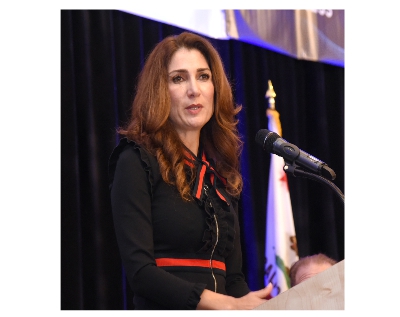
Nazli Azimi knows one thing for sure—if she had stayed in her native Iran and not come to the U.S., she wouldn’t be developing drugs to battle cancer.
Azimi in the 1990s got a student visa and the opportunity to work at the National Institutes of Health in Bethesda, Md.
“The level of postdoctoral training allowed me to come up with the ideas and to have the imagination,” Azimi recalled. “If I had not been at NIH, it would not have happened.”
What happened is Azimi in 2010 began Bioniz Therapeutics, which has raised $28 million to date. The Irvine-based company employs 13, as well as a number of consultants.
She’s convinced medical heavyweights to join her board, including Chairman David Pyott, former chief executive at Allergan Inc., and Joe Kiani, founder and chief executive at Masimo Corp.
Kiani and Pyott have also invested in Bioniz. Pyott called it “an exciting, emerging biotechnology company with a truly novel approach to addressing autoimmune diseases and cancer” at the time he joined the company in 2016.
As of the company’s last big funding round in 2017, Bioniz was reported to have a valuation topping $100 million.
Azimi’s ideas have reached the level of a phase two trial, which is about halfway through the drug testing period and is typically done in three phases with FDA monitoring throughout. If the FDA approves, she might have cancer-fighting drugs available to the public in three years.
For all these reasons, Azimi was named one of five honorees at the Business Journal’s 25th annual Women in Business Awards luncheon on May 8 (see other profiles, pages 4, 6, 8 and 10).
“She went to a university during a time when she was told she couldn’t do anything because she was a woman,” Emilie McMurray, JPMorgan Chase & Co.’s business banking market manager in Orange County, told the audience of 800 at Hotel Irvine when introducing Azimi.
“She’s an immigrant, a scientist, a fundraiser, an innovator, an author, a patent holder and an entrepreneur.
“It’s an incredibly inspiring story.”
Immunology Post-Doc
Azimi earned a doctorate in pharmacy in 1992 from the University of Tehran.
“I always wanted to be a scientist and the best way was to come to the U.S.,” she said.
She completed her postdoctoral immunology program at one of NIH’s premier research groups, where she was directed by Thomas Waldmann, who started at the institute in 1956 and became a pioneer in the field of immune therapy.
She spent a decade as a researcher at the NIH, where she “made seminal contributions to the field of immunology,” according to her company’s website. In 2004, Azimi joined the faculty at the Fred Hutchinson Cancer Research Center, where she studied immune cytokine responses to herpes virus.
A couple of years later, she and her husband, Kevin Sadati, arrived in Orange County where he’s been a practicing plastic surgeon. The pair have two children, ages 10 and 14.
Spelling Test
She decided to start her own pharmaceutical company to discover drugs for immune systems, using what she learned at NIH to develop a novel approach.
It was a tough slog since she knew little about business.
“I didn’t know how to do anything about entrepreneurship. I didn’t even know how to spell it,” she told the audience at the event. “I’ve learned along the way. I was fortunate enough to find people who believed in me.”
The toughest part was learning how to raise money, particularly since it was a couple of years after the 2008 financial crisis, she said afterwards in an interview with the Business Journal.
“Drug development is capital intensive and a lengthy process,” Azimi said. “I had no way of showing that my drug would work. I decided to financially back it myself and then have initial data. After that, I then started raising money.”
The Believers
Among those who believed in her ideas are people with a wealth of industry experience.
Her “scientific co-founder” is Yutaka Tagaya, who worked alongside her at NIH and who has published more than 80 papers. He holds several patents and is on her board of advisers.
Chief Operating Officer Fredrik Wiklund has previously taken two companies public and helped Gilead Sciences Inc. launch its first product in 1996. Chief Medical Officer Paul Frohna has successfully led clinical trials and programs for other companies including Receptos Inc. Sunil Shah handles chemistry, manufacturing and controls, a role he also performed as a senior director at Irvine-based Spectrum Pharmaceuticals Inc.
Besides Pyott and Kiani, other board members include Michael Martin, president of Takeda Ventures Inc., the investment arm of Takeda Pharmaceuticals Co., the largest drug company in Japan; and Graham Cooper, who was most recently chief financial officer at Receptos, which has worked on a promising multiple sclerosis drug.
Receptos was purchased for $7.2 billion by Celgene Corp. in 2015.
She has a board of advisers that include Robert C. Gallo, who became famous in 1984 when he co-discovered HIV as the cause of AIDS.
How was she able to convince these heavyweights to join?
The technology “has a lot of promise in a very large market,” she said. “Think of all the cancers. It’s a tremendous opportunity.”
Through its platform, the company has identified a number of product candidates that address immuno-inflammatory diseases and cancer.
Its drugs are designed to attack cytokines, the multiple proteins that block immune pathways and can lead to serious diseases.
Azimi has authored more than 30 peer-reviewed, scientific publications and holds more than a dozen patents, including the Bioniz intellectual property patent estate.
Azimi said she will continue to raise money until the drugs reach commercialization. Prior reports indicate she will need to raise $300 million in additional funding before a drug can be brought to market.
“I’m grateful to the people who have invested in the company, including our board of directors,” she said. “Without their support, it wouldn’t have been possible.”