

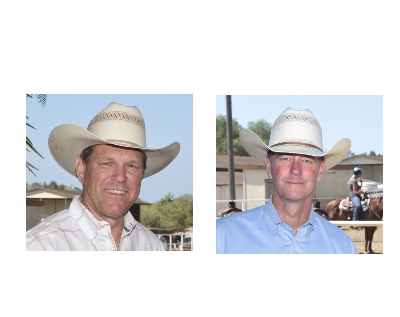
Some claim to be “kind of a big deal,” but a 1,200-pound horse—large as a car, lithe as a cobra, and not sure it likes you—removes all doubt.
Jeff Moore and about 20 others regularly ride such beasts, then add a 500-pound steer for the most focused four seconds of their lives.
OK, that’s a pro-level time in team roping. Moore, OC senior managing director at real estate broker CBRE, said he and his compadres clock in at seven seconds or more, with five-second penalties for infractions like leaving the box—the starting area where riders are horseback on each side of the quarter-ton of beef they’re about to chase—or failing to catch the animal in the arena.
“A good time is between seven and 15 seconds,” Moore said.
He and others mount up twice a week at the Ortega Equestrian Center in San Juan Capistrano to beat that clock. The others include:
• Gregory Dillion, a founding partner of law firm Newmeyer & Dillion in Newport Beach.
• John Frank, owner of a Santa Ana construction company that builds grocery stores.
• Erik Weeks, developer at Integral Communities in Newport Beach.
• Peter Pitchess, owner of packaging industry printer Chromatic Labels in Irvine.
• Charlie Black, a wealth adviser at a private bank.
No Calves
Banish images of sweet veal on the hoof, racing for its life as Black Bart drives the squealing babe into the dust from atop a fire-breathing steed, leaping off, spurs first, to drag the poor creature down by an ear and truss him for money.
This isn’t calf roping, and these guys aren’t extras from “The Wild Bunch.” Horses range from persnickety to mercurial—“quirky in their own way”—and steers and heifers aren’t calves.
“A man can’t take down a 500-pound steer.”
Team roping is catch-and-release. No one dismounts, let alone subdues the large creatures hurtling away from them.
Two riders—a header and a heeler—wait in their boxes behind a barrier on either side of the animal in the chute. At the header’s “ready” signal, the animal is released, and split-seconds later riders move.
The header ropes the animal’s horns and executes a “daily”—looping his rope around the saddle horn. He “turns the steer,” and the heeler ropes its rear legs and does a daily of his own.
The header ends facing the beast, and the work is done.
Balk, bail or blow that rope throw, and you’re finished.
5-Second Rules
Penalties are the least of their worries.
They don’t matter until an event, which follows training, practice and, of course, buying a horse.
“When you’re in the horse business, you’re paying a lot of people,” Moore said: Ortega Equestrian Center for stalls and practice space; veterinarians and farriers—specialists in equine hoof care—and often Matt Steelman of MS Performance Horses LLC in Lake Elsinore for training and to bring cattle to sessions at the center.
A horse can cost $10,000 to $30,000, and Moore figures $1,000 to $2,000 a month to care for it, all in. He said he ignored advice to “never buy something that eats while you’re sleeping.”
Performance horses are for roping and rodeo, and Steelman, 41, has been at it for 25 years, starting out as a teen cleaning stalls on the Irvine Ranch.
He “learned to rope and competed a bit in high school,” then attended Oklahoma Panhandle State University to “put myself in deeper waters”—horse and cattle country—and develop his skills.
He “trains both horse and rider,” and gained experience under J.D. Yates, “a legend” in the industry.
On the Hoof
Steelman raises, trains and sells horses and provides the cattle they help people catch.
Most are steers—neutered males—and heifers—females who haven’t calved.
He leases Mexican Corriente steers from a supplier in Paso Robles, and has had heifers—Corrientes cross-bred with Texas Longhorns—from Hemet.
“A much shorter trip to pick them up.”
Corrientes are used widely in rodeo and known as a “hearty, cooperative breed” with “the best horns.”
Awaiting her turn in the chute at a recent practice session, one heifer stood in line and peed placidly.
Steelman said training runs $500 a month and that Saturday participants pay $75 apiece for a session.
His brother Wes helps with weekend work; his day job is with branding firm Recon Group in Santa Ana.
Their father, Ken, a partner at Irvine law firm Corbett, Steelman & Specter, has been involved in OC roping circles for 40 years.
Outside the Box
Ken told an L.A. Times reporter in 1989 that he’d come to the pastime relatively late in life—after college, combat duty in Vietnam, a stint as a deputy district attorney, and starting to practice law.
Moore has been involved for about four years, “enjoying horses, going on rides,” and joining groups around the state for multiday trips.
One is the fabled El Viaje de Portola—less formally “the Portola Group” of ghost riders who play it close to the vest about an annual three-day, invitation-only ride on Tony Moiso’s Rancho Mission Viejo.
Last week Moore left OC for eight days to ride in the Rancheros Visitadores, a trail ride through Solvang to Mission Santa Inés. He leads California Sierras trail rides and owns a 60-acre Wyoming spread.
Mike Hodges, 55, a senior leasing director at Irvine Co., started team roping about seven years ago. He’d been on the “boxing and jujitsu” recreational jag and came to the arena for “fun and fresh air”—though he’s ended up with something more.
Performance Art
The old joke about owning a boat—the second-happiest day of your life is buying it, the happiest day selling it—is distinct from owning a horse in one respect: Eventually you sell the boat.
“When you buy your first $40 rope, they tell you that’s the most expensive $40 rope you’ll ever buy,” Moore said, because soon enough you’re buying a lot more.
It’s safe to say most team ropers aren’t in it for the money.
There’s the challenge, Moore said, of a “200-pound guy learning to control a 1,200-pound horse,” to which Hodges added, “Someone’s gotta be the boss. You decide, or the horse will.”
An example of that is “scoring” where a rider in the box prevents his steed from taking off after the steer, to train his mount to respond to his control—only.
There’s the “Spin and Marty,” aspect which, like the 1950s Disney TV vehicle, brings the challenge of cooperation between two different riders toward the same goal.
Regular training builds friendships and, naturally, business. While riding, though, riders are all business of a different sort, and “cap rates” only refers to how fast your cowboy hat flies off in pursuit of roping glory.
Ropers also train to compete—though again, not for the cash. Entry fees at local events run $40 to $140; first-prize money might hit four figures—excluding the coveted belt buckle.
Hodges sported one from a 2016 event.
Steelman said major competitions can cost $2,500 to enter, with first-prize cash of $150,000.
Ortega Equestrian Center owner Kathy Holman said equestrian businesses kick $50 million a year into San Juan Capistrano’s economy.
Men of the West
All that riding.
Where are they going?
In “The Lord of the Rings,” a formidable line of humans are the Dúnedain, or “men of the West”—explorers, “taller than other men,” and “skilled in riding and loved horses.”
The West—the American one—is part of the mythos and mystique of what’s happening on Wednesdays and Saturdays in San Juan, only a small part of which can be easily seen from the ground.
You have to get on the horse.
“It takes skill and work and a lot of time to be good and to learn it,” Moore said. “You have to put hours and hours into this.”
Hodges calls encouragement to his fellow caballeros—“Nice and smooth … keep going forward”—and hearkens to a big draw of it all: “These are guys who keep their word.”
The men that day by comment and camaraderie emphasized that “myths” are not—as in popular usage—lies, but the collected stories of a people, the ways and means of a body of believers, and if, as some say, it’s lost, then so are we—and if it can be found, these men will step into the saddle to seek it.
