

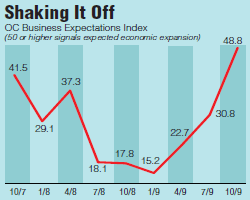
Economic expectations among local executives have jumped to a two-year high for the fourth quarter, according to a survey from California State University, Fullerton.
The Orange County Business Expectations Survey’s index reading is at 48.8 for the new quarter, topping the 30.8 reading it registered at the start of the third quarter.
The uptick, the biggest in at least the past two years, marked the third straight rise since the index hit a low of 15.2 at the start of the first quarter.
Cal State Fullerton economists view the index as a leading indicator of expectations among business owners, managers and chief executives in the county.
“This shows significant improvement,” said Anil Puri, dean of the Mihaylo College of Business and Economics at CSUF. “There’s little doubt we are past deep recession.”
The index reading suggests businesspeople now believe the worst of the recession is behind the county.
But businesspeople still aren’t overly optimistic: A reading of less than 50 indicates expectations of a shrinking economy, which has been the case since the third quarter of 2007.
And respondents remain cautious in their forecasts, according to Puri.
“Some businesses will grow out of this, others will contract,” he said. “People want to be careful not to overbuild.”
Nearly 70% of survey respondents said the overall economy is their most important issue going into the fourth quarter.
Government regulation and the availability of credit tied as distant seconds, each getting 10% responses.
For Tustin-based investment bank Askew Kabala & Co., it’s been a long wait for money to start flowing again since the 2008 meltdown.
“We might not see things get back to normal until the second quarter of next year,” said Ron Askew, the company’s chief executive.
Business Activity
The outlook for overall business activity hit a two-year high in the survey as 73% of respondents said conditions in their industries and the regional economy would at least stay the same, up from 59% for the third quarter.
A near majority of respondents, 45%, said they believed their own industry would remain stable, the same number as for the third quarter.
About a quarter of respondents said they expect to see significant growth in their industries, up from nearly 21% for the third quarter.
Nearly 30% still are looking for a decrease in their industries, down from about 34% for the third quarter.
Ronald Stein, vice president of business development for Irvine-based Principal Technical Services Inc., a staffing company for engineers in the energy industry, was one of the cautious respondents.
“The energy industry is really struggling with no one interested in investing in new projects,” he said. “I’m not much more positive about the overall economy.”
Concern about jobs lingers with little improvement in sentiment.
Most respondents, 63%, said they don’t plan on hiring or laying off workers, little changed from the 61% for the third quarter.
The number planning to hire rose to nearly 15% from about 10% for the third quarter.
Nearly a quarter said they expect to cut jobs, down from about 28% for the third quarter.
Investment banker Askew said he recently hired four people to his team of 14 to handle more business. He said he doesn’t plan to hire any more this year.
A focus on mergers and acquisitions in niche segments has spurred growth, according to Askew.
Sales Outlook
The outlook for sales among respondents got better.
Nearly half, or 48%, see little change in the fourth quarter, compared to 31% for the third quarter.
About 21% are looking for lower sales, down from almost 39%.
And about 30% said sales could improve in the fourth quarter, the same number as a quarter earlier.
An improvement in profits also is expected. Twenty-eight percent said they expect smaller fourth-quarter profits, down from 38% for the third quarter.
“We continue to make a profit but will struggle into next year,” Principal Technical’s Stein said.
Nearly a quarter of respondents expect to see higher profits, unchanged from the third quarter.
And nearly half, 47%, call for no change, up from 37%.
Inventory
Little change was found in inventory expectations, which also suggests some caution.
Nearly two-thirds plan to leave the amount of their stock unchanged, which is little changed from the third quarter’s 65% reading.
The number looking to cut supplies stayed the same at about 21%. Those looking to increase was little changed at about 14%.
About 40% said they thought the local economy was doing better than nationally, up from 33% for the third quarter.
Another 38% thought the county’s economy was doing about as well as the national one, which was similar to the third quarter.
And about a quarter of respondents said it was doing worse, down from nearly 30% a quarter earlier.
As far as economic recovery, nearly half, or 46%, said the local situation will be better than the national one.
“Orange County entered the recession first so hopefully we’ll be first to come out of it,” said Lucy Dunn, chief executive of the Irvine-based Orange County Business Council.
Another 38% thought a local recovery would be slower. Sixteen percent said it would be on par with the rest of the country.
“I think we’ll continue to see good news coming out in the fourth quarter,” Askew said.
