

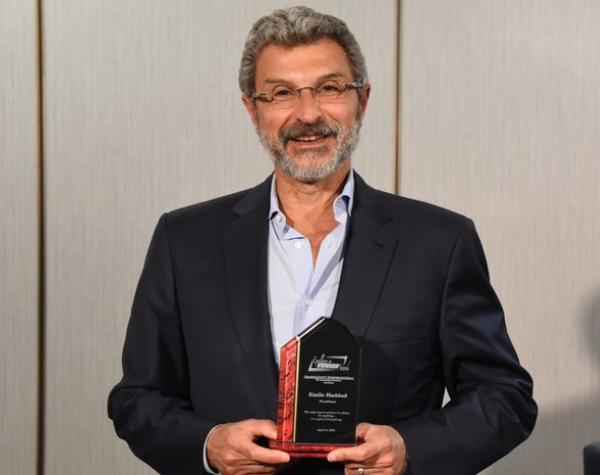
From leaving his home country during the Lebanese Civil War, starting over in America, plotting homebuilder Lennar Corp.’s expansion into California and now running Irvine-based community builder FivePoint Holdings LLC (NYSE: FPH), the Beirut native is no stranger to change, either.
After leading his $1 billion-valued company’s team of 165 through the pandemic, Haddad is already implementing new practices that address headwinds facing the California of today, like climate change, healthcare and affordable housing.
No challenge is off-limits for FivePoint, a holistic land developer that aims to create “sustainable cities of the future” through its master-planned communities in Irvine, Valencia, and San Francisco.
“Life changes quickly. The past year gave evidence to that,” Haddad told the Business Journal. “As the world changes, you must change with it, or you risk becoming obsolete.”
Haddad was one of five honored at the Business Journal’s 20th Excellence in Entrepreneurship Awards event, held virtually on May 6.
Beginnings
Haddad graduated as a civil engineer in Beirut in the 1970s, and instead of securing a stable job that pertained to his new degree, he chose to start a new company that spoke to a current challenge in his community.
“With all of the destruction during the war, every building was leaking, and there wasn’t good waterproofing materials in the area. I ordered materials from France and Italy, and started a waterproofing business,” recalls Haddad. “I told clients that if the building leaked after that, don’t pay me.”
It worked; the company quickly became one of the biggest of its kind in the region.
In 1986, he left Beirut with his parents and aunt to join his brother in California; his then-fiancé, now-wife, Dina followed two weeks later, and the group lived together in a small house in Ventura County.
About a decade and several jobs later, Haddad wound up at Lennar as part of an acquisition that paved the way for the Miami-based builder to enter the California market. Haddad would later become the company’s chief investment officer, and with Jon Jaffe (now co-CEO of the country’s largest homebuilder) led Lennar’s charge into California, including the 2005 buy of the El Toro Marine base site in Irvine.
Four years later, in the teeth of the global financial crisis, Haddad led the startup of FivePoint Holdings, a spinoff of Lennar that would take control of the former Marine base and other large California assets of Lennar. FivePoint would then go through a lengthy zoning process that paved the way for what’s now the Great Park Neighborhoods.
FivePoint has since built about 6,200 homes, including 720 affordable housing units, at Irvine’s Great Park Neighborhoods, which is entitled for 10,600 homes.
Led by Haddad, the company has done similar work elsewhere in transitioning closed military installations into mixed-use communities, including Valencia in Los Angeles, and Candlestick and The San Francisco Shipyard in San Francisco.
FivePoint’s communities are designed to include approximately 40,000 residential homes and 23 million square feet of commercial space.
The developments are projected to generate approximately 288,0
Healthcare Hub
“I’ve been in survival mode for so long, I wake up each day thinking about how I can do something different, or address a new challenge,” Haddad said.
One such challenge in the wake of the pandemic hinges on healthcare, with Haddad brainstorming how communities like the Great Park Neighborhoods can provide personalized medical offerings as an amenity.
The community will welcome a comprehensive cancer center next year when City of Hope opens its 190,000-square-feet center at 15161 Alton Parkway.
The center is part of a previously announced $1 billion investment in the region undertaken by City of Hope in conjunction with FivePoint.
The facility will provide diagnostics imaging and screenings, precision medicine, advanced treatment options, access to clinical trials, and personalized support services, among other features. It will be joined by an adjacent specialty hospital, which is being built from the ground up, and is scheduled to open by 2025.
Other healthcare companies are expected to join City of Hope at the Great Park Neighborhoods.
FivePoint owns land on the opposite side of Alton Parkway as the City of Hope campus that’s also envisioned for healthcare-focused commercial development. Additional land could also be converted into similar uses going forward.
Healthcare is just one of several components that add up to FivePoint’s goal of creating sustainable communities.
The company envisions communities such as the Great Park Neighborhoods to be the way of the future, with residential components mixing with healthcare, entertainment and education to create a cohesive, live-work-play hub.
“We want to make sure we don’t recreate old mistakes—like the issues that came about following the Industrial Revolution—and instead build communities that address environmental issues and social inequity,” Haddad said.
Residential Goals
FivePoint is gearing up to launch a new round of land sales at Great Park Neighborhoods, the first such transactions since 2019, when it sold 41 acres to two builders for about $218 million.
It’s currently selecting builders for the planned 800 to 900 homes, with deals expected to begin closing next month.
The company is also looking to increase the share of affordable housing options at Great Park Neighborhoods, with apartments being eyed as part of the developer’s FivePoint X, a 58-acre addition to the community that’s expected to bring some 425,000 square feet of mixed-commercial uses, including a 180-key hotel, plus a variety of food and retail options alongside new homes.
Construction is scheduled to begin next year on FivePoint X, which runs near the southern edge of the Great Park Neighborhoods, close to the city-owned Orange County Great Park.
Haddad points to Arte Moreno and Henry and Susan Samueli’s planned stadium-centric developments in Anaheim—he helped usher in the new wave of housing development at the Platinum Triangle while at Lennar—as positive examples of mixed-use communities that speak to the future of residential real estate in California.
“It’s very complementary to what is going on in Irvine,” said Haddad of the Anaheim developments, noting that public-private partnerships can aid future development plans in Orange County.
“Land is among the most heavily regulated industries, and it’s crucial for the city and developers to work together and remain flexible, specifically regarding zoning,” Haddad said.
