

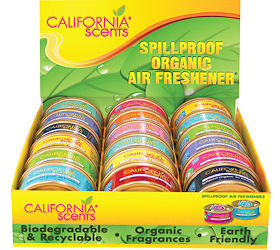
In the early days, the husband and wife founders of Irvine’s California Scents Inc. were told their products were “ugly,” “looked like a can of cat food” and that “consumers would never buy them.”
That didn’t stop their little tin cans of air freshener—plastered with punchy, tropical-colored labels, palm trees and kitschy names—from making their way to store shelves, where they have remained for nearly two decades.
Gus and Linda Doppes own and operate the privately held maker of air fresheners for autos and homes that are sold in nearly every big discount retailer, supermarket and convenience store.
Closely held California Scents, which has around 50 workers here and 100 in all, doesn’t disclose financials. The Business Journal estimates it sees some $40 million in yearly sales.
It’s one of the many products from Orange County companies you’ll find on a typical visit to any drugstore, grocery store, Wal-Mart, Target or Kmart.
California Scents was started in 1993 by the Doppeses in their garage in Laguna Niguel.
The pair, who ran a custom homebuilding business, came up with the idea during the early 1990s housing crash.
When the pair would sell their multimillion dollar, move-in ready homes, Linda would use fragrance oils to make them more appealing to potential buyers.
When home sales dried up, they got the idea of doing something with the fragrances.
“We were very novice at that time,” she said. “We knew nothing about the industry and what we were getting into.”
Linda handles operations and finance. Gus is chief executive and heads up marketing and product development.
The air fresheners are made of recycled organic plant and vegetable fibers that are cut up, soaked in fragrance oil and packed into small tin cans.
The scents have catchy names with ties to California—“Coronado Cherry,” “Monterey Vanilla,” “Palm Springs Pineapple” and “Malibu Melon.”
There’s even a few named for spots in OC, including “Laguna Breeze,” “Orange Squeeze,” “Newport New Car” and “Capistrano Coconut.”
The packaging always was about function over form, according to Linda.
“In the beginning, it was tough to get past the retail buyers,” she said. “But people went crazy over the product because it worked. Who cares if it’s ugly? You stick it behind a sofa or a plant. People don’t set their air freshener out on a dining room table.”
The look of the packaging, with bright colors such as fuchsia, teal and yellow, are meant to evoke what the Doppeses like best about California. The pair moved from the East Coast to OC in the 1980s after visiting on their honeymoon.
“It’s a fun brand,” said David Porcelli, vice president of sales. “It’s the heritage of who Gus and Linda are and how they want their brand to be perceived. They envisioned a bright, graphic package that pops off the shelf and really attracts consumers.”
The first customer was the government, which bought the air fresheners for sale in military base commissaries.
The former El Toro Marine Corps Air Station placed an initial order of around 200 cans.
California Scents landed its first major retailer—Target Corp.—in 1994. Wal-Mart Stores Inc. jumped on board the following year.
Target initially sought to redesign the products’ distinctive packaging.
After an investment of some $10,000 to come up with a prototype, Target’s retail buyers proposed that California Scents tone down its wild colors and change up the graphics.
“To us it was the ugliest thing we had ever seen,” Linda said. “It was not the California, West Coast theme we were going for, so we said, ‘No.’ It takes guts to do that.”
Not every scent and product was a hit, either. Pet cologne and sachets didn’t stay in the lineup for long.
Neither did a handful of scents that have fallen by the wayside over the years, including “Bel Air Blueberry,” “Tahoe Powder,” “Yosemite Springs” and “Catalina Floral.”
Catalina Floral—which is Linda’s favorite—didn’t make it with consumers.
“We even changed the color of the packaging twice and it still didn’t sell well,” she said. “We learned very quickly that you can’t just take your opinion or my opinion on what will sell well. That kind of hurts a little bit.”
The company stays on top of trends in fragrances by keeping tabs on trade journals and other published consumer research. As a small company, it doesn’t fund focus groups or other testing.
Right now, “clean” scents such as cotton, linen and laundry fragrances are popular, Porcelli said.
Small Player
California Scents is a small player in an area dominated by big consumer products names.
For home air fresheners, the company comes up against S.C. Johnson Ltd.’s Glade, Procter & Gamble Co.’s Febreze, Reckitt Benckiser Group PLC’s Airwick and Dial Corp.’s Renuzit, among others.
In cars, California Scents has a bigger piece of the market and competes with Watertown, N.Y.-based Car-Freshner Corp., the maker of the Little Trees pine tree that dangles from many rear-view mirrors.
The company does product design and market research at its Irvine headquarters. All of its manufacturing—including its own fragrance oil—is done from a factory in Glenshaw, Pa.
It’s on the same campus as janitorial cleaning supply maker Applied Products Inc., which Linda’s father ran for more than 60 years.
California Scents acquired Applied Products in 2007 and turned it into a manufacturer of air fresheners that are sold through distributors that supply restaurants, offices and retailers with janitorial supplies.
California Scents touts its air fresheners as having more fragrance oil than its competitors’ products. In addition to the tin cans, the products also come in sprays, gels, crystals and odor-absorbing filters.
“We have to make a better quality product than what’s on the market,” Doppes said. “We are a small company. We have to do something better than them.”
