

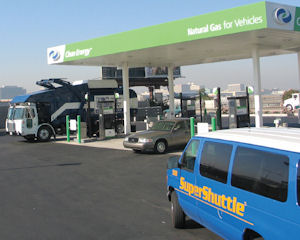
Seal Beach-based Clean Energy Fuels Corp. this month expects to complete the first corridor of an eventual nationwide network of natural-gas stations.
The initial phase of the multiyear project focuses on major transportation routes in Texas.
The plan calls for 30 stations between Dallas and Houston, followed by an expansion west to Los Angeles and east to Atlanta in the third quarter. Construction of a Chicago network linking Dallas and Atlanta also will begin in the third quarter.
About 70 stations will be constructed by the end of the year, expanding what the company calls “America’s Natural Gas Highway” throughout the Midwest, Southeast and Northeast, Chief Executive Andrew Littlefair said.
Most of the fueling stations will be located at Pilot-Flying J Travel Centers as part of an exclusive agreement with the Knoxville, Tenn.-based company. That will allow the network to follow traditional fueling routes used by commercial fleets and trucking companies.
Major transportation arteries in the U.S. will have a cluster of natural gas stations spread out every 250 miles or so when the project concludes.
Clean Energy, the biggest builder and operator of natural-gas stations in the U.S., is targeting the largest segment of the market: heavy-duty haulers that consume some $30 billion of fuel annually.
That dwarfs fuel consumption by the public-sector and waste-management industries combined.
The company more than doubled its revenue between 2009 and 2011 to $292.7 million.
Futures
Natural-gas futures last week were trading at about $2.40 per million metric British thermal units. The price of oil was around $94 per barrel, creating a spread of 39:1 and an “economic advantage,” according to Littlefair.
“There is just an awful lot of room when you look at the price of that commodity per gallon on what our (customers’) cost is at the nozzle,” Littlefair said in a conference call with analysts this month.
The U.S. supply of natural-gas deposits has never been higher, prompting Oklahoma City-based Chesapeake Energy Corp. and competitors to cut back drilling operations this year.
The gas is exhumed through hydraulic fracturing, or fracking, a somewhat controversial technique that penetrates thousands of feet into the earth by using blasts of water, sand and other chemicals to clear the way. Critics contend the process contaminates underground water reserves.
Chesapeake has invested at least $150 million into Clean Energy, and is among its largest investors, along with legendary oilman and corporate raider T. Boone Pickens.
The cost discrepancy between natural gas and oil has led major truck manufacturers—including Navistar, Volvo and Freightliner—to introduce models that run on the natural gas, while other companies convert fleets to run on cheaper fuel.
The industry will see about 4,000 to 5,000 conversions this year, a sizeable jump from 1,000 annually just a few years ago, Littlefair estimated.
“We believe the shift to using natural gas for transportation fuel is at an inflection point,” he said.
Earnings Challenge
Clean Energy has yet to clear earnings hurdles, despite favorable market conditions.
The company lost $47.6 million last year.
It reported an adjusted loss of $13.7 million in the March quarter, better than Wall Street’s consensus forecast for $15.4 million in red ink.
Quarterly revenue topped $76.3 million, up nearly 13% from a year earlier but missing Wall Street expectations of $81.6 million. Share prices have declined during the past few weeks after the quarterly financial results were issued. The share price may also have been affected by the broader market downturn this month.
Clean Energy’s gross margins—a key performance metric for commodity companies—need to improve, according to Pavel Molchanov, an analyst in the Houston office of St. Petersburg, Fla.-based Raymond James & Associates.
The company reported gross margins of 28 cents per gallon in the March quarter, up 2 cents from the previous quarter due to more commercial sales.
“The main challenge for Clean Energy is not the top line,” Molchanov said. “It’s the fact that its gross margins are too low for the company to achieve profitability.”
