

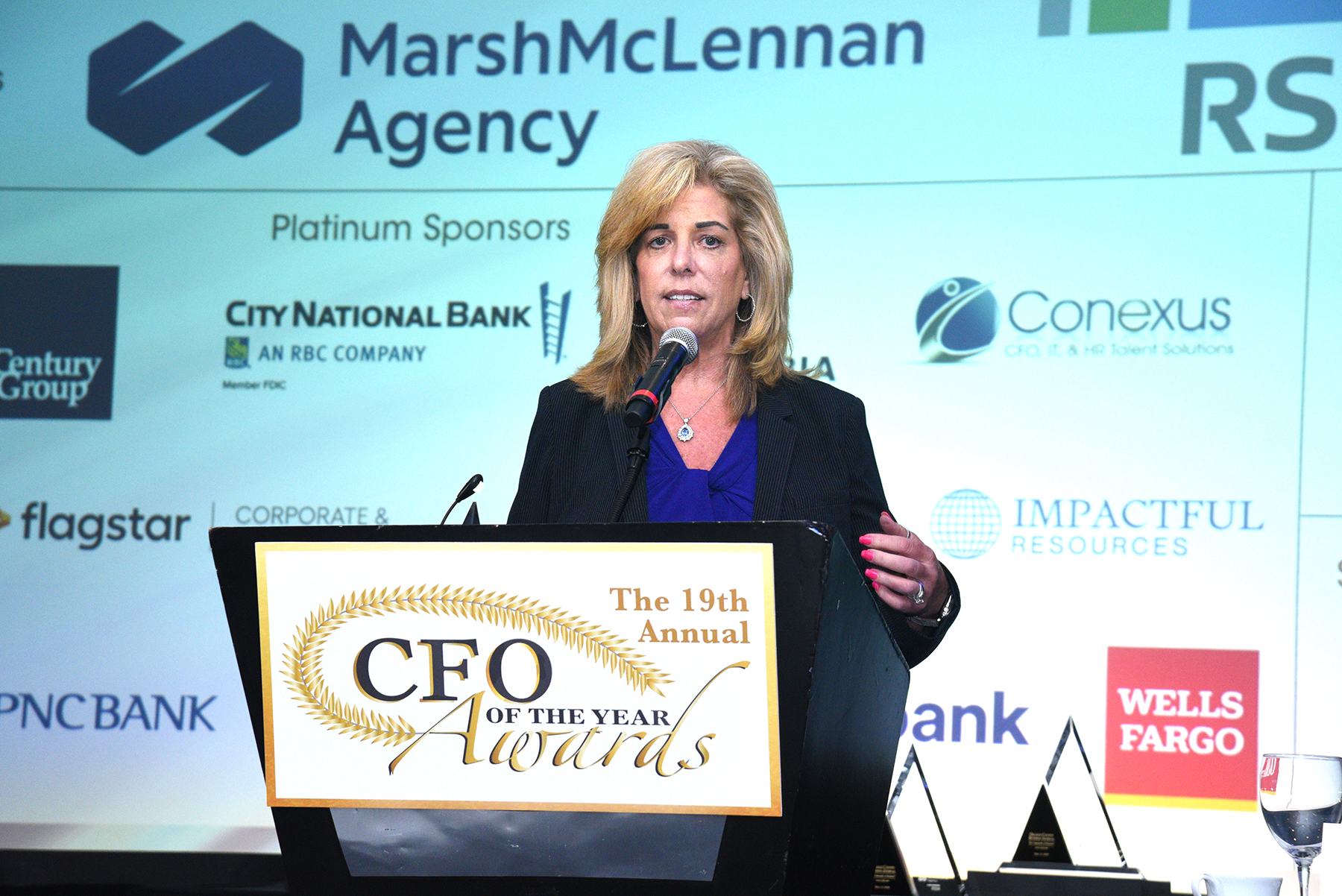
When Anna Ricardo accepted a Business Journal CFO of the Year Award earlier this month for her work at dietary supplements maker MeriCal, she told the crowd of more than 600 financial executives that she was there by the “grace of God.”
Little did many in the room know that her journey to the podium was weeks in the making after a near-fatal e-bike accident in February shattered her jaw and triggered a subdural hematoma, or “brain bleed.”
“My brain shifted eight millimeters to one side with the impact,” Ricardo told the Business Journal. “When I got home, I couldn’t even write my name.”
Now on the slow road to recovery, the chief financial officer and self-described “adrenaline junkie” has returned to work and is preparing for the Anaheim firm’s next move: a sale.
“We’re hoping to get a buyer, or many buyers, lined up by Q4,” she said. “But a lot of it’s going to depend on if we can achieve our budget this year, which I’m confident we can.”
Payroll Discipline Pays Off
If anyone has a reason to be confident, it’s Ricardo.
Three years ago, she was tapped by a recruiter to fix what she called a “mess” at MeriCal.
Over two years, she tightened the company’s financial backbone by bringing in a controller and building out a data analytics team so leadership could trust the numbers and put real controls in place.
From there, she went after clear inefficiencies.
Ricardo zeroed in on payroll—one of the biggest drags on the business. She imposed discipline by forcing weekly check-ins between operations and finance, tying labor hours directly to production output and cutting excess overtime.
“It’s managing what you’re truly manufacturing and making sure that the headcount—the standard cost headcount required for that manufacturing—is what you’re really applying to get that job done,” she said. “So, if the job says it needs six people, it should have six or less people, not eight, not seven.”
By holding teams accountable and aligning staffing levels with actual production needs, MeriCal reduced waste and improved productivity.
At the same time, she helped reshape the commercial side. The sales team got closer to key retailers like Sam’s Club, Walmart and Costco, while R&D shifted from reactive to proactive—pitching customizable formulations instead of waiting for orders.
The result: EBITDA jumped from about $400,000 in 2023 to $3.7 million in 2024 and then up to $13.1 million in 2025.
The turnaround specialist is now trying to land the plane for MeriCal’s private equity owner, Chicago-based Linden Capital Partners.
Typically, when a sale occurs, Ricardo admits the first to go are the CEO and CFO.
She’s ready for that.
Will she feel the need to retire, especially after her near-death experience?
It’s a question she gets asked a lot. But instead of slowing down, Ricardo said the accident made her realize one thing: “How much I value what I do and how much I love it.”
So, when Linden Capital wants her to fix another firm, she says bring it on.
And make it messy.
“I would hope that they would give us another project that is in dire straits.”
