

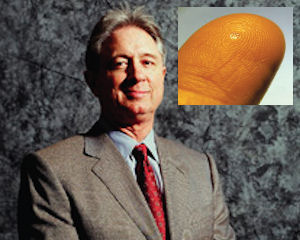
ReVision Optics Inc., a Lake Forest eye device maker with $35 million in fresh funding, plans to start a U.S. clinical trial and prepare for sales in Europe.
The company makes the Presbylens corneal inlay lens. It’s geared toward people 45 or older with presbyopia, which affects adults as they age when the eye loses its ability to focus close-up.
The lens “is a very tiny device that adds the power you need to read again,” said Randy Alexander, ReVision’s chief executive.
Presbylens is approved for use in Europe and is set to start selling there later this year. ReVision is undergoing a U.S. trial with possible approval here in 2014.
Large Market
The company is going after a potentially large market. Some 73 million Americans have presbyopia.
ReVision’s European team is training doctors and plans to debut Presbylens at the European Society of Cataract and Refractive Surgeons meeting this fall in Paris, Alexander said.
The company has raised about $72 million in venture funding.
In May, the company raised $35 million in a round of venture financing. The investment drew a mix of returning and new investors.
Newcomer ProQuest Investments of New Jersey led the round.
Returning investors Domain Associates, which has offices in San Diego and New Jersey, Canaan Partners of Menlo Park and Westport, Conn., and InterWest Partners, with offices in Menlo Park and Dallas, also took part.
The funding came in “definitely a conservative period in venture capital,” Alexander said, as most venture capitalists have been nurturing existing investments rather than looking for new ones.
“What you do is go to the people you know,” he said.
Slow Launch
Investor interest in ReVision grew once the Food and Drug Administration cleared its clinical trial for Presbylens, Alexander said.
The trial now includes about 30 patients and is set to grow to about 400 implants. The FDA is requiring ReVision to track people who receive the implants for two years.
The company expects “pretty light” revenue for 2010 and “seven figures” in 2011, Alexander said.
“This is a slow launch,” he said.
ReVision now has 30 workers and expects to hire an additional 30 people in the next two years, according to Alexander.
The company is going to sell Presbylens through its own “clinical trainers” and distributors in other countries.
Upon approval here, a direct U.S. sales force would be hired, Alexander said.
ReVision’s product, funding and potential market make it a candidate to be bought by a larger medical device maker or to go public.
The company wants to get its U.S. clinical trial to full enrollment and get Presbylens launched in Europe before considering any sort of exit, Alexander said.
ReVision also is looking at using Presbylens in patients who are having surgery for other eye conditions. Patients in their mid-40s and older who have had laser vision correction surgery and also have presbyopia could be candidates, he said.
“Their distance vision is treated with the lasers, and we implant our lens for their near vision,” he said.
Cataract patients with presbyopia are another market for ReVision, according to Alexander.
Other companies based or operating here also are eyeing presbyopia with replacement lenses. They include Bausch & Lomb Inc., a Rochester, N.Y.-based eye products company with a surgical hub in Aliso Viejo, and Abbott Laboratories’ Abbott Medical Optics in Santa Ana.
AcuFocus Inc. of Irvine, which is developing a lens to correct presbyopia, has backing from Bausch & Lomb.
There is room for several companies chasing the market because most are going after different parts of the market, Alexander said.
The company’s primary market is “early presbyopes,” or people who have just developed the condition.
ReVision, which was started in 1996, once was known as IntraLens Vision Inc. It changed its name in 2005 after it shifted strategy to correcting presbyopia and maintaining vision through implant lenses. n
