

Shelly underwent a radical mastectomy on her right breast just two weeks after receiving her breast cancer diagnosis.
She described feeling a “hollow vacuum” afterwards on the right side of her body and a longing to feel complete again.
Shelly is one of nine million women who have benefited from Johnson & Johnson MedTech Aesthetics and Reconstruction’s portfolio of breast implants and tissue expanders used in both cosmetic augmentation and post-cancer reconstruction.
J&J Aesthetics and Reconstruction claims its Mentor breast implants, which it acquired in 2009, “is the number one global brand in breast aesthetics.”
“The most important thing for us is our longevity and trust,” Alenka Brzulja, worldwide president of Aesthetics and Reconstruction, told the Business Journal.
“The Mentor brand has existed for over 50 years, and it’s the number one global brand, meaning that we know that the majority of women who do undertake a procedure place trust in Mentor, and that’s an amazing testimony.”
The business is based out of J&J MedTech’s Irvine campus and falls under its Surgery division, which reported 2025 sales climbed 3% to $10.1 billion. MedTech’s other main units include Cardiovascular, Orthopedics and Vision, which has dual headquarters in Jacksonville, Florida, and Irvine. All of the units, except orthopedics, have employees working at its campuses in Orange County.
The Medtech unit employs 1,900 in Orange County, ranking it No. 5 on the Business Journal’s annual list of medical device makers (see page 20).
The Breast Market
The global breast implants market, valued at nearly $3 billion, is expected to double over the next decade; it is dominated by a few major players.
A company that challenges J&J’s claim is Allergan, which is also based in Irvine as a unit of AbbVie Inc. Other competitors located outside of OC include Sientra by Tiger Aesthetics and the recently approved Motiva implants from Establishment Labs, Brzulja said.
J&J and Allergan are neck and neck for global market share. According to researcher Future Market Insights, J&J has 21% share as of early 2025, while Allergan has 23% share and Sientra has 14%.
J&J didn’t have a presence in the breast aesthetics and reconstruction market until it acquired Mentor for $1.1 billion.
“The acquisition has allowed us to now serve another segment of women, which has given us an opportunity to enter into the space of aesthetics and reconstruction where Johnson and Johnson has not been before,” Brzulja said.
Mentor, founded in 1969, relocated from Santa Barbara to Irvine in 2015 after it was acquired by J&J, according to Brzulja.
“The area of Orange County offers the talent pool that we’re looking for,” she said. “There’s a lot of life science and healthcare expertise.”
Brzulja has been with J&J for 30 years and is in her third year of leading the Aesthetics and Reconstruction unit.
She said that her first introduction to the Mentor brand was around 2010 when she was in charge of the EMEA (European, Middle East and Africa) marketing team for Aesthetics and Reconstruction based out of Slovenia.
Brzulja started her J&J career in the consumer side of the business with the last 20 years focused on medical devices. She served as business director of Mentor, and most recently, vice president of Cardiovascular and Specialty Solutions before being named worldwide president in 2023.
Launches MemoryGel Enhance Implants
J&J Aesthetics and Reconstruction’s portfolio has products for the two most typical procedures: aesthetic augmentation and reconstruction, typically done after a mastectomy to treat or prevent breast cancer.
Augmentation uses breast implants to increase breast size, with J&J offering MemoryGel and saline-filled breast implants.
The unit offers two product options for reconstruction procedures: implants and tissue expanders.
Patients getting breast reconstruction, particularly if their condition is compromised or if there’s been radiation, will either have a two-step procedure where they’ll start with a tissue expander that’s later exchanged for a breast implant or a direct-to-implant reconstruction, according to Brzulja.
J&J’s portfolio includes two tissue expanders for the patients that fall under the first category, which gradually stretch and expand the remaining tissue in the breast and create a “pocket” for a permanent implant.
Part of what sets J&J apart from its competitors is its continued product innovation, Brzulja said.
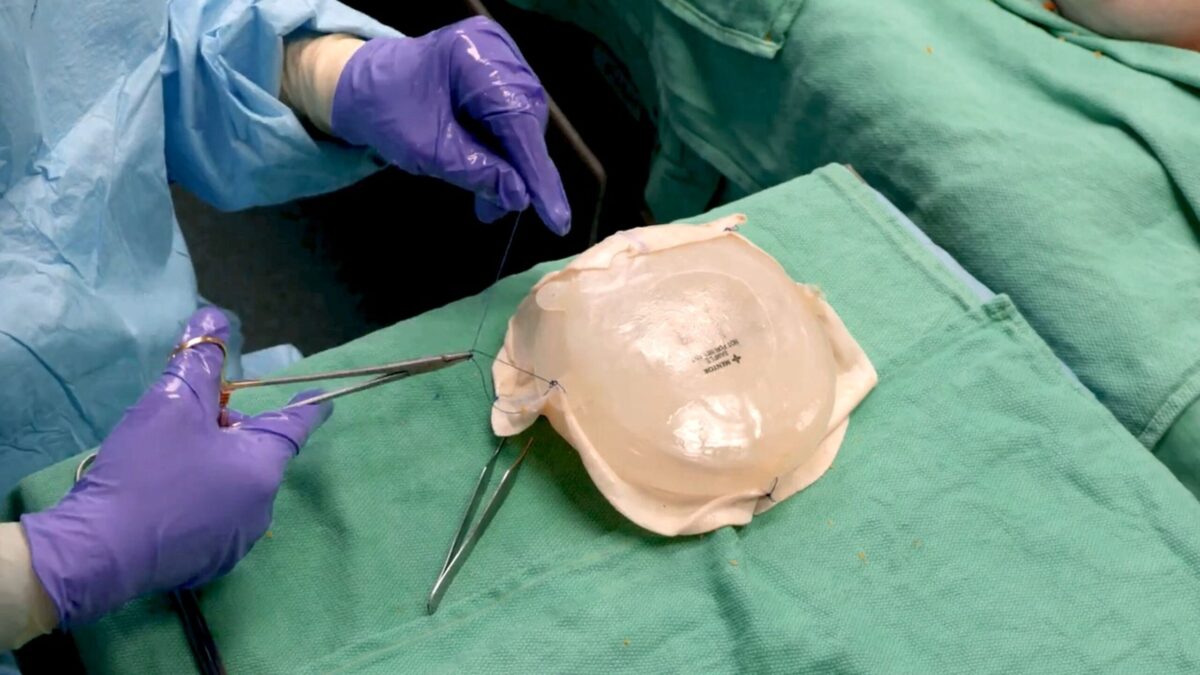
Last year, it launched the Mentor MemoryGel Enhance, the first and only implant for women with larger cup sizes undergoing breast reconstruction.
Approximately 15% of post-mastectomy patients lacked access to appropriately sized implants for reconstruction, according to J&J.
Prior to Enhance, Brzulja said that patients who needed a larger-volume implant had to either get a smaller implant that was not proportional to their body or use an external prosthesis, which is an artificial breast form worn inside the bra.
Visualizing Results Before Surgery
J&J is also innovating on the technology side of breast aesthetics.
Its latest digital tools are designed to help women visualize their desired results before undergoing a procedure.
The first is the Mentor Breast Implant Simulator app that launched in 2024.
The app creates a 3D simulation of how different implants would look on their body.
J&J launched an additional version of the app last year for surgeons to use during consultations.
Brzulja said that consultations today are “still very analog.”
“Typically, they would put in physical external sizers in the bra to determine the desired size, now they have a digital tool that will help better predict the exact product that would suit the patient’s needs,” she said.
