

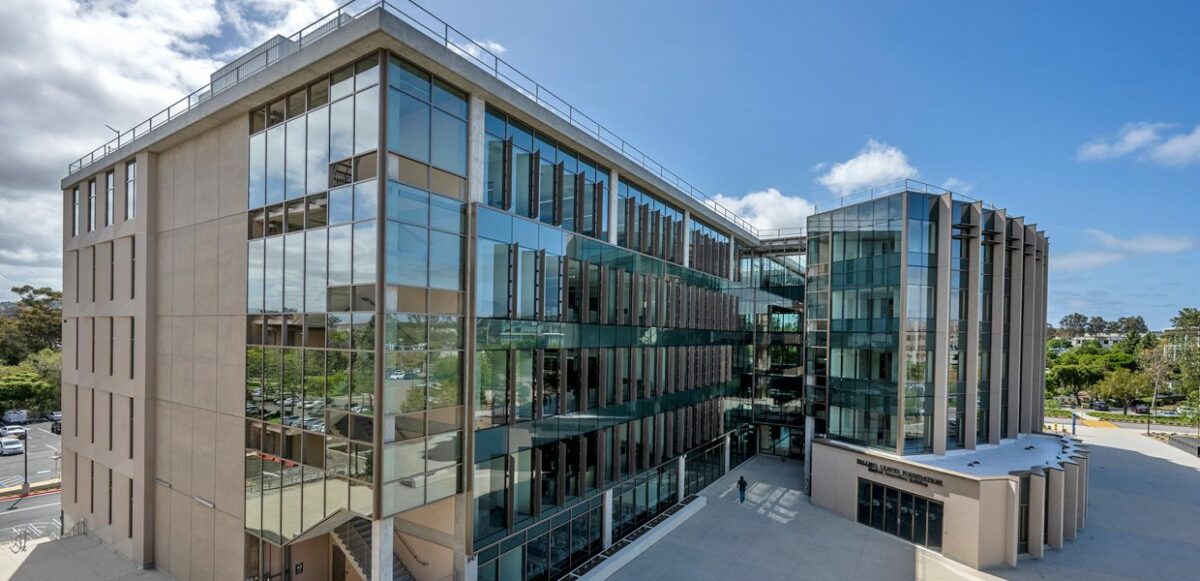
Research into potential cures for cancer, Alzheimer’s disease and blindness is taking place under one roof at a new facility that recently opened at UCI.
The Falling Leaves Foundation Medical Innovation Building brings together 13 programs pursuing breakthrough gene and cellular therapies, as well as vaccines, for these challenging diseases.
“At first it sounds unreasonable to say that you’re going to cure inherited blindness, but then you look at what they’re doing, and the answer is they’re on track to do it,” Dr. Steve Goldstein, UCI’s vice chancellor of health affairs, told the Business Journal.
The new facility, which opened last May, is part of UC Irvine’s expanding Health Sciences District. Nearby, UCI Health’s new $1.3 billion medical complex includes a 144-bed acute care hospital, the Joe C. Wen & Family Center for Advanced Care and the Chao Family Comprehensive Cancer Center and Ambulatory Care building.
Falling Leaves was funded by a $30 million gift made in 2021 from Adeline and Robert Mah through their Falling Leaves Foundation. In 2024, the couple donated an additional $20 million to support the building’s construction and to establish endowed research funds for two research centers focused on molecular innovation and vaccines, bringing their total giving toward the project to $53 million.
Adeline is the author of the best seller, “Falling Leaves: The Memoir of an Unwanted Chinese Daughter.”
UCI has raised a total of $81 million for the Falling Leaves building, including naming gifts for five of the 13 research programs.
“That’s the community just understanding what can be accomplished here,” Goldstein said.
UCI Health is ranked No. 1 on the Business Journal’s annual list of largest Orange County hospitals, reporting $2.8 billion in revenue for the year ended Sept. 30 (see page 22).
Scientists Shape Programs
Located at the corner of Jamboree Road and Campus Drive, the six-floor, 215,000-square-foot building is one of the largest interdisciplinary discovery and translational research hubs on the West Coast, according to UCI. While there are similar sized facilities focused on biomedical research at other universities, “none of them have UCI’s singular focus on project-driven medical innovation,” officials said.
“How we put the people together and chose who was going to be in it was pretty unique,” Goldstein said.
The programs weren’t shaped by officials but by the scientists themselves.
Goldstein said they received 50 proposals in total, which were evaluated by internal and external reviewers before the 13 current programs were selected.
Since UCI held a ribbon-cutting ceremony for the building last May, faculty directors have been busy moving researchers and machinery into the labs.
Each program is led by UCI faculty members from the Susan & Henry Samueli College of Health Sciences.
What follows are descriptions of six of the 13 programs:
Uncovering Why People Get Diabetes
The UC Irvine Diabetes Center aims to answer the following question: Why are some people predisposed to diabetes?
Leading the research is Dr. Qin Yang, professor of medicine, physiology and biophysics at UCI. The center—believed to be the only academic diabetes research center in Orange County—brings together 20 investigators studying Type 1 and Type 2 diabetes.
“If both parents are diabetic, you have an 80% chance of being diabetic, but other people, no matter what they eat, don’t become diabetic,” Yang told the Business Journal during a tour of the facility last week. “That’s the angle we’re looking for—why some people are more prone to diabetes.”
The stakes are high.
Diabetes affects 37 million people in the U.S. It’s an especially pressing issue in Orange County, where nearly half of adults have diabetes or prediabetes, according to the center.
Yang oversees an interdisciplinary team of investigators experienced in computer science, mathematics and bioengineering and is working to recruit more people to fill the fifth-floor space at Falling Leaves.
“I’m looking for people with different skills because diabetes is one single disease, but it actually hits multiple organs like the liver and fat tissue,” Yang said.
Before moving to the Falling Leaves facility, Yang said his investigators were scattered throughout the campus, limiting collaboration. He joked that he “fought” for the space in the new facility, saying that everyone gathered into the same space leads to spontaneous “corridor” discussions that can spark breakthroughs.
“This space puts investigators together, which is very important,” he said.
— Yuika Yoshida
The Other Seven Research Programs
• Adeline Yen Mah Vaccine Center led by Philip Felgner
• Robert A. Mah Molecular Innovation Center led by Glenn Micalizio
• Immuno-Oncology and Precision Cancer Therapeutics Research Programs led by Richard Van Etten
• Environmental and Occupational Toxicology and Disease Program led by Andrea De Vizcaya Ruiz
• Center for Neural Circuit Mapping Translational Neuroscience Program led by Xiangmin Xu
• Precision Omics Collaboratory led by founding co-directors Edwin Monuki, Abraham Qavi and Suzanne Sandmeyer
• Noel Drury, MD Institute for Translational Depression Discoveries led by Diego Pizzagalli
— Yuika Yoshida
Pursuing Off-the-Shelf Products for Brain Injuries
The diabetes center shares the fifth floor with the Stem Cell Research Center: Neuroscience Program, led by co-directors Brian Cummings and Leslie Thompson. The team is developing stem cell-based therapies for neurodegenerative diseases such as Huntington’s, Parkinson’s and Alzheimer’s.
The Sue & Bill Gross Stem Cell Research Center has 70 total faculty and plans to eventually move in five researchers into the Falling Leaves facility.
Cummings has spent more than a decade at UCI developing neural stem cell therapy for traumatic brain injury (TBI). The second arm of his research focuses on repeat mild concussions—common among athletes and military personnel. Over time, they put people at risk for dementia.
The center is using a neural stem cell line that was developed at UCI across both programs.
For TBI, these stem cells are injected into the injured tissue to replace lost tissue and modulate secondary damage that continues after the initial injury.
In the concussion program, the center is focusing on the brain’s immune response.
Cummings said that people with traumatic brain injuries or concussions have permanent neuroinflammation in their brains within the microglia, which plays a key role in brain development and injury repair.
The center is generating microglia from stem cells, transplanting them into animals to identify the signaling pathways and gene expression involved in concussion, and then engineering cells to deliver a therapy.
“The idea there is that we could transplant these cells into a football player or soldier and they lie dormant until there’s inflammation,” Cummings told the Business Journal. “Then when there’s inflammation, they would be triggered to migrate to the site of injury and release a payload.”
Their goal is to produce an off-the-shelf cell therapy for severe TBI and repeat concussions.
Cummings said they held a pre-Investigational New Drug meeting with the FDA last December and are currently seeking funding from the California Institute for Regenerative Medicine (CIRM) to support manufacturing and the first clinical trial of neural stem cell therapy for TBI. The center recently received a $12 million grant from CIRM to test a new neural stem cell therapy for Huntington’s disease.
This isn’t Cummings’ first foray into commercializing his research.
His work contributed to preclinical data that led to FDA approval of a neural stem cell trial for a rare, progressive condition affecting the central nervous system called Pelizaeus-Merzbacher disease.
Cummings and his wife have also done two trials for spinal cord injury on a cell therapy that was manufactured at UCI and is awaiting FDA approval. He said they plan to follow up on it with the TBI project.
“They all interconnect,” Cummings said.
— Yuika Yoshida
Finding a Cure for Inherited Blindness
Two of the 13 programs are working together to pioneer how to restore something we often take for granted: our sight.
“The tissue on the back of our eyes is the size of a quarter, yet it carries so much information,” Krzysztof Palczewski told the Business Journal. “You lose your sight and realize how precious it is.”
Palczewski, a world-renowned scientist focused on vision, is director of the Brunson Center for Translational Vision Research and the Genome Editing Research Program.
Palczewski and his team are using a combination of gene therapy and noninvasive imaging to develop cures for inherited blindness. So far, they’ve discovered how to reverse and prevent cell degeneration in the eyes and are now working to develop a method to guide this therapy to specific cells in need of correction.
Their goal sounds ambitious, but UCI estimates that this will be achieved within the next decade.
“Imagine today we can eradicate all inherited blindness diseases,” Palczewski said.
He’s cautious about making claims, given past promises by others that were never fulfilled, by others said the genome-editing technology his team is developing has the potential to restore sight.
Right now, they’re starting with curing blindness in mice.
“We just hired one clinician who does this with humans, so our technology will be directly transferred, so we don’t need to go anywhere,” Palczewski said.
Last September, UCI announced a $15 million gift from the Brunson Foundation, led by James and Cynthia DeBoard, to name the Center for Translational Vision Research in the Falling Leaves building. The first $5 million supported the construction of the building with the other $10 million establishing the Robert M. Brunson Center for Translational Vision Research Endowment, in honor of the late entrepreneur and philanthropist Robert Brunson.
— Yuika Yoshida
Unmet Need in Pediatic Epilepsy Care
The Epilepsy Research Center, or the EpiCenter as it’s called, occupies more than 10,000 square feet on the fourth floor.
“We’re a hybrid between biotech R&D and academia, and that’s on purpose,” Robert Hunt, founding director of the center, told the Business Journal.
Hunt, who is also an associate professor of anatomy and neurobiology at UCI, took over as director of the EpiCenter in 2021.
The center aims to develop treatments for epilepsy and other complex brain conditions, including autism, intellectual disability and traumatic brain injury.
About a third of people with epilepsy don’t have any treatments, according to Hunt. Many are children with genetic disorders or brain malfunctions.
Among the 39 or so existing anti-seizure medications, Hunt said that very few are designed for childhood genetic disorders.
One lab within the EpiCenter is developing a device designed to monitor brain rhythms in children with epilepsy. The device, now being tested at Rady Children’s Hospital Orange County, is a grid placed on the brain’s surface that records electrical activity, allowing medical teams to detect seizures or other abnormal activity in real time.
“We don’t know a lot about how a normal, healthy baby is going to change. Never mind a kid with a developmental disorder, so it’s really important to diagnostically understand what’s going on,” Hunt said.
The EpiCenter has a discovery pipeline of other treatments, including gene and cell therapies and natural remedies, in pre-clinical epilepsy studies, all with the goal of achieving commercialization, according to Hunt.
“It would be fantastic to see treatment for epilepsy that started here at UCI get not just FDA approval, but mainstream adoption,” he said.
— Yuika Yoshida
The body’s largest organ is the skin.
The Interdisciplinary Skin Science Program, led by founding director Kristen Kelly, is advancing next-generation therapies for skin conditions such as cancer, atopic dermatitis, alopecia (hair loss), vitiligo and more.
It’s one of the only six National Institutes of Health (NIH) funded skin disease research centers in the country and the only one on the West Coast, according to UCI.
An emerging issue in the field is inflammatory skin diseases, according to Anand Ganesan, professor of dermatology within UCI’s School of Medicine. He is also one of the 23 research faculty in the program.
Inflammatory skin diseases range from psoriasis to eczema.
“There are new drugs coming up all the time,” Ganesan told the Business Journal. “The problem is that nobody knows which drugs work for which people, so that’s what they rely on us for.”
Several startups have been created from technology developed at the Skin Science Program, including San Diego-based Amplifica, founded by UCI biology professor and Interdisciplinary Skin Science Program investigator Maksim Plikus. The biopharmaceutical company is developing an injectable treatment for androgenetic alopecia (AGA), a common form of hair loss.
Ganesan said the program also maintains working relationships with companies such as Chicago-based biopharmaceutical giant AbbVie Inc., whose aesthetics unit, Allergan Aesthetics, is based in Irvine.
“From a business perspective, we have unique technology that you can’t get,” he said.About 75% of program graduates work at pharma and skin biology companies in Orange County, according to Ganesan.
— Yuika YoshidaSkin Science Spins Out Startups
