

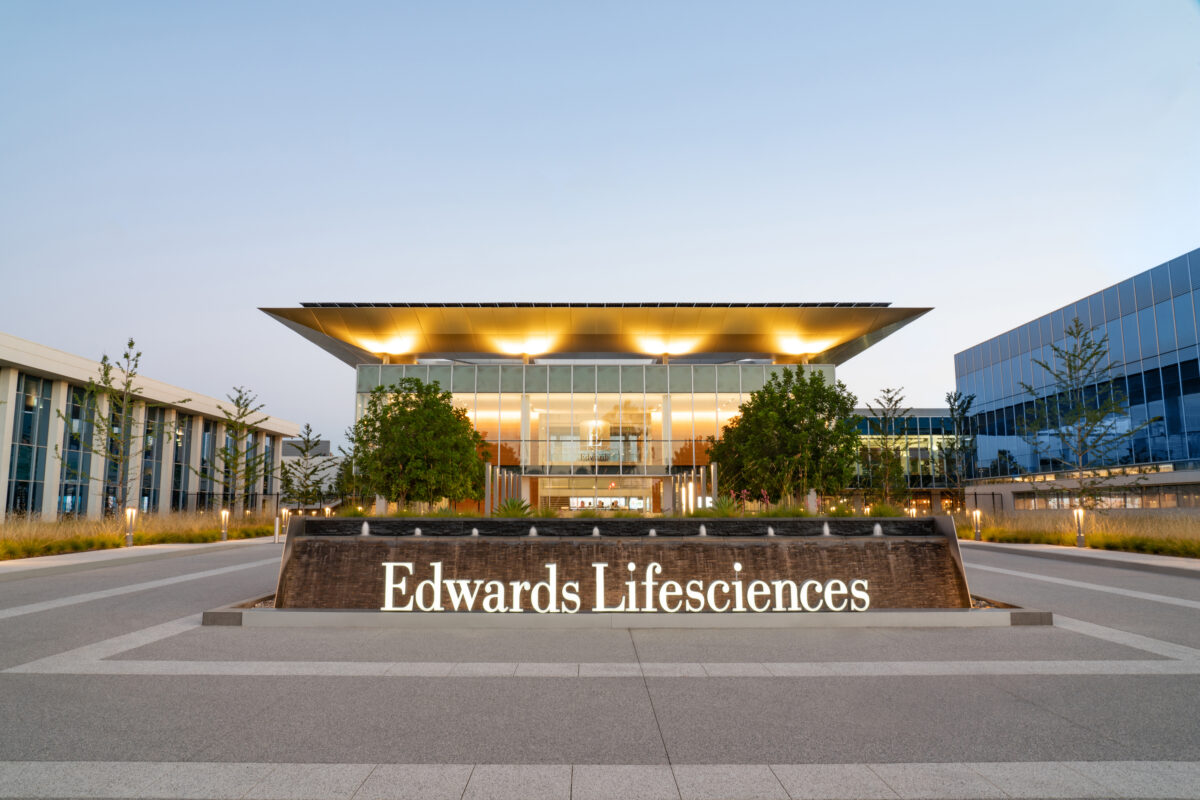
Bernard Zovighian has now been the chief executive for almost two years at Edwards Lifesciences Corp., the medtech company made famous by his predecessor Mike Mussallem.
Zovighian’s made major changes, such as selling its slowest growing unit for $4.2 billion. He wants the firm to concentrate on structural heart problems and has spent $1.5 billion to acquire three firms. He’s suffered setbacks, such as a $16.5 billion drop in its valuation on July 24 after unexpectedly slashing the sales outlook for its biggest unit.
Now, Zovighian’s efforts are beginning to show.
The Irvine-based company on Feb. 11 reported fourth quarter sales increased 9% to $1.39 billion, topping analyst consensus of $1.36 billion.
“Last year was a meaningful year for Edwards,” Zovighian told the Business Journal in an exclusive interview.
Zovighian said Edwards achieved revenue in line with its guidance “in a different way than anticipated” with growth for its biggest unit lower than expected.
Its Transcatheter Aortic Valve Replacement (TAVR) grew 6% to $1.04 billion in the fourth quarter. Meanwhile, Transcatheter Mitral and Tricuspid Therapy (TMTT) jumped 88% to $105 million, driven by increased sales of the Pascal Precision heart implant and the Evoque tricuspid valve replacement system.
Since that dramatic day on July 24 when they reached a low of $58.93, shares have steadily climbed, rising 7.2% to $75.82 on Feb. 12, a day after the fourth quarter announcement. The company remains the second biggest Orange County-based company, by market cap, and is by far the largest medtech company here with a $44 billion market cap.
Edwards also reaffirmed its 2025 forecast that predicted sales will climb 8% to 10%.
“We think this (forecast) sets an achievable bar for EW to build off through the remainder of the year,” TD Cowen analysts Joshua Jennings and Eric Anderson wrote in a note to investors.
It’s Edwards’ first full year as a “purely structural heart company” after selling its Critical Care business last September.
“The company is now more diversified with Surgical, TAVR, TMTT and two emerging opportunities,” Zovighian said.
The two emerging opportunities refer to heart failure and aortic regurgitation, new areas of focus for Edwards, which spent approximately $1.5 billion on the acquisitions last year.
“Be Ready to Fail”
Zovighian said the transition to CEO has been relatively smooth since he joined Edwards in 2015 and spent eight years in corporate roles, including five as corporate VP and general manager of TMTT, Edwards’ smallest but fastest-growing unit.
“This gave me a good chance to learn about who we are,” Zovighian said.
The easy transition is also a “true testament” to Mussallem’s leadership, who was the only CEO Edwards has ever known in its 23 years since it went public, Zovighian said.
Two of the biggest lessons that he said he learned from Mussallem was to have a long-term plan and to not be afraid of failure.
“If you want to be an innovator, you need to be ready to fail,” Zovighian said. “You need to be ready to pivot back.”
Mapping Out the Next 10 Years
When Zovighian became CEO, he decided to take the long view with a focus on the coming decade.
“If you look back on the company, what made us very successful in the last 10 years was the amazing success of TAVR,” Zovighian said.
TAVR became famous as a method to insert a heart valve through a catheter rather than open heart surgery.
He questioned, however, whether TAVR could carry the company in the future. The TAVR unit generated $4.1 billion in 2024, or about 76% of its $5.4 billion in revenue.
The answer to that was “yes and no,” according to Zovighian.
“TAVR is still going to be an important business, but it’s not going to be enough,” he said.
This was the thought process behind the company’s acquisitions last year.
Edwards in July first announced plans to acquire Innovalve Bio Medical, an early stage transcatheter mitral valve replacement company, for $300 million, building on a prior investment made in 2017.
That same month Edwards said it’s also paying $1.2 billion to acquire structural heart companies JenaValve Technology and Endotronix, which closed last year. The JenaValve deal is expected to close by the end of this year.
Zovighian identified structural heart disease as one of Edwards’ core businesses and said that the company is investing both internally and externally on the new focus.
Edwards spent more than $1 billion on research and development in 2024.
Zovighian said that Edwards continues to invest in surgical and TMTT, as well as a “number of new segments” that he said are too early to announce, though he added they’re all “related to the heart.”
“We want to be able to bring new technologies because there is still large unmet patient needs, and we want to be the company focusing on that,” Zovighian said.
New Leader for Critical Care
Last June, the company decided to make a major pivot.
Edwards announced it was selling its Critical Care unit for $4.2 billion to Becton, Dickinson and Co. (NYSE: BDX), one of the world’s largest medical technology companies with a $64 billion market cap, rather than spinning it out.
Critical Care was previously Edwards’ third-largest business unit by sales, generating nearly $1 billion last year but has seen slower growth compared to the company’s three other units.
Zovighian said he still believes spinning out Critical Care was a good idea; however, following the announcement, he said that they received several phone calls to buy the business.
“We realized that this business was very valuable to many companies,” Zovighian said. “We also realized that for the employees, it was probably a good idea to be part of a large organization.”
BD stood out from other offers because they committed to invest long-term in the business and maintaining the existing culture, Zovighian said.
“It was the best for the business, employees, patients and less risky than the spin,” Zovighian said.
BD decided to keep the unit, renamed BD Advanced Patient Monitoring, and its 500 employees in Irvine.
It moved into Alteryx Inc.’s former headquarters at Spectrum Terrace following the transaction closing last September.
Katie Szyman, who was corporate VP of Critical Care prior to the sale, led the new unit for just five months before she was unexpectedly tapped by Irvine-based medical device maker Masimo Corp. to be its next CEO.
BD then announced that Tim Patz would replace Szyman as worldwide president of BD APM.
While Zovighian called Szyman’s departure a “personal decision,” he described the appointment of Patz as a “success story for Critical Care.”
Patz has been at Edwards for nearly two decades in a variety of sales and marketing roles, and most recently was senior VP of APM Greater Asia.
“What I like about the new leader is that he’s someone who started with Edwards 20 years ago and has developed with Critical Care,” Zovighian said.
Creating the First Artificial Heart Valve
In the middle of Edwards Lifesciences Corp.’s campus in Irvine is an exact replica of Miles “Lowell” Edwards’ Oregon backyard workshop.
The retired engineer owned over 60 patents and designed industrial pumps used by the likes of Weyerhaeuser Timber Co. and Boeing.
His fascination with pumps eventually led him to the conclusion that the human heart operates similarly.
In 1958, Edwards brought this concept to Dr. Albert Starr, a young heart surgeon at the University of Oregon Medical School, who encouraged Edwards to focus on an artificial heart valve opposed to the whole heart.
Over the next two years, they developed the Starr-Edwards mitral valve, which had a caged ball design similar to other valves at the time.
In 1960, the valve was implanted in a human patient for the first time.
After the successful surgery, Edwards founded a medical device company in Santa Ana that later became Edwards Lifesciences after it was acquired by Baxter International Inc. in 1985 and then spun out in 2000.
