

Boston Scientific Corp. is getting ready to continue the introduction of a heart device it got through its buy of San Clemente-based Cameron Health Inc. last year.
“We’re making progress toward resuming our controlled S-ICD launch in late third quarter,” Michael Mahoney, the Massachusetts-based device maker’s chief executive, said during a recent earnings call.
Boston Scientific received the S-ICD implantable cardioverter defibrillator when it bought Cameron for more than $1 billion in 2012. S-ICD is used to prevent heart attacks.
S-ICD is distinguished by the lack of lead wires, which often fracture and can cause problems for patients.
It has been hailed as a potential breakthrough in the implantable defibrillator medical device segment—one that’s had its share of setbacks, such as recalls and government investigations—in recent years.
“S-ICD is one of [Boston Scientific’s] shining lights,” Raj Denhoy, an analyst with Stamford, Conn.-based Jeffries LLC, said in a research note this year, adding that the device continued “to generate a fair amount of buzz as it is the first really novel advance in ICD therapy for a number of years.”
Boston Scientific had to pull back its launch of S-ICD because sales “outpaced our ability to supply the market, and we’ve seen significant supply constraints since March,” Mahoney said, adding that Boston Scientific is managing the situation with its customers.
Mahoney said later in the call that Boston Scientific would start shipping S-ICD primarily to research sites, where it initially concentrated the introduction.
“And by fourth quarter, we’ll be able to ramp up more significantly and also expand our commercial presence in the U.S. and globally beyond our trial centers,” he said.
Overall, Boston Scientific’s defibrillator segment posted a 2% sales decline in the second quarter to $475 million.
Analysts did note that the dip was smaller than in previous years and suggested the category could be poised for some growth.

“We suspect in the case of a potential stable-to-improving implanted cardiac defibrillator market that a rising tide lifts all boats,” said Danielle Antalffy, a medical device analyst for Boston-based Leerink Swann LLC, in a research note issued about a week before Boston Scientific’s report.
When S-ICD returns to the market, it could be set for a higher Medicare reimbursement.
The Centers for Medicare & Medicaid Services is expected to release its final Medicare payment proposal for implantable cardioverter defibrillators this month. Regulators proposed in the spring that a 6.4% payment increase for the defibrillators for the 12 months starting Oct. 1.
Leerink noted in an earlier research report that Medicare would pay on average a base rate of $35,934.11 for an ICD. Medicare now pays an average of $33,759.22 for the devices.
Masimo Gets Supplier Deal
Irvine-based patient monitor maker Masimo Corp. said it entered a new year-to-year group purchasing deal with Community Health Ventures. Terms weren’t disclosed.
Community Health Ventures is the business development affiliate of Bethesda, Md.-based National Association of Community Health Centers. It represents more than 9,000 federally qualified health centers serving more than 22 million people nationwide.
The deal allows Community Health Ventures’ participants prenegotiated, special pricing and financing terms for Masimo’s Pronto-7 and Pronto patient monitors. Pronto and Pronto-7 offer noninvasive and spot-check testing of total hemoglobin; oxygen; pulse rate; and perfusion monitoring.
CombiMatrix Inks Blue Shield Pact
Irvine-based molecular diagnostics provider CombiMatrix Corp. signed a deal with San Francisco-based Blue Shield of California to provide diagnostic laboratory services.
The Blue Shield contract brings 3 million patients into CombiMatrix’s fold.
A Blue Shield spokesperson called the contract “a standard contract with standard rates” and mentioned that CombiMatrix is one of several laboratory providers it contracts with.
Separately, CombiMatrix said Robert Hoffman, chief financial officer of San Diego-based drug maker Arena Pharmaceuticals Inc., is now a company director. Hoffman’s appointment filled a vacancy on CombiMatrix’s board, which now has seven directors.
Hoffman joined Arena in 1997 and served in various finance and accounting roles as Arena had an initial public offering, follow-on financings, and a transition to being a commercial-stage drug maker.
Tendon Device Cleared for Europe
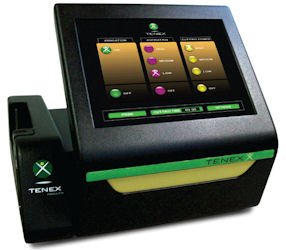
Tenex Health Inc., a Lake Forest-based medical device maker, said late last month that it received European regulatory clearance for its TX1 system that treats tendon pain and will launch it in select markets outside the United States.
TX1 uses a minimally invasive hand piece device to cut and debride diseased tendon tissue in an outpatient setting. The company said the TX1 procedure usually takes less than 20 minutes and uses only local anesthesia, and that because surrounding healthy tendon tissue isn’t disturbed, patients have less discomfort and faster recovery times compared to traditional open tendon surgery.
Tenex, a privately held company, said TX1 has been used to treat more than 6,000 patients to date, including professional golfer Nick Price and Los Angeles Lakers star Pau Gasol. It received Food and Drug Administration approval in 2011 and was introduced last year.
