

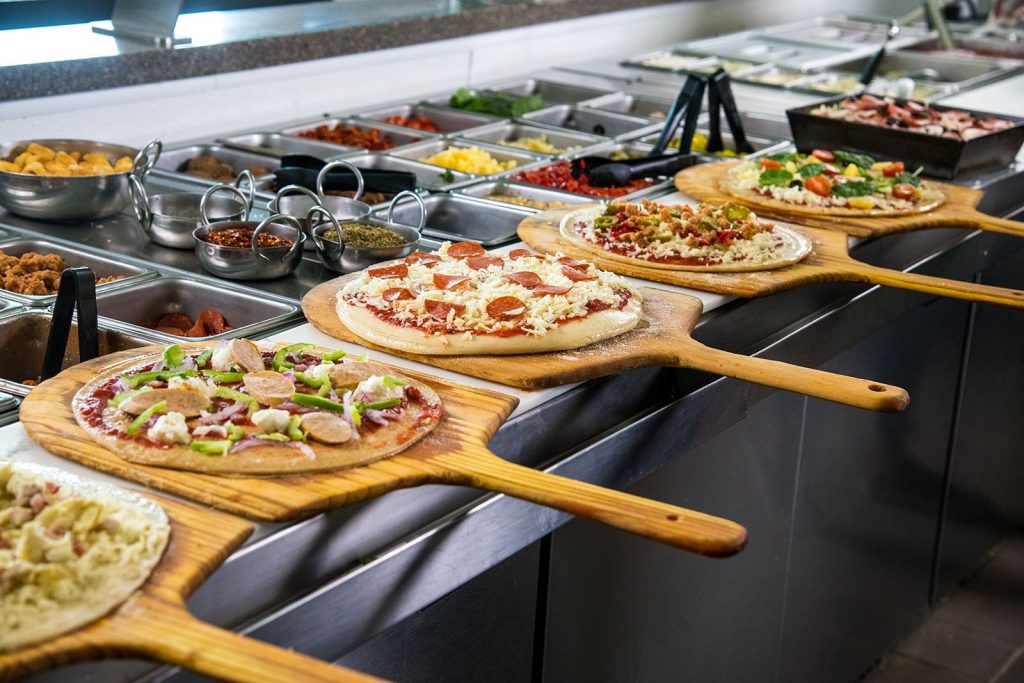
With the opening of the first Pieology Pizzeria in 2011, founder Carl Chang sought to turn one of America’s most craveable foods into an affordable and interactive experience.
At its peak, before the COVID-19 pandemic, the fast-casual pizza chain had over 200 restaurants. Today, there are 45 with more store closures expected following the company’s decision last week to file for bankruptcy protection.
“We lost our way under previous leadership,” Chang told the Business Journal in an exclusive interview.
The chain’s parent company, The Little Brown Box Pizza LLC, filed for Chapter 11 bankruptcy protection in the U.S. Bankruptcy Court, Central District of California, on Dec. 8. The petition was signed by Chang, the company chair and majority stakeholder of the Irvine-based chain.
Chang said reorganization will allow the chain to get back to its roots.
Instead of focusing on hypergrowth, Chang says he’ll be working on improving operations at stores that can attain profitability.
“I want Pieology to be what it once was when I first launched the concept—great quality food, affordable prices and community-focused,” he said.
Pandemic Disruptions
Pieology, once considered a Southern California leader in the burgeoning fast-casual pizza sector, is ranked No. 21 among the largest restaurant chains in Orange County, with 2024 revenue of $101.8 million across 103 stores, according to the latest data from Technomic Inc. Pre-pandemic, the chain reportedly had over 200 locations.
But the bankruptcy filing shows it’s been shedding stores over the past several months.
The company said it closed 17 locations before the bankruptcy filing, leaving the systemwide total at 45.
The chain blamed pandemic-related disruptions, inflationary cost pressure, labor shortages and rapidly shifting consumer behavior as contributing factors to the company’s struggles in recent years.
“I think most of us in the fast casual pizza segment were all having our challenges,” Chang told the Business Journal in a Dec. 11 phone interview.
In response, the company invested “substantial capital” to improve operations, including jumpstarting online ordering and delivery platforms that were non-existent before the pandemic, installing high-efficiency cooking and refrigeration equipment, and redesigning the menu.
“We’ve been trying to reinvent ourselves ever since,” Chang said.
Loss of Liquidity Sparks Bankruptcy
But the most significant hardship came earlier this year.
In April, the company took over 29 underperforming franchised locations from its largest franchisee, which was “substantially past due on payment obligations,” posing a risk to the brand’s integrity, according to a Dec. 10 bankruptcy filing.
However, shortly before closing, key investors backed out.
The sudden “loss of liquidity” significantly hindered the brand’s turnaround plan, which called for using the capital to stabilize the acquired stores.
“A few of the investors changed their mind, unfortunately,” Chang told the Business Journal. “If we knew that before the fact, we would have probably chosen a different strategy.”
Instead, the brand faced mounting operational pressures and insufficient liquidity to support the additional restaurants.
That led to last week’s bankruptcy filing.
The reorganization plan calls for shedding “burdensome leases” and concentrating company resources on stores capable of achieving sustainable profitability and stabilizing operations. Ultimately, that means closing more underperforming stores among the 29 the company recently absorbed.
Of those, Chang says he believes they can keep about 16.
“Our focus will be on the key 16 units that we’ve identified that we believe we can successfully continue to run and improve,” Chang said.
Custom Pie Craze
Chang, the brother of ex-tennis pro Michael Chang who was an early investor in the chain, opened the first Pieology near California State University, Fullerton nearly 15 years ago.
Build-your-own concepts were not new to fast food, as Subway and Chipotle Mexican Grill had been allowing customers to personalize sandwiches and burritos, respectively, for years. But Chang carved a niche by serving cheap personalized pies in an assembly-line format that would eventually pave the way for a revolution in the pizza industry, a high-margin category in the restaurant sector.
Instead of paying extra for toppings—typical at national brands such as Domino’s and Pizza Hut—Pieology offered smaller, personal pizzas with endless toppings for a flat price. Rivals soon followed, including Pasadena-based Blaze Pizza.
Yelp, which had much more persuasive power over consumers back then, helped bolster Pieology’s popularity among millennials. The ultimate compliment came when fans began referring to Pieology as “The Chipotle of Pizza.”
In 2015, Chang received the Business Journal’s Excellence in Entrepreneurship Award. At the time, the family-owned chain had 55 locations and “commitments for 500” more stores.
“I’d like to share this honor with my family and extended family, the Pieology team, who have all supported my vision and helped to build a solid foundation for Pieology to continue to thrive,” Chang said in a statement after winning the award. “To be recognized for doing what I love and bringing smiles to those in the communities we serve is truly indescribable.”
Rivals with Big Backers
In 2015, Chang told the Business Journal that he had started incubating the idea for Pieology in 2007. The first restaurant served 11.5-inch made-to-order pizzas in under three minutes for about $7.
But a bevy of other fast-casual pizza players emerged shortly after Pieology, many of whom were backed by major investors and were run by veteran restaurant operators. One of them was Blaze Pizza, founded in 2011 by Rick and Elise Wetzel, the same founders of Wetzel’s Pretzels—a chain that at its peak was found in nearly every major mall in America.
Raising capital came easily. Early investors who catapulted Blaze into the national spotlight included NBA superstar LeBron James and Maria Shriver.
The brand was calculated with its growth, choosing to unveil its first outlet in Pieology’s home base in Orange County. It opened in 2012 at the University Center in Irvine, near UCI, where Pieology planned to open its second location.
Blaze’s high-profile backers allowed the fast-casual chain to grow much faster than Pieology, which eventually sputtered out as Blaze and Seattle-based MOD Pizza surpassed it in sales and unit counts.
MOD Pizza was founded in 2008 but didn’t enter the California market until a few years later. Its first Orange County store opened in Irvine in 2013—two years after Pieology opened in Fullerton.
By 2018, Blaze and MOD were the fastest-growing restaurant chains in the U.S. by sales growth. Today, Blaze, now based in Atlanta, has more than 340 restaurants across 38 states and six countries, while MOD has more than 400 restaurants.
As for Chang, a decade ago, he was optimistic about his chances of winning the fast-casual pizza wars. Today, he says his personal goal is get back to the original vision of serving and giving back to local communities.
“I’m not really focused on large expansion or growth or anything else anymore,” he said. “I just want to get back to blocking and tackling, providing great service and good food.”
Unsecured Claims
In its Chapter 11 filing, Pieology listed liabilities ranging from over $1 million to $10 million.
Local companies listed with unsecured claims include TRC Retail of Newport Beach ($71,332), real estate developer Investment Concepts of Orange ($53,228), Irvine-based Pacific Castle ($36,626) and Kimco Realty property, Pavilions Place ($46,771). Its two largest unsecured claims, totaling more than $360,000, came from Sysco outlets in Alabama and Houston.
