

Production delays, an early recall and criticism from fiscal hawks bemoaning government funding for the green industry are more than enough to ruffle most executives.
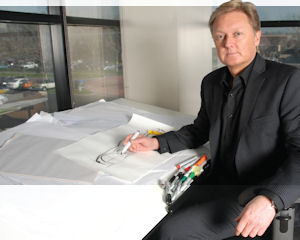
Henrik Fisker, who honed his design and marketing skills at some of the premier luxury car brands in the world, isn’t among them.
The cofounder of Fisker Automotive Inc. in Anaheim doesn’t dwell on the past or any missteps his company has taken in its four-year history.
He prefers the road ahead.
“We have a new disruptive technology which will really change the way you think about cars,” he said on a recent morning at Fisker Automotive’s headquarters along La Palma Avenue.
Fisker’s resume of iconic designs includes the Aston Martin DB9 and BMW Z8 Roadster. He’s confident Fisker will sell some 12,000 cars this year, zooming from startup to $1.2 billion in sales during its first 12 months in full production.
The company’s flagship model is the Karma, a highly touted luxury hybrid sedan that sells for roughly $100,000.
Its technology features an advanced powertrain that combines an electric motor with a gas-powered engine. After 50 miles, the internal combustion gasoline engine powers the electric motors for an additional 250 miles.
Fisker lives in Los Angeles and has been testing the 50-mile limit for months in his Karma on daily commutes, varying his routes on the local freeway system.
Fisker said he sat down at the drawing table with an environmentally friendly vehicle in mind. That meant a car that that didn’t sacrifice style, power or size—hallmarks of the classic sports car.
“We have a design which I think has been recognized worldwide,” he said.
Kudos
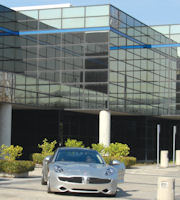
Industry kudos include Automobile Magazine’s 2012 design of the year and Top Gear’s luxury and top car of the year.
Will consumers follow suit?
That bears watching as Fisker Automotive takes on the likes of BMW, Jaguar and Mercedes-Benz in the highly competitive luxury car market.
Fisker’s Irvine dealership has sold nearly 140 Karmas to date. The first car left the showroom floor Dec. 15. About 20 owners are driving them around OC today.
The Irvine location expects to move 180 to 200 Karmas in 2012, according to Marcelo Sandoval, who runs sales there.
“I’m way ahead of the pace,” he said.
To hit 12,000 units, Fisker would have to sell about the same number of cars Jaguar did in the U.S. in 2011, according to motorintelligence.com.
BMW outdueled Mercedez-Benz last year as the top luxury brand in the U.S., selling 247,907 cars, nearly 3,000 more than its chief rival.
Fisker Automotive has gone to some lengths beyond its hybrid engine to build an eco-conscious brand. The Karma’s solar roof—the largest designed for a car, according to the company—is billed to extend driving range another 200 miles annually.
The wooden floors in Anaheim were taken from reclaimed hardwood skids from its Delaware plant. Part of the Irvine dealership’s floor is made from 200- to 300-year-old wood taken from sunken ships on the floor of Lake Michigan.
Fisker Automotive also offers buyers a host of wood trims, from mahogany rescued in California storms to walnut burl reclaimed from the state’s 2007 wild fires.
“Not one tree has been cut down to make the Karma,” Sandoval said.
The Irvine location, like all the company’s 44 franchised dealerships in the U.S., has solar-powered signs.
BMW Vets
Fisker launched the company in 2007 with longtime colleague Bernhard Koehler. The duo first met in 1992 during their days at BMW, and their careers have run parallel paths since.
Koehler formerly served as director of operations at DesignworksUSA, BMW’s U.S. unit in Newbury Park.
Fisker held the title of president and chief executive there.
The pair earned industry and enthusiast credibility with the Aston Martin DB9 and Vantage, as well as the BMW Z8—cool enough for James Bond to call his own in The World Is Not Enough.”
They centered their own car company on design.
They started with Fisker Coachbuild in 2005 to design a concept car, and later morphed into Fisker Automotive.
“We immediately had a business plan and went out to raise money, and we got the first round done fairly quick,” Fisker said.
That was a $5 million investment from Palo Alto Investors LLC and Italian entrepreneur Gianfranco Pizzuto, who later started GP Supercars, now Fisker Automotive’s importer in Northern Italy.
Fisker has raised more than $876 million in private funding to date and more than $1 billion counting government loans and grants.
The company took some heat in October after ABC News ran a story suggesting that a $529 million Department of Energy loan to Fisker aided manufacturers in Finland instead of their U.S. counterparts. The story also lumped Fisker Automotive with defunct solar-panel maker Solyndra LLC in Fremont, which went bankrupt after receiving a $535 million loan from the Energy Department.
Solyndra is one of three companies to seek bankruptcy protection after getting significant backing from the Department of Energy under a green industry initiative. The most recent, New York-based electric battery maker Ener1 Inc., was chosen for a $118 million stimulus grant in 2009, and filed for bankruptcy last week.
The final assembly of the Karma in Finland accounts for less than 5% of the total cost of the car, according to Fisker. He said the federal agency’s loan requirements have been followed, and the company has created more than 2,000 jobs in the U.S.
600 Workers Here
The company employs about 600 in Anaheim and plans to hire up to 1,500 workers in Delaware at full production at a former General Motors Co. plant that Fisker bought for $18 million.
“Governments around the world, whether that’s in China or Europe, are supporting their local car makers to race to get out first with this new technology,” Fisker said. “We’re the first in the world to come out with this technology in the luxury class before the Japanese, before the Europeans. We have used the proceeds in a good way.”
The loan flap was one of several road blocks the company has faced in recent months.
The Karma got a certification from the U.S. Environmental Protection Agency on a driving range of 32 miles rather than the 50-mile range Fisker touted prior to the government certification.
Independent tests have shown the car gets 50 miles on the electric charge.
The automaker’s Waltham, Mass.-based lithium-ion battery pack supplier, A123 Systems Inc., in December warned of a potential coolant leak from misaligned hose clamps. The announcement led to the recall of 239 Karmas.
The problem has been fixed, according to the automaker.
“All car makers have recalls, even Toyota,” Fisker said. “It’s a state of business. There is nothing unusual about that.”
Earlier this month a software upgrade delayed more deliveries.
“We were slightly optimistic and missed some deadlines, but it was important for us to get the product right,” Fisker said. “There were extremely big expectations set for a new car company because we were in a lot of press.”
Tempered PR
Fisker plans to temper early publicity of his next model, a lower-priced midsize sedan that’s been estimated at $50,000.
He said it would be released sometime in 2013. It will also lose its Project Nina name—inspired by Christopher Columbus’ voyage from the old world to the new—before it goes on sale.
Fisker is avoiding setting timetables on new models, including an upscale station wagon tentatively dubbed the Surf, but his eyes are clearly set on the future.
“The reality is we were out faster than anybody else, and now it’s in the market,” he said. “We really don’t look back. We’re going to look forward now.”
