
Orange County will see slow job growth over the next two years while housing construction in Southern California remains weak, according to California State University, Fullerton economists.
The economists, Anil Puri and Mira Farka, head the Woods Center for Economic Analysis and Forecasting, which released its annual economic forecast on Oct. 30. On the national front, Puri and Farka forecast that economic growth will slow to 2.1% this year from 2.8% last year before picking up to 2.4% in 2026.
“The economy is not in as bad a shape as many analysts believe, and overall fundamentals are quite solid,” the two researchers told the Business Journal the day before the forecast was released.
Inflation, as measured by the Consumer Price Index, is projected at 3% for next year, about the same pace measured in September.
Bumbling, Stumbling Economy
The U.S. economy has muddled through “bumbling and stumbling, teetering and tottering, and, against all odds, coming out fine—at least so far,” Puri and Farka say.
They cite the economic strength shown in the second quarter and a “sturdy” 2.5% rise in household spending.
The economists also addressed concerns that the frenzy over AI is forming a “bubble” that could burst and disrupt business models.
“What matters for the here and now is that, bubble or not, the AI-driven boom is still in its infancy—it has a few more innings to play and a few more dances left in it yet,” the forecast said.
While the median OC home price was a staggering nearly $1.4 million as of August, there are suggestions that “the county’s market may be cooling after a five-year surge,” the CSUF report says.
“With homeownership increasingly out of reach, a greater share of Californians are renters—44%, compared with 35% nationally—and rents, particularly in coastal cities, are among the highest in the U.S.,” Puri and Farka said in the forecast released at an event at the Hyatt Regency in Irvine.
New housing construction is “woefully inadequate,” according to the report. It noted that the average monthly number of building permits for private housing in Southern California fell from 2,933 in 2015 to 2,130 in 2025, a 27% decline.
California Employment Lags
In terms of employment, California’s economy continues to lag behind the nation as a whole, the economists said in the 31st Annual Economic Forecast.
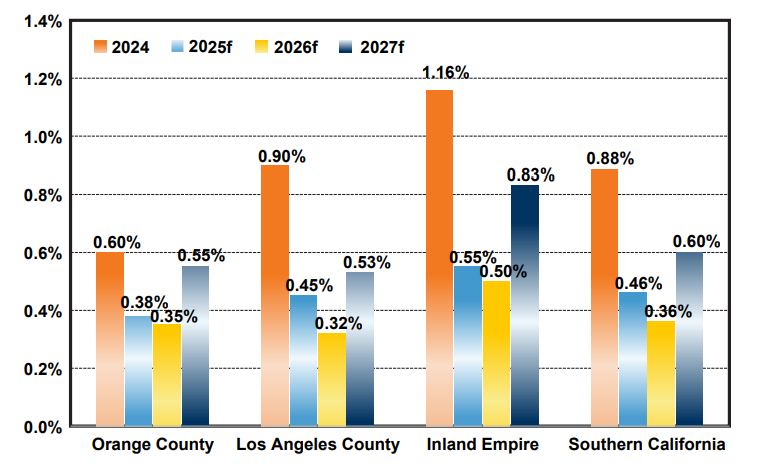
Orange County’s payroll employment is expected to rise by “only” 0.38% this year, followed by increases of 0.35% in 2026 and 0.55% in 2027, the economists said.
“Over the long term, payroll employment growth in Orange County has hovered around 1%,” the researchers told the Business Journal, referring to the period from 1991 through 2024. “But it has been very slow since the pandemic.”
Puri and Farka said that “lack of housing and slow labor force growth are hampering employment growth” in Orange County.
Orange County’s unemployment rate fell to 4.6% in August from a revised 4.8% in July and above the 4.5% in August last year, according to the state’s Employment Development Department.
Departures from OC, Aging Labor Force Growth: CSUF Economists
On issues affecting Orange County: “As we mentioned in the report, lack of housing and slow labor force growth are hampering employment growth. Both are equally important and are somewhat linked. Labor force growth has slowed partially by aging demographics (this is a nation-wide phenomenon) and partially due to outmigration.
The latter is linked to living costs, chief of which is housing costs. This is the main reason why areas that have seen employment (and labor force growth) are areas where cost of living (particularly housing) is cheaper— Inland Empire, Central Valley, etc. whereas expensive areas have created fewer jobs.”
On the labor force and housing: “Labor force growth since the pandemic has been much slower in Orange County, and in fact, in California as a whole. Domestic out-migration and slow recovery in foreign immigration has kept population growth rates lower since the pandemic.
Again, housing costs have sky-rocketed in the county (by 70%) since the pandemic, which has made dynamics of labor market growth (and employment) more challenging.”
The U.S. economy as a whole: “Consumer balance sheets, net wealth, and business earnings are still healthy and other economic indicators are not falling off the cliff. Consumers are still spending.
It is true that employment growth is anemic, and we expect it to be slow over the next several quarters (partly also because of labor supply issues – lower immigration) but a few factors should support growth in 2026 and beyond: The OBBB (President Trump’s One Big Beautiful Bill) will provide stimulus in the near term.
Its cutbacks don’t take effect until after 2027. Rate cuts should juice growth. Productivity growth from AI will boost corporate profits and the tariff-induced domestic production will add to economic strength.”