
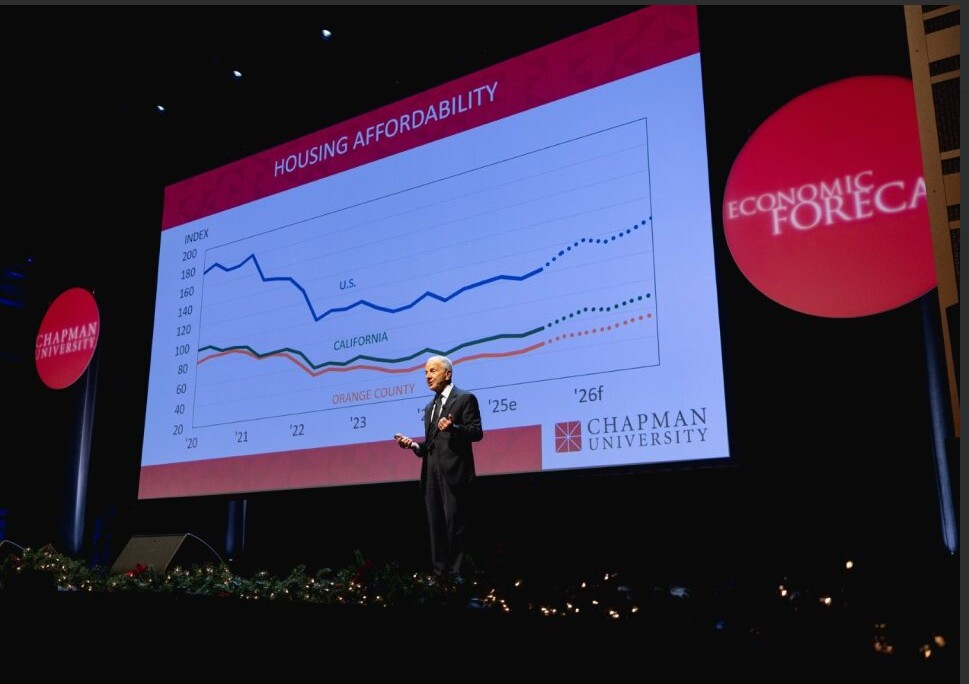
Look for a slight pickup in U.S. economic growth next year and get set for virtually no growth in Orange County jobs while local home prices are still out of reach of many families, Chapman University economists forecast.
The experts, led by university President Emeritus Jim Doti, presented their annual outlook on Dec. 11 to several hundred business leaders and academics at the Musco Center for the Arts on the campus in Orange.
“While there are some negatives like job growth and tariffs, there are other big major positives like capex (capital expenditures) spending on AI,” Doti told the Business Journal.
The U.S. economy will grow a modest 2% next year despite the negative impact of President Donald Trump’s tariffs, the Chapman experts forecast. The researchers have consistently been among the country’s most prescient economic forecasters.
A year ago, the Chapman forecasters predicted 1.8% real GDP growth for 2025. The economists didn’t change their estimate, maintaining it will be 1.8% this year.
By contrast, California State University, Fullerton economists predicted in October a higher 2026 U.S. growth rate of 2.4%.
The Philadelphia Fed Survey of Professional Forecasters, which is based on 33 forecasts, is predicting 1.9% increase in 2025 and 1.8% in 2026. Those forecasts have risen from three months ago when they were at 1.7% and 1.6% respectively.
“Household wealth is record high—incredible growth there,” according to Chapman’s Doti.
Inflation to Tick a Bit Higher
Inflation as always will be closely watched, especially following the Federal Reserve’s decision to cut interest rates by a quarter of a percentage point last week.
Inflation as measured by the consumer price index should even out to 3.1% by the end of next year, just above the September rate, according to Doti’s team.
The Chapman researchers also acknowledged that the “constant state of flux” of Trump’s tariffs makes forecasting even more difficult (see stories, this page).
Despite the OC difficulties, a growing trend toward more rental apartment construction will help make living in Orange County somewhat more affordable, but the rental costs are still extremely high.
For years, business leaders have pointed to housing as an impediment to local job growth. They include warnings from Anduril Industries founder Palmer Luckey and Bill Carpou, chief executive of business accelerator Octane.
“An increasing proportion of residential construction will be multi-family units. In 2022, 51.9% of all new residential permits were multifamily. Our forecast for 2026 indicates that that percentage will increase to 68.2%,” the Chapman economists said.
Would-Be Home Buyers
Home buyers will face challenges with family incomes often falling short, according to the Economic Forecast.
On the residential front, the forecast of a decline in mortgage rates from an average of 6.6% in 2025 to 5.6% in 2026 will lead to an increase in housing affordability. However, even with the increase, median family income will be only 55.1% of what is required to purchase a median-priced home, according to Doti’s team.
That lack of housing affordability “will constrain housing appreciation to about 2% in 2026,” they said.
New residential construction, as measured by housing permit activity, is forecast to amount to almost 8,000 units, slightly above this year’s level.
Yet, construction activity will depend in large part on population growth. In 2021, the population in Orange County declined by almost 24,000.
While there was virtually no population growth in OC in 2024, the number “may turn negative again if foreign immigration drops sharply,” according to the economists.
Weak Job Market in OC
Doti’s team said, “As weak as job growth is at the national level, it’s even worse in Orange County.”
The researchers summed it up like this: “Weak job creation stymies growth—even lower mortgage rates won’t help.”
“Our forecast for job growth in Orange County predicts virtually no growth in 2026,” the economists said, with total payroll employment inching up slightly from 1.69 million to just under 1.7 million.
In fact, some companies have been shedding jobs locally, including Verizon and Amazon.
There is a bright spot for teachers, doctors and nurses: the education and health sector is the only one expected to register significant growth at 3.8%.
The other key members of Dotis’ team at the A. Gary Anderson Center for Economic Research are economics Professor Raymond Sfeir and Fadel Lawandy, clinical associate professor of real estate and finance.
Tariffs, Job Cuts Make Predicting More Difficult
Pity the renowned economic experts trying to forecast the full effects of President Donald Trump’s tariffs and his government headcount cutbacks.
“We’ve never had increases in tariffs the likes of which we’ve experienced this year,” said Chapman University economists led by President Emeritus Jim Doti.
“Even the infamous Smoot-Hawley Tariff Act of 1930—widely perceived as worsening the Great Depression—only increased tariffs on average from 13.5% to 20% and focused mainly on agricultural and manufactured products. In contrast, the Trump tariffs cover most goods and affect all of our trading partners. The fact that those tariffs seem to be in a constant state of flux doesn’t make forecasting any easier, nor do the unprecedented reductions in government employees.”
Doti’s team added: “Much of the spike in investment spending spurred on by epic levels of AI will be offset by the negative economic impact of tariffs.”
—Kevin Costelloe
Chapman’s Doti Says Sees SoCal University Graduates Leaving for Other States
Chapman University President Emeritus Jim Doti spoke with the Business Journal on Dec. 8 to discuss his team’s 2026 economic forecast. Here are excerpts:
• On the forecast of 2% economic growth in the U.S. in 2026: “While there are some negatives like job growth, and tariffs, there are other big major positives like capex spending on AI. Household wealth is record high, incredible growth there. So, when you put all these things together, the model is telling us 2%. So, if I were a betting man, I’d bet on that.”
• On the greater proportion of apartment construction relative to single-family homes: “I believe the greater proportion or increase in proportion of multifamily is a result of the affordability problem. People can’t afford a home. They have to live somewhere. So, an apartment can be built at lower cost and obviously more affordable.”
• However, “we don’t have good data on rents.”
• “Thankfully, we are producing more apartments and that should mitigate or help prevent rents from increasing faster than they otherwise would.”
• Drop in mortgage rates “does not solve the affordability problem.” The median family income in Orange County is 45% below what is needed to buy a median-priced home.
• Zero population growth: “In the future, it’s not likely that we’re going to be able to attract 10,000 or, more specifically, 12,000 immigrants. Given national trends, I suspect that will drop sharply, maybe perhaps to zero.”
• Southern California has great schools, including UCLA, CalTech and Chapman itself, but the region isn’t generating enough jobs. “I think a lot of our graduates from these schools will be going and seeking jobs in other states because that’s where the growth seems to be.”
• On California taxes: “When are we going to realize that many of our problems simply relate to the fact that our taxes are too high? It doesn’t take a genius to see that.” High relative state taxes not only drive out jobs, but they also drive out people, his team’s forecast added to the Chapman report.
—Kevin Costelloe
Chapman’s Look Ahead in Brief
Here are some key points from Chapman University’s forecast of what lies ahead for 2026:
• U.S. economic growth will accelerate slightly to 2% from an 1.8% currently estimated for this year.
• ‘Epic levels of AI investment’ in the U.S.
• ‘Negative impact’ of Trump’s tariffs.
• OC median existing home price will increase by 2% to almost $1.3 million.
• ‘Virtually no growth’ in OC jobs.
• Permits for new residential construction are predicted at 7,872 for next year, up 3% from this year.
• OC population may fall if immigration drops sharply.
—Kevin Costelloe