

Elliot Stern, president of Saddleback College, said the school is preparing students for the “workplace of the future” with its latest expansion.
This fall, Saddleback opened two new buildings for its advanced transportation and culinary arts programs at its satellite campus in Tustin.
“These are two fields that learning-wise are going to be key to future training,” Stern told the Business Journal.
Both facilities, totaling 50,000 square feet, cost $63 million to construct. Combined, they can serve up to 1,800 students.
It’s the first time Saddleback will have formal credit offerings off-site outside of adult education, according to Stern.
They’re the newest additions to South Orange County Community College District’s Advanced Technology Education Park (ATEP) at the grounds of Tustin’s former military base.
The 61.4-acre complex serves students at Saddleback and Irvine Valley College, which opened its School of Integrated Design, Engineering and Automation in 2018.
Advanced Transportation
Saddleback’s new automotive technology building was designed to look like a high-end dealership, with its lobby modeled after a showroom.
The 30,000-square-foot facility has conference space and four classrooms with large garage doors allowing cars to be brought in.
In the back is an automotive shop featuring 14 lift bays and a lab for calibrating automotive radar systems. Behind the building, there is a 15,000-square-foot yard storing 36 donated vehicles for instruction and supplies.
“This is the first time to our knowledge that a facility has been built specifically to support non-fossil-fueled vehicles and autonomous vehicles,” Stern said.
Two of the 12 certificates of achievement Saddleback offers focus on emerging technologies such as electric vehicles and hybrid propulsion systems, as well as alternative fuel technology.
One of the most exciting features, according to Stern, is what’s called a black room, where students learn to calibrate and adjust light detection and ranging (LiDAR) sensors for autonomous vehicles.
“So, it’s very different than a traditional auto tech facility,” Stern said.
At the same time, Saddleback wants to train students on all levels of equipment, so they’re prepared wherever they end up getting employed, according to Casey Cooper, interim manager of ATEP operations and programs at Saddleback.
The auto shop has “some of the oldest pieces of equipment someone might find in a shop” for tire certification and engine repair, requiring students to learn how to do things manually.
“Regardless of whether it’s the oldest standard or the newest standard, our students are going to leave with the opportunity to be functional,” Cooper told the Business Journal during a tour of both facilities.
The issue with being in the southernmost end of Orange County up until now is that the area has limited dealerships and regional headquarters, according to Stern.
“Being closer to central county at the north end of South County really gives us an opportunity to partner with bigger industry partners,” he said.
The new auto building is a few miles from the headquarters of Rivian Automotive Inc. (Nasdaq: RIVN), among other notable EV firms based in the area.
Some of Saddleback’s current industry partners include Jaguar, Land Rover, Audi and Subaru.
Saddleback offers internships to students through partnerships with local dealerships and businesses.
“The issue that we have with a lot of students in auto tech is they are in such great demand that the dealerships are pulling them away from their academic programming before they complete and get all their training,” Stern said.
“This way, students can earn money and the dealership wins because they’re getting an employee that hopefully will be loyal upon graduation.”
Culinary Arts Program
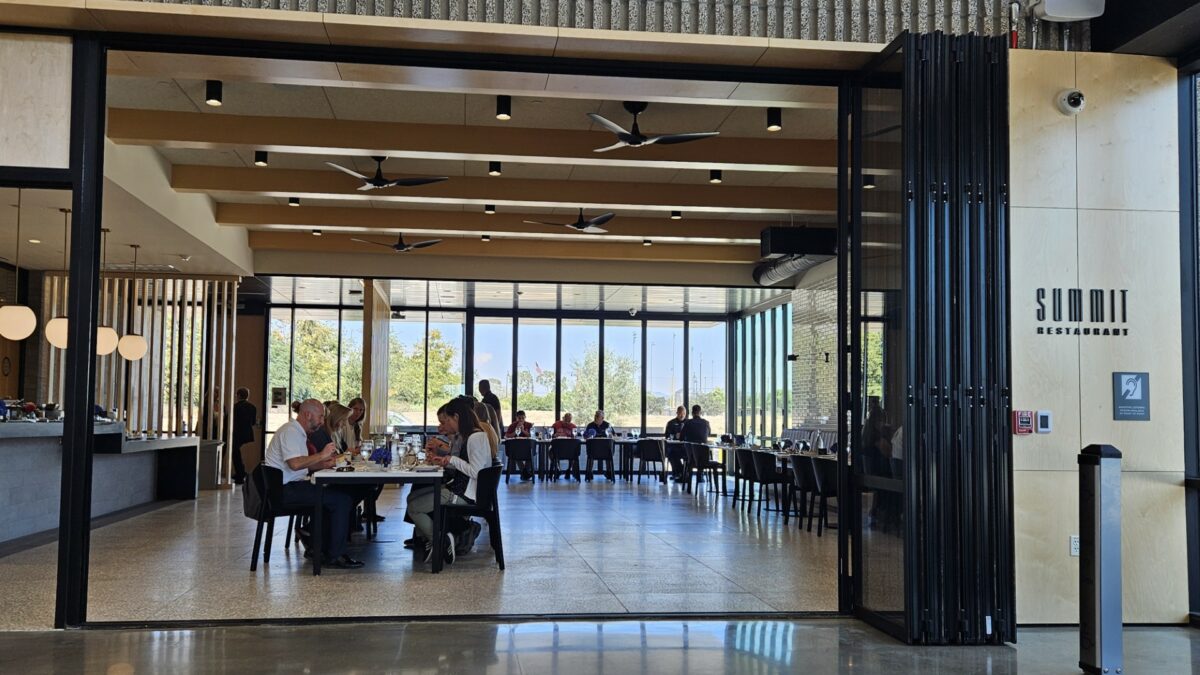
The culinary program moved from “probably the worst facilities on campus” to a 20,000-square-foot, state-of-the-art facility, Stern said.
It houses four commercial kitchen labs, a student-run restaurant that can seat up to 70, an outdoor vegetable and herb garden and a café in the lobby featuring pastries made by students.
In each kitchen lab, there are cameras and large TV monitors to display what the instructor is doing.
Kitchens are all-electric as part of Saddleback’s focus on sustainability, according to Cooper.
“The future of the industry is going to be electric, so we wanted students to be comfortable and trained on these pieces of equipment,” Cooper said. .
The culinary program offers nine degree, certificate and noncredit pathways ranging from food science to hospitality management.
Saddleback introduced two new one-semester programs this fall: a foundational and basic culinary program and baking and pastry, intended for entry-level employment in the food service industry.
Stern said that their new short certificate programs, which can be completed in one semester or less, are attracting a lot of adult education students.
Culinary, in particular, has students aged 25 or over looking to upskill.
“It’s a passion program,” Stern said. “They often go back because it’s something they always wanted to do and didn’t get to.”
The school had expected enrollment for culinary and auto to go down due to the move, but has seen increases in both.
Saddleback’s total enrollment as of October was 24,555 students. Of those, 18,448 are part-time.
Currently, there are 641 students enrolled in culinary and 558 in auto, a 54.8% and 16% increase from last year.
Stern said they expect “those numbers to double in the next three to five years.”
In January, Saddleback is slated to open its new computer science and math building that has been under construction for four years.
The three-story, 50,000-square-foot building will have specialized learning areas such as a cybersecurity lab with glass walls, meant to mimic most major technology companies, Stern said.
“Students will look in from the lobby and see what it is to work in a cybersecurity lab and a profession that maybe they didn’t think was for them,” Stern said.
