

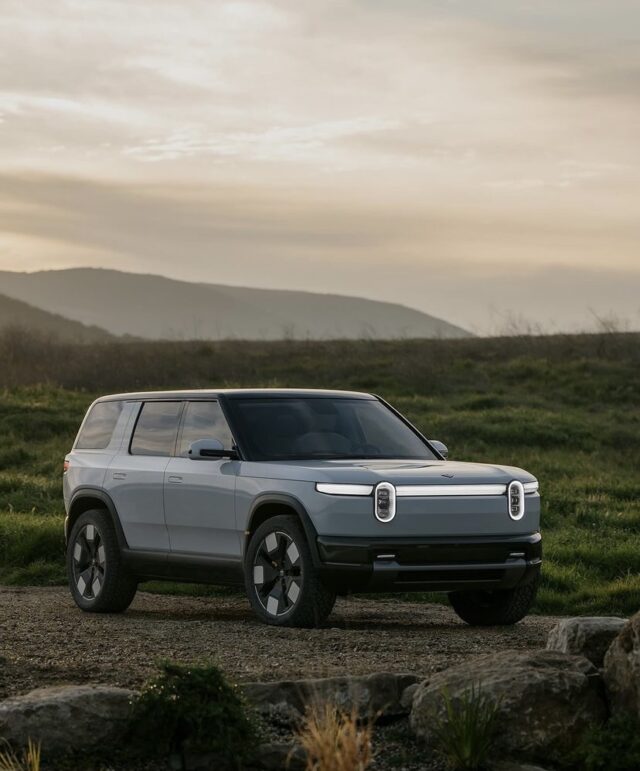
Rivian Automotive Inc. is cutting 4.5% of its workforce, impacting roughly 600 companywide employees, as the electric vehicle maker aims to streamline operations ahead of its next major vehicle launch.
“These are not changes that were made lightly,” Chief Executive RJ Scaringe told employees in an Oct. 23 memo obtained by the Business Journal. “With the changing operating backdrop, we had to rethink how we are scaling our go-to-market functions. This news is challenging to hear, and the hard work and contributions of the team members who are leaving are greatly appreciated.”
Scaringe, who knew at the age of 10 that he wanted to start his own car company, said the workforce reduction was a “very difficult” but necessary decision to ensure the success of the business.
“With the launch of R2 in front of us and the need to profitably scale our business, we have made the very difficult decision to make a number of structural adjustments to our teams,” he said in the memo. “These changes result in a reduction in the size of our team by roughly 4.5%.”
The Irvine-based company’s R2 is a smaller and less expensive SUV, set to arrive in 2026.
Scaringe outlined a few organizational changes, as well, including consolidating Vehicle Operations into the Service division and folding the Delivery and Mobile Operations into the Sales division.
This will “ensure the purchase experience is as seamless as possible with a single touchpoint throughout the entire sales process and to delivery,” he said.
Search Begins for First Ever CMO
Perhaps the biggest staffing change is happening to Scaringe himself, as he picks up an additional title.
He said the company is forming a single, unified marketing organization that will be led by Rivian’s first chief marketing officer.
While the company recruits for that newly created position, Scaringe said, “I will be acting as interim CMO.”
The Marketing Experiences team, led by Denise Cherry, and the Creative Studio team, led by Matt Soldan, will both report directly to Scaringe.
“These changes are being made to ensure we can deliver on our potential by scaling efficiently towards building a healthy and profitable business,” Scaringe said. “I am incredibly confident in R2 and the hard work of our teams to deliver and ramp this incredible product.”
It’s unclear how many workers in OC were impacted by the recent layoffs. The company declined to comment when asked by the Business Journal.
Rivian employs an estimated 1,800 workers in Orange County, making it the largest automaker with operations here.
Restructuring Ahead of R2 Launch
The layoffs, first reported by the Wall Street Journal, come less than two months after Rivian made another workforce reduction.
In September, the automaker made cuts to its commercial sales and service team that affected less than 1.5% of its total workforce. At the time, the company said it was striving to streamline operations ahead of the R2 launch.
“We have made some recent changes to the commercial team as part of an ongoing effort to improve operational efficiency for R2,” a spokesperson told the Business Journal at the time.
Rivian operates more than 60 service centers and 20 retail showrooms across the U.S.
Last week, Rivian also agreed to pay $250 million to settle a 2022 securities class-action lawsuit that accused the electric vehicle maker of misleading investors about the cost of its vehicles at the time of its initial public offering. The company denied any wrongdoing, saying the settlement “will enable Rivian to focus its resources on the launch of its mass market R2 vehicle in the first half of 2026.”
Rivian (Nasdaq: RIVN) shares dropped 1.3% to $12.92 on Oct. 23, the day of the layoff announcement. Its market cap at press time was $16 billion.
The latest restructuring comes as Rivian prepares for the 2026 debut of its smaller, lower-priced R2 SUV.
The vehicle puts Rivian into a lower price point with the R2 starting around $45,000, compared to R1’s average price tag of $90,000.
With the R2’s smaller price point, it reaches “the full breadth of the market,” Scaringe told the Business Journal in a recent interview.
“All the things we’ve done in R2 are built off of learnings we’ve had from R1,” he said. “We took everything we did on R1—which is an amazing car—we refactored into a smaller form, much smaller, and took a lot of cost out.”
The EV maker recently broke ground on a $5 billion plant in Georgia, which is projected to produce up to 400,000 vehicles annually.
A factory in Illinois is scheduled to produce as many as 43,500 vehicles this year.
Scaringe, who grew up “wildly into cars,” told the Business Journal on Oct. 2 that he’s optimistic about the EV sector, despite recent headwinds, including the end of federal EV tax credits.
“I’ve said this many times: I’ve never been as confident as I am today about what our trajectory looks like.”
