
At the headquarters of Rivian Automotive Inc. in Irvine, a photo of founder and Chief Executive RJ Scaringe as a kid driving a red go-kart is pinned to the wall of a meeting room.
Growing up “wildly into cars,” Scaringe said he knew as a 10-year-old that he wanted to one day start his own car company.
“I didn’t really know what that meant. I certainly had no idea how hard that was going to be and then subsequently started working towards it,” Scaringe told the Business Journal in an exclusive interview.
Scaringe has succeeded in an industry that has had few startups because of high capital costs. He has convinced investors like Amazon, Ford and Volkswagen to pony up billions.
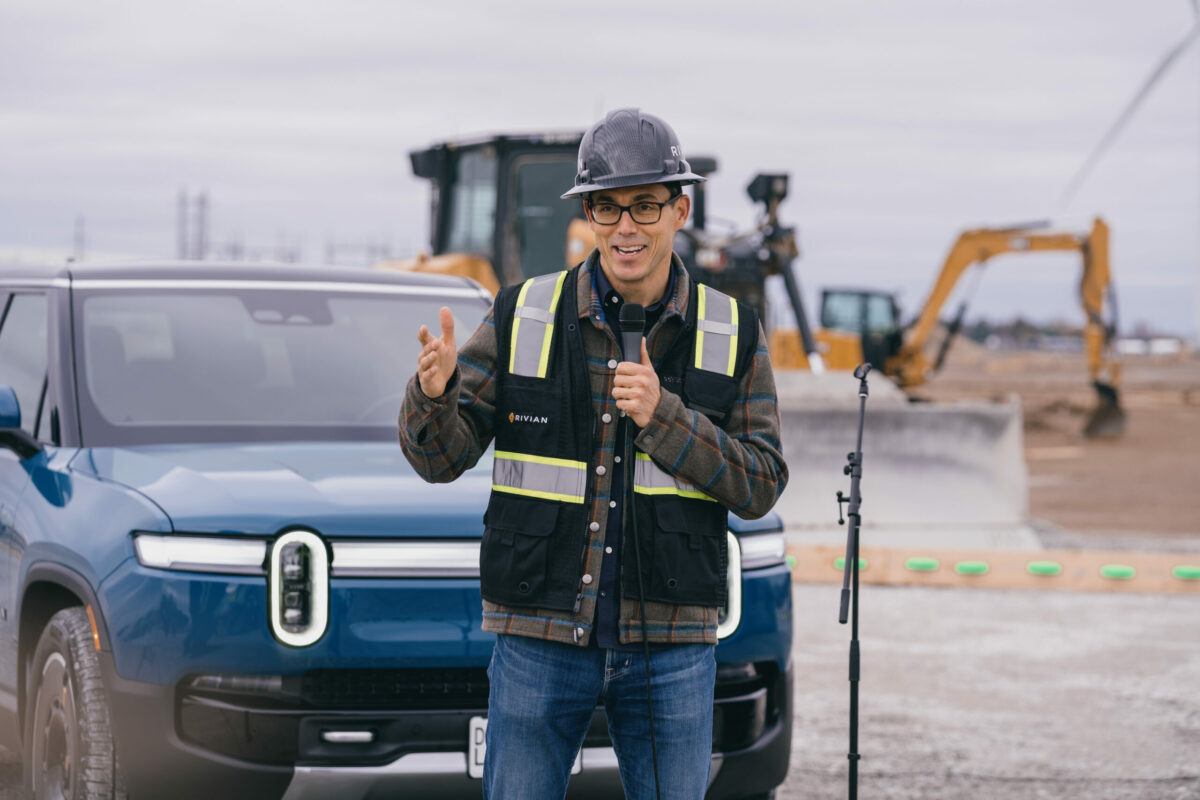
He started a factory in Illinois that’s scheduled to produce as many as 43,500 vehicles this year. Rivian last month broke ground on a $5 billion factory in Georgia with a goal of annually making up to 400,000 vehicles.
“It’s just a very hard business to build, and so hard that most entrepreneurs, I should say, are highly idealistic and optimistic,” Scaringe said. “And as I reflect back, it’s good that I was so idealistic.”
While the share price has faded after its exuberant initial public offering in 2021, the company still sports a $16 billion market valuation with sales that are expected to reach $5.3 billion this year and then accelerate 33% to $7 billion in 2026.
Even with the end of federal EV tax credits, the founder is holding onto his vision.
“I’ve said this many times: I’ve never been as confident as I am today about what our trajectory looks like.”
With about 1,800 employees in Orange County, it is the largest automaker with operations here.
The Beginning
Scaringe dove into the car industry as a teen. He gained experience restoring cars, then jumped to a machine shop in his Florida hometown, where he worked until he went to college. Scaringe studied mechanical engineering at Rensselaer Polytechnic Institute in New York City and then pursued his PhD at the Massachusetts Institute of Technology (MIT).
In 2009, Scaringe founded Rivian right out of school.
“I knew I wanted to start a car company, but then as I started to think about it more, I realized I wanted to start something that was going to help make these things that I love so much less bad,” he said with a laugh.
“I realized the cars that I adored and I enjoyed being around and working on were part of so many of our big geopolitical and social challenges.”
Whether those conflicts were about oil, local air quality or the general climate, Scaringe said he was motivated to figure out how to make more efficient cars.
“To me, it’s so clear, it’s indisputable that I can’t even imagine a future state where in the fullness of time—now whether that’s 10 years from now or 50 years from now—that everything on the road is electric.”
Scaringe designed Rivian to be a major part of this transition.
The entrepreneur said he initially started with a sports car but shifted to an SUV and truck instead, knowing these were top-selling vehicle types.
“That is something we’re deeply convicted in. And part of why Rivian exists is to help make really exciting and engaging electric vehicles that, regardless of your views on sustainability or climate, it’s just a better product.”
Not the Classic Startup Story
Scaringe said that one of the biggest challenges of starting an automotive company was the amount of capital required to stay afloat and scale.
“You need a lot of capital to develop the technology. You need technology to raise the capital,” he said.
“For a hardware business, it’s the hardest part. It’s very different than a typical software business, where you can do a Series A financing and launch it out of your house or out of your dorm room, which is the classic story.
“I used to say all the time, if you had $5 billion, a 4,000-person engineering team, a manufacturing plant, 300 to 400 willing suppliers, and you had all those things at the very, very beginning, it would still take you four years to launch the first product,” Scaringe added. “And the challenge is you have none of those things.”
Scaringe took Rivian public in 2021 with that year’s largest initial public offering (IPO) of almost $12 billion. Its market cap soared above $120 billion shortly thereafter.
Rivian has since released the R1 SUV and truck alongside its electric commercial delivery vans, which are used by Amazon.
Next in the lineup are the smaller and less expensive R2 SUVs, set to arrive in 2026, and the R3 models—which were revealed in 2024 at Rivian’s retail showroom in Laguna Beach.
Manufacturing currently takes place out of a 4.3-million-square-foot facility in Normal, Illinois. Rivian in September broke ground on its long-awaited plant in Georgia, where it plans to manufacture the R2 and R3 platforms starting in 2028. The secondary outpost is expected to generate 400,000 units of annual production capacity.
Volkswagen Group is Rivian’s most recent believer. After forming a joint venture in 2024, the Irvine automaker unlocked a $1 billion equity investment from Volkswagen after reporting its second consecutive quarter of gross profit in May; it was funded during the second quarter ended June.
In total, the JV deal secured $5.8 billion from the German manufacturer to further develop Rivian’s in-vehicle software.
Unlocking Growth with the R2
Since going public four years ago, Rivian has had a long list of things to prove to investors and Wall Street. At press time, the company has a $15.7 billion market cap with shares trading around $13.14 apiece.
As of now, Scaringe said it’s no longer about whether customers are going to buy the EVs.
“When an investor looks at Rivian today, they’re not questioning the demand generation capabilities because of the success of R1,” he said.
Esquire named the Tri-Motor R1S the publication’s Car of the Year for 2025. In California, the R1 is the best-selling premium SUV, EV or non-EV, over $70,000 according to the state’s New Car Dealers Association in 2024.
“It’s, ‘can we ramp R2, and can we grow awareness beyond the coast?’” Scaringe said.
In Orange County, Rivian sales are down 11% to 999 through the first eight months of 2025; its market share is 0.9%, according to the OC Automobile Dealers Association.
By contrast, rival Tesla also saw its sales fall 15% to 15,910; it has a 13.9% market share, lagging only Toyota, which has an 18.1% share. During the same period, overall vehicle sales climbed 2.1% to 114,105 in Orange County.
The CEO said that the R2 will be the key to unlocking future growth. And so far, production is on track.
The vehicle puts Rivian into a lower price point with the R2 starting around $45,000, compared to the R1’s average price tag of $90,000. And the R3 crossovers will be priced even lower.
With the R2’s smaller price point, it reaches “the full breadth of the market.”
“All the things we’ve done in R2 are built off of learnings we’ve had from R1,” Scaringe said. “We took everything we did on R1—which is an amazing car—we refactored into a smaller form, much smaller, and took a lot of cost out.”
“Just bringing that to market is going to open up a whole new aperture of different types of customers who can come into the brand,” he added.
Rivian recently narrowed its delivery outlook for 2025 to a range of 41,500 to 43,500 vehicles, from its previous guidance of 40,000 to 46,000.
Scaringe said the R2 release will be responsible for generating a “tremendous amount of growth.”
He said he’d be “happy” if the company could get a sizeable fraction of the huge market for the R2 vehicle type—5-seater, two row SUVs.
“We’re right bullseye in the biggest market, priced perfectly with the right segment.
From Their Eyes
Underneath that photo of RJ Scaringe at around 10 years old driving a go-kart is a picture of his oldest son Pete also riding in a go-kart. The nine-year-old recently starred in Rivian
Automotive’s latest commercial called “What If.”
Scaringe said it was around this age when he knew that he was going to create a car company.
Cut to founding Rivian in 2009, moving to California a few years later and now raising his three sons Pete, Max and Miles in Orange County, Scaringe is preparing to launch the second iteration of Rivian vehicles in 2026—the R2.
When looking back on the moments leading up to now, Scaringe thinks about his children when they launched the first car.
“They were born into this environment of ‘Dad is working on this car,’ and for their lives until end of 2021, it was this abstract thing, because there was no car out there,” he said.
The R1 rolled out to customers in November 2021, around the same time Rivian went public.
“So seeing it through their eyes, that suddenly this thing that Dad was working on became a thing that their friends at school would talk about and they would see, it was sort of surreal,” Scaringe said.