
Investing in hybrid technology is the most innovative way forward for luxury automakers, according to Karma Automotive Chief Executive Marques McCammon.
“If you want to prove that a battery technology can really stand up to the test of the market, you put it in something that’s very high performance, where the demands on it are very, very, very high,” McCammon told the Business Journal in an exclusive interview.
The Irvine automaker is building its future around extended-range electric vehicles, or EREVs, arguing that affluent buyers want electric performance without the limitations of charging infrastructure, McCammon said.
“That formula has never existed before,” he said. “That’s the part that we think is the new definition of exotic and ultra-luxury for the future.”
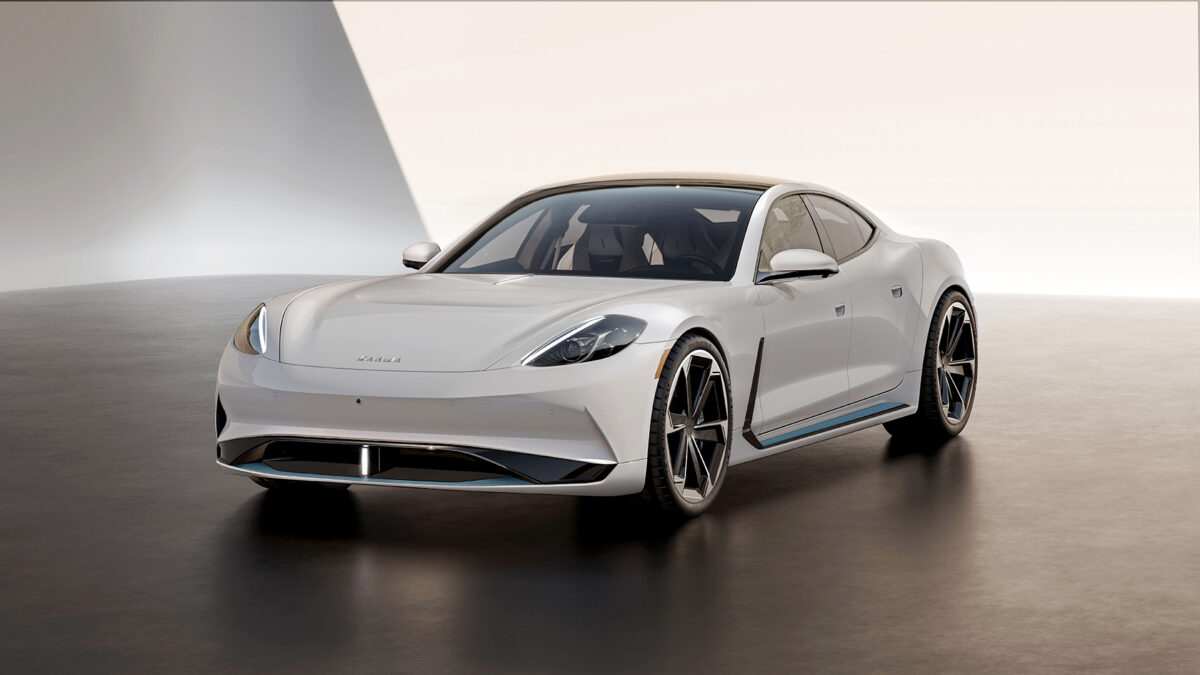
That’s why Karma is shifting its focus in 2026 to the Gyesera, a grand coupe originally planned as an EV that will now launch with EREV hybrid technology.
“I always tell people, what if you could drive an Aston Martin DBS or an Aston Martin Vantage but you get 68 miles to the gallon?” McCammon said. “You have all of the experience and all the same materials and all the same level of finish and customization of your most premium exotic car, but you also have 60 to 70 miles of fuel economy, and the ability to drive it completely as an EV or as a hybrid.”
Hybrid-electric technology has become the core of Karma’s portfolio, according to the CEO. By pushing EREVs, Karma is helping customers embrace the benefits of electric drive — “what it provides in terms of efficiency and performance is immutable” — while negating the obstacles of range and infrastructure, McCammon said.
Gyesera (pronounced gee-ya-sare-ah) is the fastest car Karma has made so far with a 566-horsepower motor that can accelerate the vehicle from zero to 60 miles per hour in 3.7 seconds, according to McCammon. The automaker aims for each Gyesera to be a “one of one” with expanded customization options as well.
“It is intended to go after the notion of moving the company upmarket to ultra-luxury and exotic spaces,” McCammon said. “We’re really going for a truly bespoke type of feeling and offering.”
Karma is planning to make “no less” than 50 Gyeseras this year, with a starting price yet to be announced. The company manufactured 146 Reveros in 2025, each starting at $123,100.
The Karma Roadmap
Karma’s origins date back to 2014, when the Wanxiang Group, a Chinese auto-parts supplier, acquired Fisker Automotive’s assets, including a plug-in hybrid powertrain, at a bankruptcy auction.
In 2016, Karma launched the Revero, a luxury plug-in hybrid with two electric motors; over the years, it’s won several awards.
Karma, which calls itself California’s only ultra-luxury automaker, typically makes only a couple hundred vehicles a year at its 550,000-square-foot assembly plant in Moreno Valley.
At the end of 2026, Karma will start testing its next vehicle, the Amaris GT, to prep for production in 2027. The Amaris is Karma’s first two-door coupe that will feature the EREV powertrain.
Karma added the Amaris to its production pipeline last year in response to waning consumer interest in fully electric vehicles, according to McCammon.
Karma hasn’t given up on fully electric vehicles yet. The company is currently working on Kaveya, a fully electric vehicle that will have more than 1,000 horsepower and a top speed of 200 miles per hour. The Kaveya, with a base price of around $300,000, will be in production from late 2027 to early 2028.
“Kaveya as all-electric is a strategic move to highlight the power of solid-state battery,” McCammon said. “We’re pointing the way through this vehicle.”
Karma is collaborating with Boston-based Factorial Inc. to launch the first solid-state battery production program in the U.S. for passenger vehicles, starting with the Kaveya. The battery maker is also working with Mercedes-Benz, Stellantis, Hyundai Motor Co. and Kia Corp.
Solid-state batteries are considered a better alternative to conventional lithium-ion batteries used in current electronic devices and can enhance overall vehicle efficiency, according to Factorial.
Ivara: A Luxury SUV
By the start of 2029, Karma will be manufacturing the Ivara, the culmination of all the technology the company has been developing and testing since the Revero. The automaker will return to using an EREV powertrain but with solid-state batteries and have new software-defined and AI-enabled architecture in the vehicle.
“That is our technology demonstration at scale,” McCammon said.
The Ivara also marks the first crossover SUV for Karma, which can seat up to five people. An early design concept of the Ivara was first shown at Monterey Car Week in 2024 and after a “strong” response, McCammon greenlit the product for development.
“Every model that Karma releases, our core technology pillars push forward one increment,” McCammon said. “So, we advance the powertrain, we advance the body technology and the lightweighting and we advance the software architecture.”
While McCammon considers the solid-state battery as a “gamechanger” for the mass market, he doesn’t want to throw new technology at the customer all at once.
“I think that where the industry makes mistakes is when we try to take the entire universe of technology and dump it into a vehicle. At one point, what happens is you give your customer technology overload,” he said.
“If you throw everything at them, you don’t give them enough time for them to tell you what parts of your portfolio matter to them the most.”
Karma Adds Members-Only Club
Karma Automotive is elevating the ownership experience for customers looking to purchase its limited-production ultra-luxury hybrid vehicles.
The Irvine-based automaker launched an exclusive engagement and ownership program in June called Karma Nexus, giving members priority access to all vehicles and events while also offering select participants the chance to invest in the company through direct invitation.
“Karma’s goal is for our products and experiences to reflect the successes of our Nexus members in ways that are as unique and distinctive as they are, and Karma Nexus represents the next level of that investment dynamic,” President Marques McCammon said in a statement.
McCammon partnered with Kai Cunningham, co-founder and chief executive of investment firm Limited Ventures, to form Karma Nexus. Cunningham advises athletes, entertainers and other high-net-worth individuals on wealth management through venture capital, private equity, real estate, and strategic brand partnerships.
Karma Nexus members already include several professional athletes such as Minnesota Timberwolves player Anthony Edwards and his business manager Justin Holland, Minnesota Viking quarterback Kyler Murray, Bryce Young of the Carolina Panthers and former QB for Mater Dei High School, Dylan Harper of the San Antonio Spurs and his brother on the Boston Celtics, Ron Harper Jr.
“My team and I are very intentional about where I put my name,” Heisman Trophy winner Murray said. “Karma checked every box. It’s luxury, it’s innovative, and it’s built for the future. That’s exactly where I want to be.”
Former NBA players Tracy McGrady and Josh Childress are also members.
Karma said that everyone “elected to invest in the company in addition to their vehicle ownership.” As a privately owned company, the automaker will keep the investments confidential.
“Karma stood out to me because I have the opportunity to help build a unique, luxury brand from the ground up,” Spur player Harper added.
“In a category where athletes represent enormous consumer influence and spending power, this deal could become a blueprint for future partnerships across the industry,” Cunningham said.
—Emily Santiago-Molina