

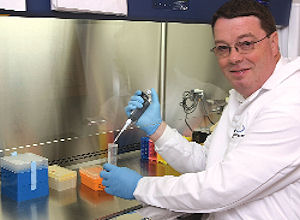
Could the University of California, Irvine’s new stem cell center turn research into business for the school?
“That is absolutely one of the things we would like to have happen,” said Peter Donovan, co-director of UC Irvine’s Sue and Bill Gross Hall.
The center, an $80 million, 100,000-square-foot building that debuted this month, could be the source of companies or licensed technology and possible treatments of spinal cord injuries, diabetes and Alzheimer’s disease, among others.
That could spur revenue that flows back to the university, Donovan said.
Researchers and officials plan to reach out to biotechnology companies, large drug makers and venture capitalists in a bid to attract money and alliances, he said.
“One of the things that we’d really like to do—and this field is ripe for it—is to engage that community much better than we have in the past,” Donovan said.
The university has little history producing companies compared to other public and private universities in the state, such as the University of California, San Diego, the University of California, Los Angeles, and Stanford University.
The UCI Office of Technology Alliances—which seeks to commercialize university research—lists 31 companies that originated from faculty members, most healthcare-related.
They include Xytis Inc., an Irvine-based, venture-backed drug developer, and Corona del Mar-based Bone-Rad Therapeutics Inc., which is developing radioactive bone cement to be used for managing bone tumors.
But the school has yet to produce a breakout.
Irvine-based drug developer Cortex Pharmaceuticals Inc., which was started in the late 1980s around work done by UCI neurosciences researcher Gary Lynch, is one of the oldest to come out of UCI.
Like many smaller drug makers, Cortex has faced regulatory and fiscal challenges and seen its grandest ambitions go unrealized.
Through Dec. 31, Cortex had incurred net losses of $115.7 million since its inception, according to its annual report filed with the Securities and Exchange Commission.
Cortex did post a $5.6 million profit in the first quarter, primarily on a sale of some of its compounds for treating respiratory depression to Canadian drug maker Biovail Corp. in March for $9 million plus future payments.
The Office of Technology Alliances worked with Cortex to make the Biovail deal happen, said Ronnie Hanecak, an assistant vice chancellor in the office.
UCI isn’t disappointed with how Cortex has panned out, according to Hanecak.
“I think they’ve learned a lot over the years,” she said. “They’re always going to be the underdog in a business discussion because they’re not the Merck or the Pfizer. They’re people who are seeking funding and partnerships.”
There have been other deals for some companies founded on UCI technology.
Ability Biomedical Corp., a developer of antibodies for various diseases, was acquired by Medarex Inc. of New Jersey for $4.7 million in 2004.
Ability grew from research by Thomas Lane and Hans Keirstead, UCI’s premier stem cell researcher and Donovan’s co-director at the Gross center.
UCI has ties to—but can’t lay claim to—one breakout university company: IntraLase Corp., a maker of laser devices used to correct vision problems that was based in Irvine and now is part of Santa Ana’s Abbott Medical Optics Inc.
IntraLase’s technology was developed at the University of Michigan by its inventors, Tibor Juhasz and Ron Kurtz, who later came to UCI.
Not everything can be developed into a company, according to Hanecak.
“Some technologies are suitable for a startup and others are not,” she said.
Drug Maker Interest
Drug makers are starting to show interest in stem cells as a way to help improve drug screening and for developing treatments for specific diseases, Donovan said.
“Big Pharma hasn’t been that interested in the stem cell field until relatively recently,” he said.
The Gross center, named after a donation by bond fund manager Bill Gross and wife, Sue, has a dozen labs and room for a dozen researchers and about 120 students, post-doctoral researchers and technicians. It’s expected to be occupied by early July, Donovan said.
It’s designed to accommodate researchers and fundraising events for potential donors.
“The more research funding that comes in, the more research that’s done, the more discoveries that are made,” Hanecak said. “That means there’s an increase in inventions that are disclosed to our office.”
She said her office already is working with researchers on some technology, including screening for potential drug candidates.
In some cases, UCI could seek to license developments from the center.
Licensing candidates include improvements on existing technology. Hanecak cited a device that places coolant on a patient’s skin to help reduce inflammation and scarring during laser surgeries that was developed at the Beckman Laser Institute, which is on UCI’s campus.
UCI licensed the device to Candela Corp., a maker of cosmetic medical lasers. Candela was bought for $65 million in late 2009 by Syneron Medical Ltd., an Israeli company with its U.S. headquarters in Irvine.
“It’s been a very successful product and it’s returned a lot of money to the university,” Hanecak said.
Another licensing example came from stem cell researcher Keirstead, who developed a possible treatment for a spinal cord injury that was licensed to Geron Corp. of Menlo Park. Geron is hoping to restart a clinical study of the treatment in the third quarter.
University Efforts
Efforts to create companies from university research began to take off after Congress passed the Bayh-Dole Act 30 years ago. The law gave universities the right to commercialize products and inventions that came out of federally funded faculty research.
UCI’s cousin down the road, UC San Diego, has been one of the most aggressive in seeking to turn research into business. UCSD officials have created programs and consortiums to assist professors who want to start their own companies.
UCSD biochemist Roger Tsien has started several companies, including Aurora Biosciences Corp., which made machines and tests to screen potential drug components.
After getting venture capital, Aurora went public and was bought in 2001 for nearly $600 million by Vertex Pharmaceuticals Inc. of Cambridge, Mass.
