

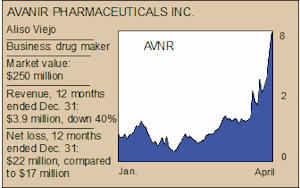
Investors in Aliso Viejo’s Avanir Pharmaceuticals Inc. have driven up its shares this year on promise from the drug maker’s lead product.
Avanir’s stock has risen about 50% since the beginning of the year with a recent market value of about $250 million.
One reason for Avanir’s rise is that it’s “getting close” to filing its application with the Food and Drug Administration for Zenvia, its primary drug candidate, said Eric Benevich, a company vice president.
The drug maker has said it will file for FDA approval in the current quarter, and a decision could be made in the fall. If Zenvia is approved, it would be launched in early 2011.
“I think that drives (investor) interest as a near-term milestone,” Benevich said.
Zenvia’s being developed to treat uncontrollable episodes of laughing or crying, also known as involuntary emotional expression disorder, or pseudobulbar affect.
Besides the Zenvia regulatory progress, Avanir is getting a boost from what Benevich called “important fundamental investors.”
Securities and Exchange Commission December filings show that Avanir’s major institutional investors include Baltimore-based T. Rowe Price Group Inc., with 1.9 million shares as of December, and two units of New York-based BlackRock Inc., which have a combined 2.9 million shares.
“Other investors notice when blue-chip investors like that start to build a position and there’s a little bit of a halo effect that comes with that,” Benevich said.
Avanir also is gaining a higher Wall Street profile.
Company officials visited about a dozen financial conferences in the past year and met with portfolio managers for mutual funds, hedge funds and venture capital funds to raise awareness, according to Benevich.
The company has caught more analyst interest, as well.
Investment bank Canaccord Adams Inc. started coverage of the drug maker with a “buy” rating, saying it expected regulatory approval for Zenvia near the end of the year.
“We think Zenvia is a promising potential drug for pseudobulbar affect disorder,” said Ritu Baral, a Canaccord Adams analyst, in a report.
Baral wrote that Zenvia, if approved, could have a potential patient market of 150,000 people, leading to a peak sales estimate of $350 million.
In addition, Avanir is a “compelling acquisition target, especially after a positive Zenvia advisory committee meeting or approval,” Baral said.
Avanir’s “base case assumption” is that it would commercialize Zenvia itself, Baral said, although he acknowledged that the drug maker would be a potential target for a bigger player.
Avanir plans to sell Zenvia to neurologists, geriatric psychiatrists, long-term care doctors and geriatricians.
As it awaits a regulatory decision on Zenvia, Avanir’s starting to build up its commercial organization. It is recruiting a vice president of sales and a senior director of managed markets who will interact with Medicare, Medicaid and health maintenance organizations.
But its big push will come if Zenvia’s approved—Benevich said it initially plans to hire 75 salespeople to call on doctors.
Avanir is using Patheon Inc., a Canadian contract drug manufacturer with a U.S. base in Research Triangle Park, N.C., to manufacture Zenvia.
Avanir, which now has 25 workers, has also hired medical liaisons who work with doctors at academic medical centers.
Marketing efforts also are under way, including getting a Web site for Zenvia developed and participating in medical conferences, Benevich said.
Chief Executive Keith Katkin was unavailable for comment for this article because he was in Toronto presenting data from a clinical trial for Zenvia at the American Association of Neurology’s annual meeting.
The company also is exploring other potential uses for Zenvia, including treating chronic pain in diabetics.
Its primary focus is on developing Zenvia—which it has a patent for domestic production until 2025.
It has already sold off or partnered its other products, including its Abreva cold sore cream, which is marketed by GlaxoSmith-Kline PLC. Avanir receives royalty payments on sales.
Roller Coaster
Avanir has had some ups and downs with Zenvia.
Back in 2006, the FDA sent a letter to Avanir saying that Zenvia could be approved but expressed concerns about one of its ingredients and asked for more testing. That setback proved costly. At the time, Avanir cut 16% of its workforce in an effort to reduce its cash burn rate.
Avanir moved its headquarters from San Diego to Orange County in 2006 under former chief executive Eric Brandt. Brandt, a veteran of Allergan Inc., the county’s biggest drug maker, left Avanir shortly afterward to become chief financial officer for Irvine chipmaker Broadcom Corp.
