

A thriving Orange County begins with the health and well-being of its people. Regardless of income, insurance or ZIP code, every resident deserves access to quality, safe medical and behavioral healthcare right here in our community.
Access to quality healthcare is vital in any community, and a strong healthcare ecosystem in Orange County is also good for business. Healthcare is one of the largest and fastest-growing sectors in Orange County, employing more than 176,700 people as of this year’s first quarter. With multiple new facilities under construction, the sector is a major economic engine. A healthier population can reduce costs for individuals and employers, improve workforce productivity and strengthen communities.
Yet the system is under strain, especially with an aging population and ongoing retirements of key healthcare professionals. Despite training programs, the pipeline of qualified healthcare workers is not keeping pace.
According to the Association of American Medical Colleges, the U.S. could face a shortage of up to 86,000 physicians by 2036. California is seeing critical gaps in primary care and nursing roles. According to the California Department of Health Care Access and Information, Orange County already has primary care shortage areas in the northern and central parts of the county.
Without intervention, these shortages could worsen access to care, increase long wait times and untreated chronic and mental health conditions, and create greater disparities in underserved communities.
Addressing this healthcare talent shortage is essential for the sustainability and resilience of our regional healthcare system. With growing pressures on both the supply and demand sides, combined with the impacts of technology, traditional approaches used by healthcare providers may no longer be enough.
To ensure Orange County attracts and retains a steady pipeline of skilled talent ready for high-demand roles in healthcare, organizations across our industry should be working together to find innovative talent development solutions.
A sector-focused, systems approach to solving the healthcare talent shortage is essential to ensure critical jobs are filled.
Efforts are underway to increase the health professional pipeline. For example, CalOptima Health developed a $50 million Provider Workforce Development Initiative.
About $25 million in education grants were awarded to bring more students into the health care workforce by providing scholarships and stipends to address financial challenges. CalOptima Health also invested $5 million in behavioral health training and education.
Sector-Based Solution for Systems Change
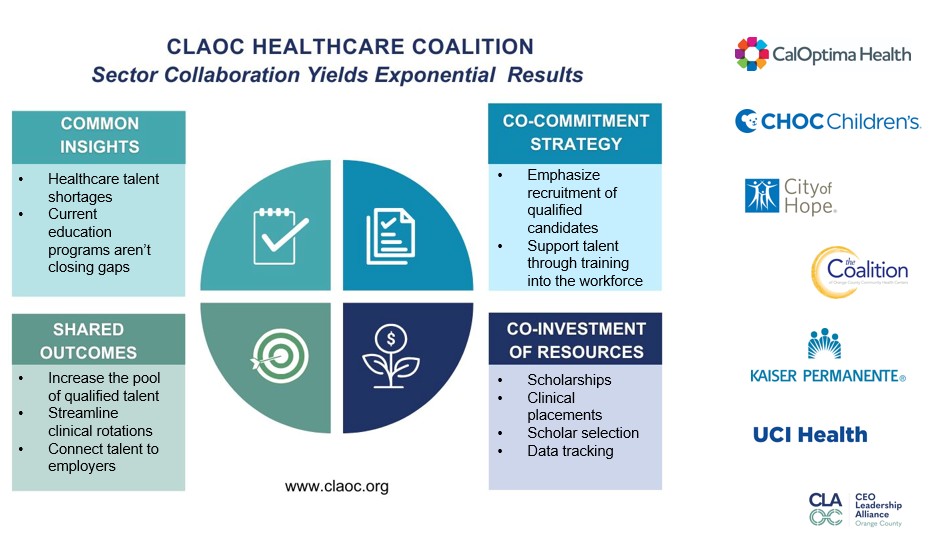
Recognizing that no single institution can solve this alone, we’re also partnering with other leaders in Orange County’s healthcare ecosystem. The CEO Leadership Alliance Orange County (CLAOC) recently launched the CLAOC Healthcare Coalition, a new regional alliance committed to solving the healthcare workforce crisis through collective action.
CLAOC Healthcare Coalition members CalOptima Health, CHOC/Rady Children’s, City of Hope Orange County, Coalition of Orange County Community Health Centers, Kaiser Permanente OC, Kaiser Permanente South Bay, and UCI Health are aligning efforts to expand the healthcare talent pipeline and ensure Orange County has the qualified workforce needed to deliver exceptional care now and into the future.
These leaders are working to address shared workforce challenges, including talent shortages in high-demand roles, training capacity limits and retention hurdles.
Three-Phase Coalition Strategy
To address the healthcare workforce shortage with both urgency and longevity, the CLAOC Healthcare Coalition has adopted a three-phase strategy that aligns immediate needs with long-term systems change:
Phase 1 – Short-Term: Allied Health Technician Pipeline
The immediate priority is to expand the pipeline of allied health technicians, the trained professionals who support physicians and nurses in diagnostics, surgery and lab services. Growing this segment of the workforce will help reduce care delays, improve patient outcomes and create accessible, high-wage career opportunities across Orange County. This pilot is seeded with $84,000 in funding from CLAOC through a grant from the Samueli Foundation and will serve as a model for future coalition-led efforts.
Phase 2 – Mid-Term: Nursing and Behavioral Health Workforce Expansion
The coalition will also support existing regional efforts to address critical shortages in nursing and behavioral health. This includes identifying scalable solutions to increase training capacity, expand clinical placements and improve both recruitment and retention across these high-demand fields. By aligning with local nursing schools, behavioral health education programs and employers, we aim to strengthen and accelerate these vital workforce pipelines.
Phase 3 – Long-Term: Sustainable, Opportunity-Focused Talent Ecosystem
The long-range strategy focuses on building an evergreen, opportunity-for-all healthcare talent ecosystem that meets the evolving needs of our community. This includes aligning education systems with workforce demands, expanding access to care for all OC communities and working to remove structural barriers such as cost, transportation and policy constraints that limit access to healthcare careers. Through this approach, we can help respond to emerging workforce shortages and address persistent gaps in essential roles such as primary care physicians. And as we build a stronger pipeline of local talent, Orange County’s healthcare workforce will be more likely to reflect and serve the rich diversity of our region.
Call to Action
CLAOC’s vision is that building a sustainable healthcare workforce pipeline will need the participation from all sectors of our community. Whether you’re an employer, educator, philanthropist or civic leader, you have a role to play.
Residents can sponsor scholarships for healthcare students. Reported statistics about current students illustrate the dramatic need for support. As one example, in a 2023 study at one local Orange County community college, 44.2 % of students reported experiencing food insecurity and 55.5 % experiencing housing insecurity.
Healthcare employers can offer clinical placement sites, prioritizing students from local communities and those enrolled in nonprofit training programs. This will help them ensure completion of state-mandated clinical training hours.
Healthcare industry professionals can act as mentors to support emerging professionals in the field.
To get involved, visit www.claoc.org. Together, we can build a stronger, more resilient healthcare system and a healthier Orange County for all.
