

The budding recovery is proving to be a double-edged sword for manufacturers as materials prices and other costs rise before a strong turnaround in demand, leaving little room to raise prices.
“Even though we’re expecting conditions in our industry to improve over the next several quarters, it hasn’t happened yet,” said Ron Hill, chief executive of Orange-based Hill Bros. Chemical Co., which makes chemicals for industry and construction. “The only rise we’re seeing is skyrocketing manufacturing costs.”
Prices for all sorts of materials used by manufacturers—from copper to computer chips—are up by 50% or double from the recession lows of early 2009.
Lower prices for precious metals, chips and oil had been a bright side for manufacturers during the recession as they struggled with a sharp falloff in sales.
“Since mid-2009, the price of oil and other key commodities has been going up,” said Raymond Sfeir, a Chapman University economics professor who oversees a quarterly survey of local purchasing managers. “Manufacturers are getting squeezed in the middle.”
Markets still are too soft for manufacturers to pass along rising costs to customers, according to Sfeir.
“The recession is not over for Orange County manufacturers,” he said. “It’s going to take until at least six months for conditions to improve significantly.”
Good and Bad
At Fountain Valley-based Kingston Technology Co., the largest maker of memory products for computers and consumer electronics, higher prices for memory chips are good and bad.
The company, which buys memory chips from Asian, European and U.S. producers, has wrestled with low prices for the past two years.
Lower memory chip prices would seem to be a good thing for Kingston as they cut a key cost for the company. But prices for Kingston products fall in tandem, cutting profits and revenue and slashing the value of chips the company has on hand.
Now memory chip prices are up about 50% from their 2009 low, rebounding faster than demand from computer makers and Corporate America.
“It’s still a little bit too cloudy to raise prices,” Kingston spokesman Mike Sager said. “Even if corporate buying continues to go up, we need to see clearer signals. It’s very early and very hard to predict at this point.”
For now, Kingston is doing what it can to absorb higher chip prices, according to Sager.
“When chip prices go up, there’s not much we can do,” he said. “If our customers aren’t buying, then it’s all up to supply and demand in the market.”
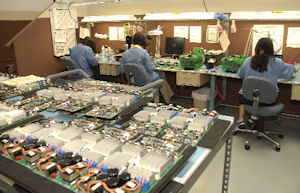
Express Manufacturing Inc., a contract electronics maker in Santa Ana, is bracing for higher chip prices this year, according to spokesman John Koon.
The company makes circuit boards and other electronics for other companies. Chips are the company’s biggest materials cost, Koon said, and are manageable for now.
But customers remain cautious about spending, he said.
The company is doing what it can to try to spur sales, according to Koon.
“We’re doing more marketing activities and looking for good salespeople to hire now,” he said.
Rising materials costs come on top of more expensive workers’ compensation and healthcare insurance premiums—something manufacturers didn’t get a break on during the recession.
Insurance costs continued to rise throughout the downturn and are up again this year.
That’s frustrating for Dave Gonzales, chief executive at Garden Grove contract electronics maker Revco Products Inc. Last year he said he had to cut about 10 jobs and now employs about 30 people.
“We’ve been in business 32 years and never had a workers’ comp claim,” Gonzales said. “But we still have to come up with thousands of dollars a year to pay into the system.”
Revco’s workers’ compensation premiums went up about 5% for 2010, according to Gonzales.
The Workers’ Compensation Insurance Rating Bureau, a nonprofit trade group for insurers, recently sought—but didn’t get—a 23% increase in rates. Twice a year, the bureau petitions the state’s insurance commissioner on rates, with its next request due in March for the second half of the year.
Healthcare
Manufacturers also saw a higher than average increase in healthcare costs at 10% to 15%, according to David Braunstein, chief executive of Torrance-based California Manufacturing Technology Consulting, a nonprofit partially funded by the Commerce Department.
“The rise in insurance costs hasn’t slowed during the recession,” he said. “And healthcare, in particular, is a widespread problem that doesn’t show any sign of abating.”
Higher insurance premiums coupled with rising raw materials costs are forcing Javier Castro to shift more work to Mexico, he said.
The chief executive of Bazz Houston Co. has 85 workers at the company’s Garden Grove headquarters. The maker of metal stampings and springs slowly has been building a workforce of about 35 people in Tijuana.
Surcharges on stainless steel used by Bazz Houston are up about 30% this year from 2009. Prices for copper and steel the company uses are up 50% from October, according to Castro.
“It’s very difficult, if not impossible, to go back to our customers and pass along those increased costs. So it’s really cutting into our margins,” he said.
The cost of dealing with state environmental regulations—a perennial factor for manufacturers—also is going up, Castro said.
He pointed to a new South Coast Air Quality Management District rule covering the use of evaporated lubricants in Southern California.
“We’re being forced to add a new cleaning operation to remove lubricants used during our manufacturing operations,” he said. “That’s going to drive up costs on some of our parts by 5% to 10%.”
Competitors in Northern California and neighboring states aren’t facing the same regulation, Castro said.
Bazz Houston expects to move more jobs to Mexico, he said. That’s hard to swallow for a manufacturer that has been in OC since 1974.
“Even if the economy improves significantly in the near future, it’s still going to be difficult for us to remain competitive and keep building our business in Southern California,” Castro said. “It just seems like we’re facing a storm of rising insurance and regulatory costs.”
