

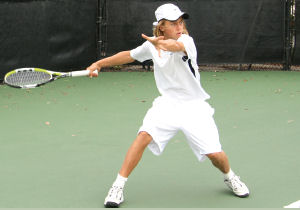
Few games have taken root in Orange County like tennis has.
It’s hard to find an area with more tennis clubs per person, with the Newport Beach Tennis Club, Racquet Club of Irvine and the Coto de Caza Golf & Racquet Club, to name a few.
Laguna Beach’s Lindsay Davenport, a former No. 1 women’s singles player, is the county’s biggest tennis name. Some of the best coaches in the game also call OC and the areas around it home.
Vic Braden, who coached former world No. 1 Tracy Austin and is regarded by many as a legend of the game, helped create the tennis center at his home community of Coto de Caza.
Braden, who is 80, now is starting a free tennis program in Santa Ana’s Cabrillo Park, among other ventures.
The number of players in OC and the rest of Southern California likely is second only to Florida, the nation’s hub for players and academies.
OC even has its own tennis boarding academy—something Florida is famous for.
“Irvine has more nationally ranked kids than any town in the country of its size,” said Mitch Bridge, head coach at Advantage Tennis Academy, where students live as they learn tennis.
Aspiring tennis pros here work hard. Parents spend a lot of money on coaching, traveling, equipment and other necessities.
The 14 boarders at Advantage Tennis Academy put in about 10 hours of work a day—about five hours of tennis and five hours of independent study, according to Bridge.
The academy runs like a private school with heavy emphasis on studies, he said.
The cost to board at the academy for a year is $37,500. Part-time and full-time programs for locals can run from $8,000 to $22,000 per year. The academy also offers camps that can run about $800 per week.
Some of the 100 or so players who attend the academy in one way or another have scholarships, which are based on need or performance.
A sponsorship by McKenna Cars, which owns McKenna Volkswagen in Huntington Beach as well as Porsche, BMW and Audi dealerships in Los Angeles, helps provide scholarships, according to Jimmy Johnson, cofounder and director of the academy.
“The whole part about sponsoring was I really believe in Jimmy Johnson and his team,” said Dan McKenna, owner of McKenna Cars. “They really are dedicated and A-1 class guys.”
McKenna’s son and daughter play at the academy. The McKennas live in Laguna Beach, so his kids play in the academy’s after school sessions.
The other option is to train with a coach.
“There are a lot of really good coaches here,” said Debbie Graham, a former world No. 28 singles player and U.S. Tennis Association coach who now coaches here. “There are good coaches in Florida. But it’s California—it’s a nice place to live. There are a lot of really big names in tennis who coach here.”
Anne Hardebeck, a doctor with Kaiser Permanente whose daughter works under Graham and other Southern California coaches, puts about 30,000 miles a year on her car traveling to and from her daughter’s coaching sessions, tournaments and other tennis appointments.
She spends about $500 per week on training and coaching with local coaches such as Graham and Robert Van’t Hof—who’s coached Davenport and former pro Todd Martin.
All of the tennis adds up to about four or more hours a day, which Krista Hardebeck balances with home schooling.
She won the tennis association’s Girls’ Under 18 National Clay Court Championships as a 14-year-old this past summer and currently is ranked third in the nation in the under 18 division.
She hopes to attend Stanford University one day or become a pro, Anne Hardebeck said.
Anne Hardebeck’s husband also is a doctor. Even so, the financial burden that comes with tennis is difficult, she said.
“We don’t want to go into a huge amount of debt for an uncertainty,” Anne Hardebeck said. “I can’t even imagine how hard it would be for a junior (tennis player) who didn’t have any money.”
The Hardebecks currently are looking for sponsors for their daughter.
School, getting good grades and maintaining some sort of balance also are important, Anne Hardebeck said.
Others, too, express concern about kids getting too wrapped up in tennis.
“It’s so important as a parent to really round out (kids) and make sure education is the most important part,” coach Graham said. “If they’re really good, it will happen on its own.”
Most professional tennis players turn pro after no or just a few years of college.
Dennis Claus, owner of Tustin real estate brokerage Westgate Properties and coach of boys’ tennis at Foothill High School in Tustin, said high school can play a vital role in rounding out a player.
“The high school experience—going to prom, making those friendships—you can’t get that back,” he said.
Both of his children played tennis for Foothill High.
Tennis also is a way to meet other kids or just have fun, said Don Murray, chief executive of Irvine-based professional services company Resources Connection Inc.
Jessica Murray, his daughter, grew up playing tennis on Laguna’s Emerald Bay tennis courts and played for Laguna Beach High School.
“Tennis is a great sport for her because she can play it the rest of her life,” Don Murray said.
But there’s no denying that serious tennis playing requires devotion. That devotion has its sacrifices and benefits. Players develop confidence, character, discipline, pride and a commitment to excellence, Advantage Tennis Academy’s coaches said.
“A (college) scholarship is something you earn,” the academy’s Bridge said.
And the sport can open doors and provide opportunities that perhaps wouldn’t have popped up without it, he said.
Matt Siow, who worked with Bridge at the academy, now is in his first year at Princeton University.
“While nothing was guaranteed, tennis played a part in my acceptance into Princeton,” Siow said.
Tennis can be a lifelong game.
“There is a 90 and older division now,” coach Braden said. “A kid has 84 years to work on his game.”
Tennis’ status as a “lifetime sport” may be why its popularity among recreational players has grown.
“The growth of tennis (in the U.S.) has been No. 1 in the last two years,” Braden said.
Coach Claus, who runs a series of adult tennis tournaments through his Grand Prix Tennis, said there are about 22,000 people in his database, with about half of them being active players.
They’ve helped him raise money for ovarian cancer research through a tournament he puts on every year, he said.
